
Lost Bill of Lading: Why an LOI Alone Won't Free Your Cargo
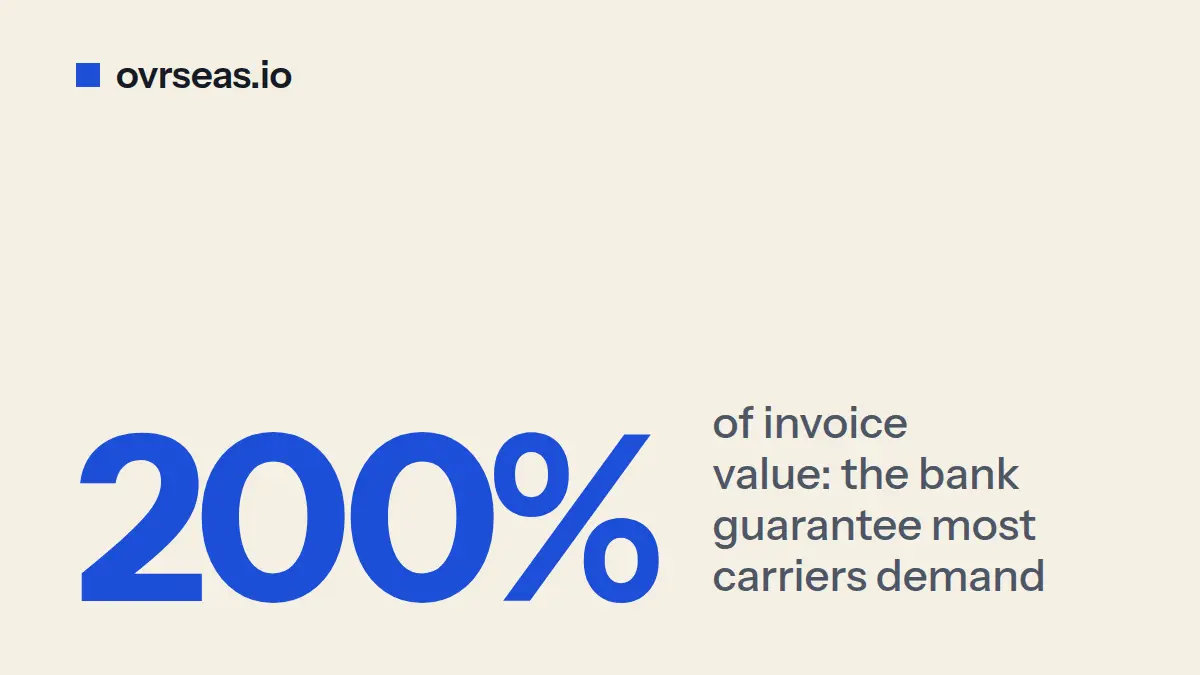
A lost original bill of lading is not a paperwork delay. It is a months-long, six-figure problem. A Letter of Indemnity (LOI) alone will not release your cargo. Most major carriers require a bank guarantee at 200 percent of the CIF invoice value, held for 30 months. In a 2024 case published by BIMCO, the shipowners refused even that and required a court order — and the vessel sat anchored for over two months while demurrage costs reached roughly two million dollars.
This guide covers why an LOI fails on its own, what carriers actually demand from a standard form, when shipowners insist on a court process, and what exporters can do to reduce the risk.
What happens when an original bill of lading is lost?
When an original bill of lading is lost, the cargo cannot be released without proof of ownership. The carrier holds the cargo until a replacement process is completed. This usually involves a Letter of Indemnity (LOI), a bank guarantee, and in some cases a court order. The vessel may also remain at anchor, with demurrage accruing every day.
The original bill of lading is a document of title. Whoever holds the original has the legal right to claim the cargo. If it is lost, no party can present it to the carrier — and the carrier cannot safely release the cargo to anyone else, because the real holder may still appear later with a valid original.
The result is a stranded shipment, a clock running on demurrage and storage, and a carrier waiting for paperwork that is heavier than most shippers expect.
Why doesn't a Letter of Indemnity work on its own?
A Letter of Indemnity does not work alone because it is a promise, not money. A LOI says the requesting party will compensate the carrier for any loss from releasing cargo without the original bill. The carrier's risk is real. If the true holder later presents a valid original, the carrier faces a mis-delivery claim equal to the cargo value.
P&I (Protection and Indemnity) clubs, which insure shipowners against third-party liability, generally advise caution before releasing cargo on a LOI alone. According to BIMCO's 2024 case report, the shipowners followed exactly this guidance from their P&I club. Their position was described as cautious, but it was also legally defensible.
So most carriers ask for something stronger than a promise. They ask for a financial backstop that can pay out without litigation if a claim arrives.
What does a carrier's standard LOI form actually require?
A carrier's standard LOI form requires a bank guarantee, not just a signed letter from the shipper. According to Hapag-Lloyd's official LOI form for the issuance of a duplicate bill of lading, the bank's liability covers 200 percent of the CIF invoice value. The guarantee remains in force for 30 months from the date of the underlying bill of lading.
If a claim is still pending when the 30-month period expires, the carrier can require the bank to extend the guarantee in two-year blocks until proceedings are concluded. The Hapag-Lloyd form also makes the indemnity joint and several. Every signing party is fully liable, and the carrier does not have to chase the requestor first before claiming against the bank.
In practical terms, this means a 500,000 dollar shipment can lock up roughly 1 million dollars in bank credit for at least two and a half years on a single lost-document event. For exporters with limited credit lines, that is real working capital frozen because of one missing piece of paper.
Disputes under the Hapag-Lloyd form fall under German law and the jurisdiction of the Hamburg courts, although Hapag-Lloyd reserves the right to sue elsewhere if it chooses. Other major carriers use similar structures. The 200 percent / 30-month standard is the common shape of the industry, not an outlier.
When does a lost B/L need a court order?
A lost bill of lading can require a court order when the shipowner refuses any LOI, even one backed by a bank guarantee. According to BIMCO's 2024 case report, the shipowners demanded a court application at the discharge port to officially declare the original bills void. Only then would the owners issue a fresh set.
This is unusual but legally permissible. A carrier is not required to accept a LOI. They are entitled to insist on the strictest form of protection: a court declaration that the original bills no longer carry title to the cargo.
The cost falls on the shipper or consignee. In the BIMCO case, the parties argued for weeks over who held the title and who would file the application. The court process itself was expected to take up to two months. During that time, the vessel sat at anchor and the demurrage clock kept running.
The lesson is operational, not legal. The carrier's choice of remedy is not predictable in advance. When originals are lost, the cost depends on who is sitting on the other side of the table.
How can exporters reduce the risk of losing the original?
Exporters can reduce the risk by minimizing how often paper originals move through couriers and intermediaries. Every handoff is a potential failure point. Every additional party in the chain — bank, broker, freight forwarder, consignee — is one more place a document can disappear.
Three practical steps reduce exposure. First, use a sea waybill or a telex release wherever the trade and payment terms allow. These do not require a paper original to be presented at the destination. Second, when negotiable bills are required (for example, under most documentary Letters of Credit), ship the originals through a single trusted courier with end-to-end tracking. Third, keep certified copies and clear photographic records of each original before it leaves your office.
For high-value or repeat shipments, electronic bill of lading (eBL) systems are increasingly viable. According to BIMCO, eBLs cannot be lost in transit, removing the entire paper-handling failure mode that drove the 2024 incident.
The original is not just paperwork. It is title. Treating it that way before something goes wrong is much cheaper than treating it that way after.
Frequently asked questions
What is a Letter of Indemnity in shipping?
A Letter of Indemnity (LOI) is a written promise where the requesting party agrees to compensate the carrier for any loss or claim arising from a specific action — most commonly, releasing cargo without presentation of the original bill of lading. It is contractual, not financial. Most major carriers will not act on a LOI unless it is supported by a bank guarantee.
How long does a bank guarantee for a lost B/L last?
According to Hapag-Lloyd's published LOI form, the bank guarantee remains in force for 30 months from the date of the underlying bill of lading. If a claim is pending when the 30-month period expires, the carrier can require the bank to extend coverage in two-year blocks until all related proceedings are concluded.
Can a carrier refuse a Letter of Indemnity?
Yes. A carrier is not legally required to accept any LOI, even one with a bank guarantee. In BIMCO's 2024 case, the shipowners refused all LOIs and required a court order voiding the original bills before they would issue a new set. Any demurrage during the wait fell on the cargo interests.
What is the difference between a sea waybill and a bill of lading?
A sea waybill is a non-negotiable transport document. The cargo is released to the named consignee without the need to present a paper original at destination. A bill of lading is a document of title — the holder of the original has the legal right to claim the cargo, which is why losing one is so costly. Sea waybills remove that risk but do not work where Letters of Credit require negotiable documents.
Quick checklist when an original B/L is lost
Notify the carrier and the consignee in writing as soon as the loss is confirmed
Prepare a written statement of loss on company letterhead
Confirm with the carrier whether a LOI alone is acceptable, or whether a bank guarantee is required
Expect a 200 percent / 30-month bank guarantee as the standard requirement
Be prepared for a court application if the carrier refuses any LOI
Document the cargo's current location and the demurrage clock daily
Use a sea waybill, telex release, or electronic bill of lading on future shipments where the payment structure allows
Type the parties once
Shipper, consignee and notify party come from one shipment record into the B/L instructions, commercial invoice and packing list — the same on every page.
No credit card required · 14-day free trial
Related Templates

Related Articles
Bill of Lading Consignee: Straight vs To Order
Named consignee or to order? The bill of lading consignee box decides who can claim your cargo and what your letter of credit requires.
CIF vs CIP Insurance: ICC(C) vs ICC(A) Explained
seven named perils. CIP requires ICC(A) — all risks. Same Incoterms group, very different coverage.
Container Shipping Document Checklist: 3 Cut-Off Deadlines
Container shipping has three separate cut-off deadlines. Miss one and your cargo gets rolled to the next vessel. Here is the full checklist.