
CIF vs CIP Insurance: ICC(C) vs ICC(A) Explained
Both CIF and CIP require the seller to buy insurance. But the minimum coverage is set by two different Institute Cargo Clauses — and the gap matters more than most exporters realize.
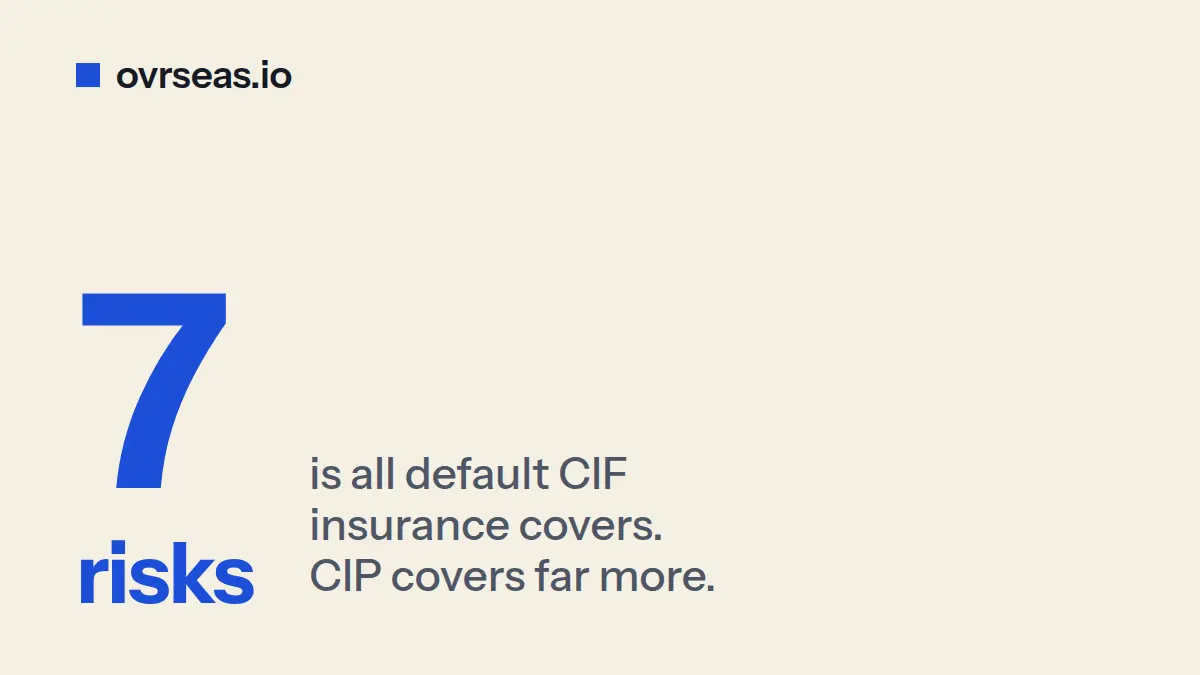
Under Incoterms 2020, CIF defaults to Institute Cargo Clauses (C), a named-perils policy that covers only seven specific risks. CIP defaults to Institute Cargo Clauses (A), an all-risks policy with limited exclusions. Same "insured" word in the term. Two completely different policies underneath. A claim that pays out under CIP can be denied outright under CIF.
This guide breaks down what each clause covers, what it leaves out, why the ICC raised CIP's minimum in 2020, and how to upgrade your CIF insurance when the default isn't enough.
What's the difference between CIF and CIP insurance under Incoterms 2020?
Under Incoterms 2020, CIF requires the seller to insure at the Institute Cargo Clauses (C) level — a named-perils policy covering seven specific risks. CIP requires the higher Institute Cargo Clauses (A) level — an all-risks policy. According to the ICC, the CIP minimum was raised from ICC(C) to ICC(A) in the 2020 revision because CIP is typically used for containerized goods, where ICC(C) leaves buyers exposed.
The split exists for a reason. CIF is meant for bulk maritime trade — oil, grain, ore — where cargo damage risks are narrower and the cargo is loaded directly onto a vessel. CIP is multimodal and used for higher-value manufactured goods that face theft, water, and handling risks throughout a longer supply chain.
The insured sum is the same under both terms: 110% of the contract value, payable in the contract currency. The seller is the party buying the policy. The buyer is the beneficiary — the seller assigns the rights to claim so the buyer can recover directly from the insurer.
What does Institute Cargo Clauses (C) actually cover?
ICC(C) covers seven named perils: fire or explosion; vessel stranded, grounded, sunk, or capsized; overturning or derailment of a land conveyance; collision or contact of the vessel with any external object other than water; discharge of cargo at a port of distress; general average sacrifice; and jettison. The cause of loss must match one of these. Anything outside the list is not covered.
The structure is "named perils" — not "all risks." That means the policy lists every covered cause of loss. If a peril isn't on the list, it isn't insured. The 2009 revision of the clauses kept this principle intact, and ICC(C) 2009 remains the version most policies reference today.
This narrow coverage works for bulk commodities where the major risks are catastrophic vessel events — sinking, collision, grounding. For those cargoes, ICC(C) gives adequate protection at a low premium. That's why CIF stayed at ICC(C) in Incoterms 2020 while CIP moved up. The cargo profile fits the policy.
What does ICC(C) leave out?
ICC(C) does not cover theft, pilferage, water damage from sea entering the container, earthquake, volcanic eruption, washing overboard, or rough handling damage. According to industry analyses of the 1/1/09 clauses, only ICC(A) protects against theft, pilferage, and non-delivery. ICC(B) adds earthquake and washing overboard. ICC(C) excludes both.
The gaps matter most for containerized cargo. Containers spend hours or days at terminals where theft and rough handling are real exposures. They get stowed on deck where seawater can enter through damaged seals. They can be dropped during loading or fall when stacks shift in heavy weather. None of these losses match ICC(C)'s seven perils.
The "external object other than water" wording in peril 1.1.4 is also worth noting. Collision with another vessel or a quay is covered. Damage from waves or seawater entering the hold is not. That distinction alone disqualifies a large share of real-world container losses.
If your cargo is electronics, machinery, finished goods, or anything moving in a container — the ICC(C) default leaves most realistic transit risks uninsured.
Why did ICC change CIP from (C) to (A) in Incoterms 2020?
The ICC raised the CIP minimum from ICC(C) to ICC(A) in Incoterms 2020 because CIP is used for containerized goods that face risks ICC(C) doesn't cover. According to ICC, the CIP Incoterms rule now requires a higher level of cover compliant with Institute Cargo Clauses (A) or similar clauses. CIF was deliberately left at ICC(C) because it's used for bulk maritime cargo where the lower coverage matches the risk profile.
The change was substantial. Under Incoterms 2010, both CIF and CIP defaulted to ICC(C). Buyers receiving containers under CIP got minimum coverage that didn't match their actual exposure — most container losses (theft, water, handling) weren't in the policy. The 2020 revision aligned the default with the use case.
The ICC also clarified that CIF should not be used for containerized shipments in the first place. The recommended Incoterm for container cargo is CIP if insurance is included, or FCA if the buyer arranges carriage and insurance separately. CIF remains technically permissible for containers but is no longer endorsed for that use case.
For exporters, the practical takeaway is simple. If you ship containers and use CIP, your default insurance is now real protection. If you ship containers under CIF, the default is still minimal — and you'll likely need a contract amendment to bring it up to ICC(A).
How can you upgrade CIF insurance to match CIP coverage?
Both CIF and CIP allow buyer and seller to agree on higher coverage in the sales contract. The Incoterms minimum is a floor, not a ceiling. To upgrade CIF, write a clause such as "insurance to be effected with Institute Cargo Clauses (A) cover" into the contract terms. The seller will procure the higher policy and pass the premium difference into the price.
Three practical approaches work in real contracts:
Switch the term. For containers, use CIP instead of CIF. CIP's ICC(A) default is built in, so no contract amendment is needed.
Upgrade by agreement. Keep CIF but specify ICC(A) cover in the sales contract. Common phrasing: "Seller to insure at Institute Cargo Clauses (A), sum insured 110% of CIF value."
Add war and strikes clauses. None of ICC(A), (B), or (C) covers war or strikes by default. Both require separate Institute War Clauses (Cargo) and Institute Strikes Clauses (Cargo) endorsements regardless of which main clause you use.
The buyer can also arrange supplementary insurance independently if the seller refuses to upgrade. The standard cargo policy market offers "difference in conditions" cover specifically for this gap — it sits on top of the seller's ICC(C) policy and fills the missing perils. Premium is paid by the buyer.
One more nuance: according to Incoterms 2020, the policy must let the buyer claim directly from the insurer. Claims service in the buyer's country is a good extra to ask for, but it is not a rule.
Frequently Asked Questions
Is ICC(A) the same as "all risks"?
ICC(A) is often called "all risks," but it has exclusions. It does not cover willful misconduct, ordinary leakage and wear, insufficient packing, inherent vice, delay, war, or strikes. The "all risks" label refers to its open-perils structure — it covers every loss except those specifically excluded — not to literally every risk in transit.
Does CIF require any insurance if no clause is specified in the contract?
Yes. CIF requires the seller to procure insurance at the ICC(C) minimum even without a specified clause. According to Incoterms 2020, the seller must obtain cargo insurance at its own cost complying at least with the cover provided by Clauses (C) of the Institute Cargo Clauses, with sum insured equal to 110% of the contract price.
Who is the beneficiary of CIF or CIP insurance?
The buyer. The seller buys the policy but assigns it so the buyer can claim directly against the insurer. The seller's obligation is to procure cover; the buyer holds the rights to claim if a loss occurs during the insured transit. The seller must also provide the buyer with the insurance certificate.
What does the 110% insurance amount cover?
Both CIF and CIP require the seller to insure for at least 110% of the contract value. The extra 10% above invoice value accounts for the buyer's anticipated profit and additional expenses if the cargo is lost. The currency of the insurance must match the currency of the sales contract.
Can the buyer demand a higher coverage level than the Incoterms minimum?
Yes. The Incoterms minimum is a floor, not a maximum. Buyers can request ICC(A) under a CIF contract, or add war and strikes endorsements to either CIF or CIP. The agreement must be written into the sales contract before shipment. The seller will pass the additional premium cost into the contract price.
Quick reference checklist
CIF default → ICC(C), seven named perils only
CIP default → ICC(A), all risks with named exclusions
Both → 110% of contract value, buyer is beneficiary
Containers under CIF → upgrade to ICC(A) by contract, or switch to CIP
Bulk maritime → ICC(C) usually adequate; CIF defaults are fine
War and strikes → always separate endorsements regardless of clause
Policy lets the buyer claim directly from a reputable insurer
Write the Incoterm once
The term, named place and edition print the same on your quotation, commercial invoice and packing list, because they come from one shipment record.
No credit card required · 14-day free trial

Related Articles

Is There an Incoterms 2026? What Version to Use Now
There is no Incoterms 2026. The ICC's current version is Incoterms 2020. Here is what to cite in your 2026 export contracts.
Lost Bill of Lading: Why an LOI Alone Won't Free Your Cargo
Lost your original B/L? An LOI alone won't free your cargo. Carriers want a 200% bank guarantee — and sometimes a court order.
Incoterms Responsibilities for EXW, FCA, FOB, CIF and DDP
Each Incoterm shifts costs, risks, and insurance between buyer and seller. Learn where the 5 most-used rules draw the line.