
Container Shipping Document Checklist: 3 Cut-Off Deadlines
Your documents are ready. Your container is packed. But you missed one cut-off deadline by two hours, and now your cargo is sitting at the terminal while the vessel sails without it.
This is called a rollover. According to an Ocean Insights study using H2 2019 data, container rollovers affect between 5% and 17% of all containers shipped, depending on the carrier. Many of those rollovers are caused by documentation or timing issues that the shipper could have prevented.
This guide covers the documents you need for a container shipment, the three cut-off deadlines that control whether your cargo gets loaded, and how to build a timeline that keeps everything on track.
What documents do you need for a container shipment?
A standard container shipment requires seven or more documents, depending on the trade lane, product type, and destination country's regulations. Missing any one of them can delay your shipment at the port of origin or cause problems at customs on the other end.
Here are the core documents for most ocean container shipments:
Commercial Invoice — the primary document for customs valuation. It states the buyer, seller, product description, quantity, unit price, total value, and payment terms. Customs authorities use this to assess duties and taxes.
Packing List — details how goods are packed inside the container, including carton count, dimensions, net weight, and gross weight per item. The terminal and customs both reference this against the commercial invoice.
Bill of Lading (B/L) — issued by the carrier based on your shipping instructions. It serves as a receipt of cargo, a contract of carriage, and a document of title. The carrier needs your B/L instructions before the documentation cut-off.
Shipper's Letter of Instruction (SLI) — tells your freight forwarder exactly how to handle the shipment, including routing, documentation preferences, and special handling. This is especially important when you work with a third-party forwarder.
VGM Declaration — the Verified Gross Mass of the packed container. Required under SOLAS regulations since July 2016, enforced by the IMO. Without it, the terminal will not allow your container through the gate.
Certificate of Origin — proves where the goods were manufactured. Required for FTA preferential tariff claims. Some countries require it for all imports, regardless of trade agreements.
EEI Filing (AES) — required for U.S. exports valued over $2,500 per Schedule B number, or for any export requiring a license. Filed through the Automated Export System before the cargo leaves the country.
Depending on your shipment, you may also need a Proforma Invoice for pre-shipment agreements, a Dangerous Goods Declaration for hazardous cargo under IMDG Code, or a USMCA Certificate of Origin for shipments between the U.S., Canada, and Mexico.
What are the three cut-off deadlines before vessel departure?
Container shipping operates on three separate cut-off deadlines tied to the vessel's departure schedule. Each cut-off is enforced independently by the carrier and the terminal. Meeting one does not exempt you from the others. Missing any single cut-off can result in your container being rolled to the next available vessel.
Here are the three cut-offs every exporter should track:
1. Documentation Cut-Off (SI Cut-Off)
This is the deadline for submitting your Shipping Instructions (SI) to the carrier. The SI provides the information the carrier needs to prepare the Bill of Lading, including shipper details, consignee, notify party, cargo description, and container numbers. According to multiple freight logistics sources including BRF Logistics and KFLV, the documentation cut-off is typically set 1 to 3 days before vessel departure, though some carriers and routes may require submission 5 to 7 days in advance.
If you miss the SI cut-off, the carrier cannot issue the B/L in time, and your container will not be included in the vessel's load plan.
2. VGM Cut-Off
The VGM cut-off is the deadline for submitting the Verified Gross Mass of your packed container. Under the IMO's 2016 SOLAS amendment, no container can be loaded onto a vessel without a verified weight declaration from the shipper. According to Hapag-Lloyd's VGM FAQ, the VGM cut-off is determined locally by each terminal and carrier. Industry-wide, it typically falls 48 to 72 hours before sailing, as reported by FreightAmigo.
Most terminals enforce a strict "No VGM, No Gate-in" policy. As Maersk states on its official VGM page: a packed container will not be loaded unless its Verified Gross Mass has been provided by the shipper prior to the load list cut-off date. If you miss this deadline, your container physically cannot enter the terminal.
3. Cargo Cut-Off (CY Cut-Off)
This is the final deadline for your container to arrive at the terminal gate. For FCL (Full Container Load) shipments, the container must be delivered and gated in before this deadline. According to DCSA's cut-off standards documentation, the cargo cut-off is typically 24 to 48 hours before departure, though busy ports or peak seasons may impose earlier deadlines.
If your trucker arrives after the cargo cut-off, the terminal will not accept the container for that sailing.
What happens when you miss a shipping cut-off?
When a container misses any of the three cut-offs, it gets rolled. A rollover means your cargo is removed from the current vessel's load plan and rescheduled for the next available sailing. That typically adds one week or more to your transit time. In some cases, containers get rolled multiple times.
According to Windward's shipping intelligence data, rollovers account for 19% of all container shipping delays. Common causes include late documentation, missing VGM, late gate-in, carrier overbooking, and port congestion.
The financial impact is immediate. While your container waits at the terminal, demurrage charges begin to accumulate. According to YardView's 2025 analysis, demurrage fees in 2025 range from $75 to $300 per day, per container, depending on the carrier, port, and container type.
At scale, these costs are enormous. The U.S. Federal Maritime Commission (FMC) reports that nine major ocean carriers collected roughly $15.4 billion in detention and demurrage charges between April 2020 and March 2025. Between 2020 and 2022 alone, those same carriers billed approximately $8.9 billion and collected $6.9 billion, according to the FMC's Final Rule published in February 2024.
Beyond fees, a rollover can trigger a cascade of downstream problems: missed delivery windows, production delays for the buyer, potential contract penalties, and damaged business relationships.
How do you build a document timeline that works?
The most reliable approach is to work backward from the vessel's scheduled departure date. Confirm the exact cut-off times with your carrier or freight forwarder as soon as the booking is confirmed, then set your internal deadlines with buffer time built in.
Here is a practical timeline for a standard FCL export shipment:
Day 10-14 before sailing: Finalize commercial invoice and packing list. Confirm product descriptions, quantities, and values match across all documents. If a Certificate of Origin is needed, start the application process.
Day 7-10: Prepare Shipper's Letter of Instruction. Coordinate with your freight forwarder on routing and documentation requirements. File EEI if exporting from the U.S.
Day 3-5: Submit Shipping Instructions (SI) to the carrier. Double-check all B/L details: shipper, consignee, notify party, cargo description, shipping marks, and container numbers.
Day 2-3: Submit VGM declaration. Weigh the packed container or calculate the gross mass using SOLAS Method 2. Confirm the VGM is filed before the carrier's VGM cut-off.
Day 1-2: Deliver the container to the terminal before the cargo cut-off. Ensure all customs clearances are complete before gate-in.
As DCSA (Digital Container Shipping Association) notes in its cut-off standards documentation, cut-off times are not fixed. They are tied to vessel schedules, and if the schedule changes due to delays or congestion, cut-off times are recalculated. Confirm deadlines regularly, especially during peak season.
Quick reference: Container shipping document checklist
Commercial Invoice — with accurate product descriptions, values, and Incoterms
Packing List — matching quantities, weights, and shipping marks with the invoice
Bill of Lading instructions — submitted before the SI cut-off
Shipper's Letter of Instruction — complete routing and handling details
VGM Declaration — filed before the VGM cut-off, using a certified method
Certificate of Origin — if claiming FTA preferential tariffs
EEI / AES Filing — for U.S. exports over $2,500 or licensed goods
Dangerous Goods Declaration — if shipping hazardous materials
Three cut-offs control whether your container sails or stays. Track all three, build your timeline backward, and confirm deadlines with your carrier on every booking.
Type the parties once
Shipper, consignee and notify party come from one shipment record into the B/L instructions, commercial invoice and packing list — the same on every page.
No credit card required · 14-day free trial
Related Templates

Related Articles
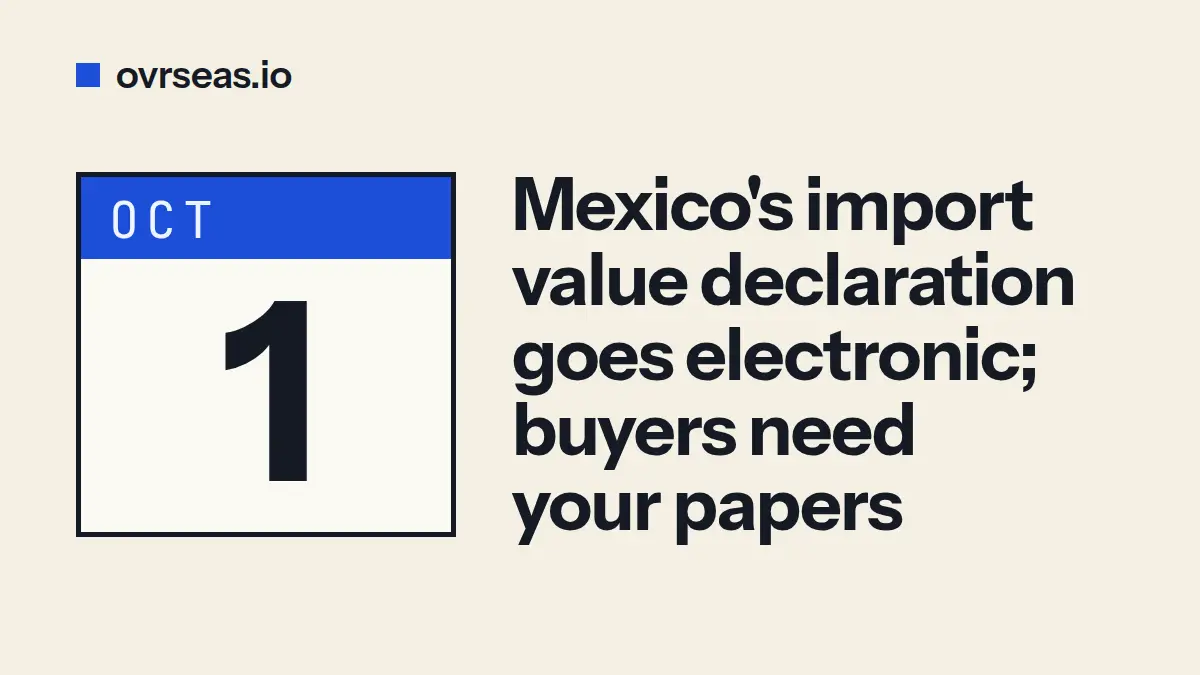
Mexico's Electronic Value Declaration Is Mandatory on 1 October — What Your Buyer Will Need From You
From 1 October 2026 your Mexican buyer files the customs value declaration electronically. Every input to that filing — invoice, contract, payment proof, Incoterm — comes from you.
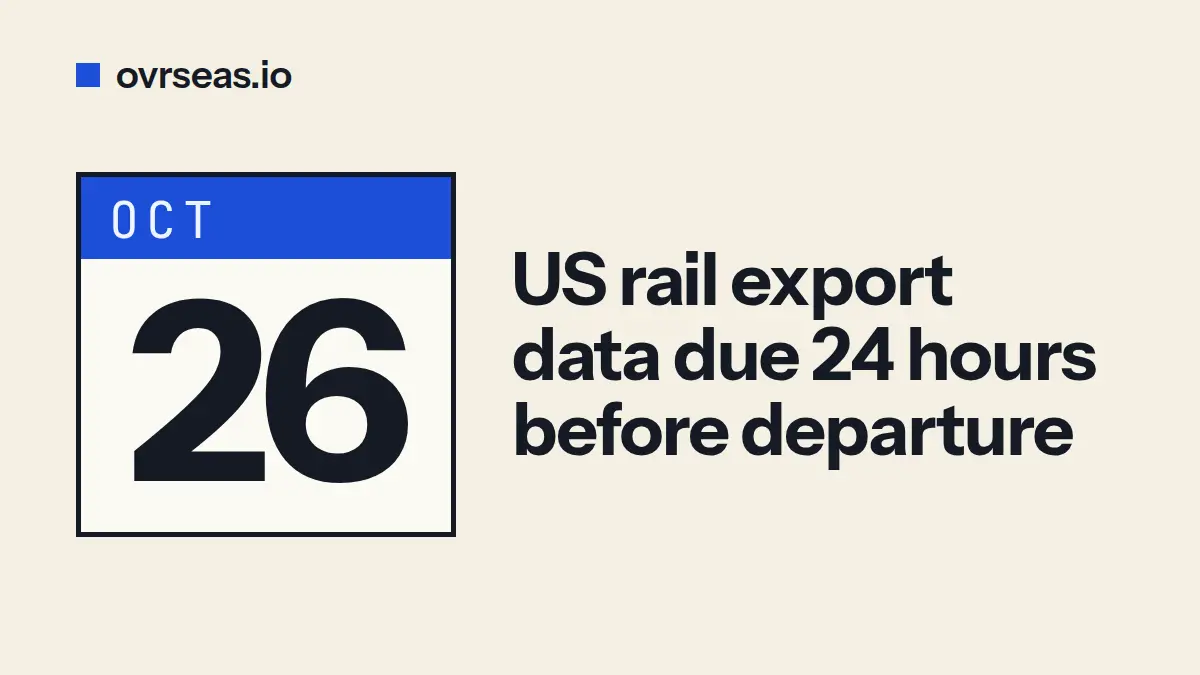
CBP's Rail Export Manifest Rule: What Has to Be Right 24 Hours Before Departure
CBP's final rule for rail export manifests takes effect 26 October 2026. The initial filing is due 24 hours before departure, and six of its seven mandatory fields come off your own shipment documents.
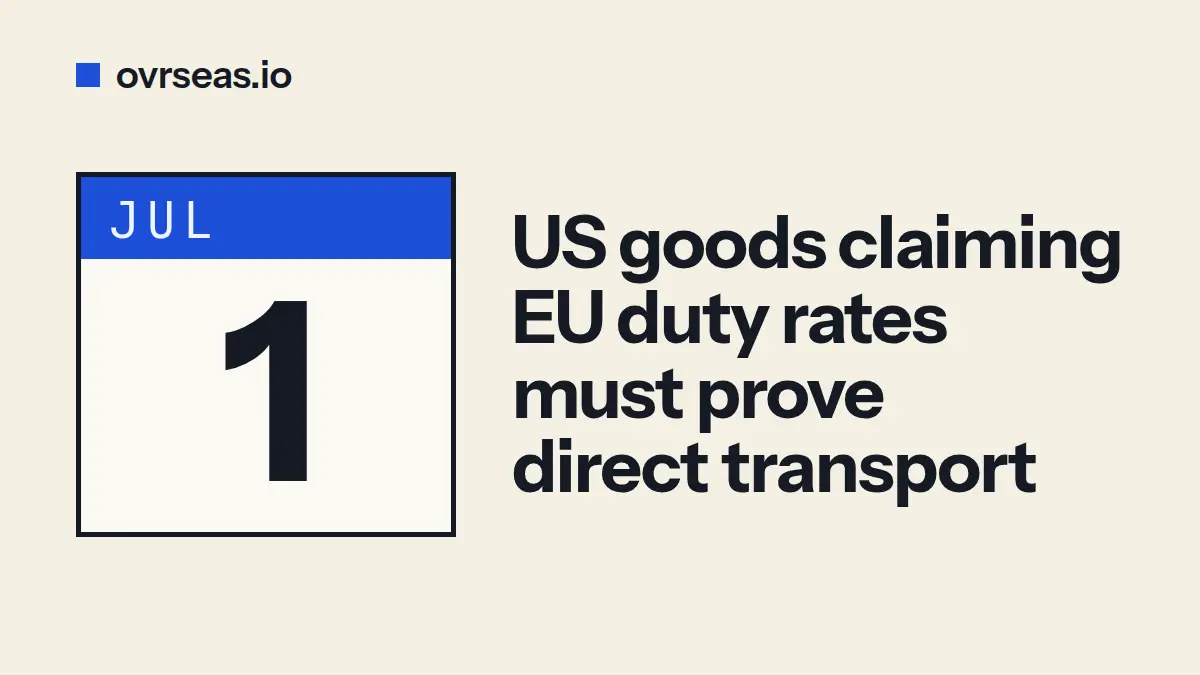
EU Direct-Transport Proof (July 2026): What US Exporters Must Now Show
From 1 July 2026, US goods claiming the EU's adjusted duty treatment must prove direct transport. Here's the document-consistency check for small exporters.