
LCL Freight Is Billed on Volume or Weight, Whichever Is Bigger
LCL (less than container load) freight is not billed on CBM alone. The carrier compares your cargo's volume with its weight and charges for the bigger number. This is the W/M rule: weight or measurement. If you only calculate CBM, you can under-budget a heavy shipment.
The rule: whichever is greater
Carrier tariffs state it plainly. Crowley's published Tariff 003, Rule 2, says its rates apply per CFT/100 Lbs, CBM/2000 Lbs, CBM/500 Kilos or CBM/1000 Kilos, "whichever yields the greater revenue," and that "rates indicated by W/M or WM are optional weight or measurement rates and the rate yielding the greater revenue will be charged" (Crowley Logistics, Tariff 003, Rule 2 "Application of Rates").
The unit pair depends on the carrier. The Crowley tariff above lists four bases, including CBM against 1000 kilos (1 metric tonne), and others against 2000 lbs or 500 kilos. If your quote uses CBM against 1,000 kg, the larger number becomes your chargeable unit, often called a revenue ton. The two are not physically equal. It is a billing convention, so read the basis line on your quote before you compare offers. The examples below use the 1 CBM : 1,000 kg basis.
How to work it out
- Calculate total CBM. Use length × width × height in cm ÷ 1,000,000 for each carton, then multiply by the quantity (see how to calculate CBM).
- Convert gross weight to tonnes. Total kg ÷ 1,000.
- Take the larger of the two numbers. That is what the rate per W/M is multiplied by.
Example 1: light and bulky, volume wins
120 cartons, each 50 × 40 × 30 cm and 18 kg.
- Volume: 0.06 CBM × 120 = 7.2 CBM
- Weight: 18 kg × 120 = 2,160 kg = 2.16 tonnes
- Chargeable: 7.2 (volume is larger)
At a rate of $60 per W/M, ocean freight is 7.2 × $60 = $432. The weight did not matter.
Example 2: dense cargo, weight wins
40 cartons, each 40 × 30 × 30 cm and 45 kg (tiles, tools, machine parts).
- Volume: 0.036 CBM × 40 = 1.44 CBM
- Weight: 45 kg × 40 = 1,800 kg = 1.8 tonnes
- Chargeable: 1.8 (weight is larger)
At the same $60 rate, freight is 1.8 × $60 = $108. A CBM-only estimate gives 1.44 × $60 = $86.40, which is about 20% too low. Heavy cargo is where the surprise comes from.
Example 3: the same volume, two weights
Same volume, heavier cargo: the heavier one is billed on weight.
| Cargo | Volume | Weight | Chargeable |
|---|---|---|---|
| Cushions | 2.0 CBM | 600 kg (0.6 t) | 2.0 |
| Steel parts | 2.0 CBM | 3,000 kg (3.0 t) | 3.0 |
Same 2.0 CBM, but the steel parts are billed as 3.0, 50% more.
Small shipments and minimum charges
Many consolidators also set a minimum per bill of lading. One vendor glossary (a single source, not a tariff) says "most LCL consolidators have a minimum bill of lading charge, typically equivalent to 1 or 2 CBM," so 0.3 CBM is billed as at least 1 CBM (GoFreight, LCL glossary). The minimum differs by consolidator and trade lane, so treat 1 CBM as an example and check your own quote.
What to ask your forwarder
Three questions settle most surprises before you accept a quote.
- Is the rate per W/M, and is it 1 CBM = 1,000 kg on this lane?
- What is the minimum charge per shipment?
- Are the origin and destination charges also billed per W/M, or per shipment?
Other fees often sit outside the ocean rate. See LCL vs FCL hidden fees and the break-even point. Air freight uses a different volume rule, covered in volumetric weight for air freight.
Check your numbers
Run the volume side in the CBM calculator, then compare it with your gross weight in tonnes. If the CBM total is large, the load planner shows whether the cargo is closer to an LCL or a full container.
How this was made: drafted with AI assistance from the carrier tariff and glossary linked above; arithmetic recomputed; published under Seungho Im's byline.
Enter a shipment once. Get every document.
Commercial invoice, packing list, certificate of origin and more — filled from one shipment record, so the shared fields always match.
No credit card required · 14-day free trial

Related Articles
How Many Boxes Fit in a 20ft or 40ft Container? Worked Numbers
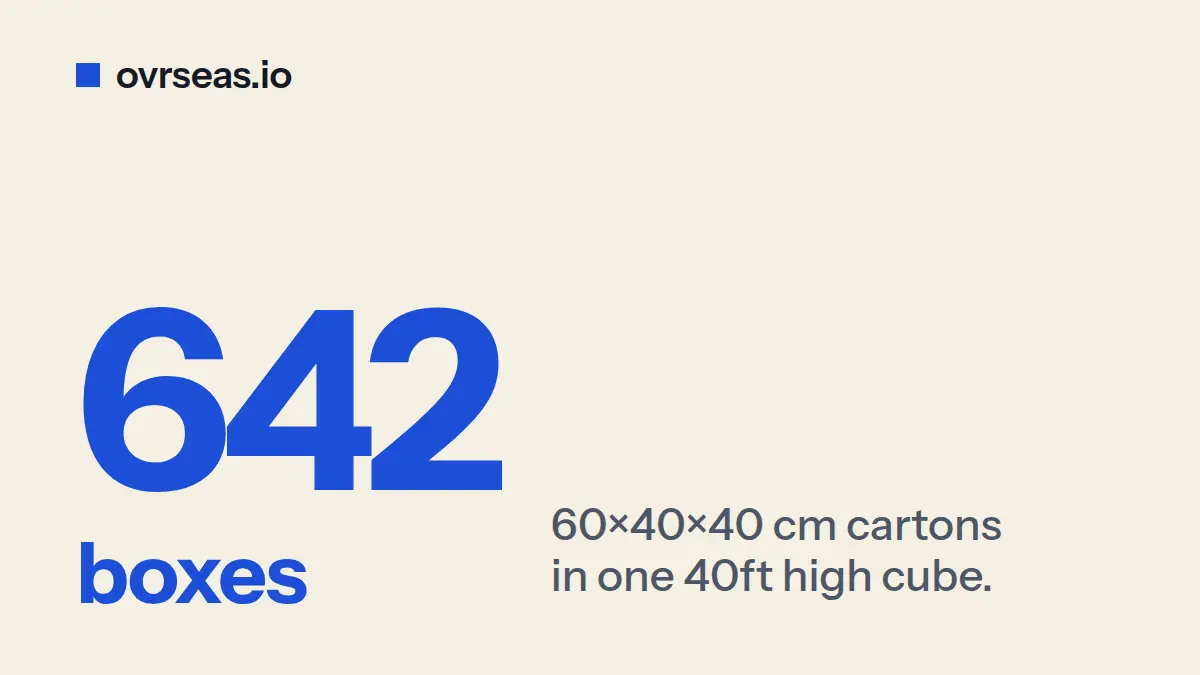
A 60×40×40 cm carton fits 260 times in a 20ft, 535 in a 40ft and 642 in a 40ft high cube. Worked numbers for cartons, pallets and heavy loads, and why the volume shortcut overstates.
How to Calculate CBM: Formula and 3 Worked Examples
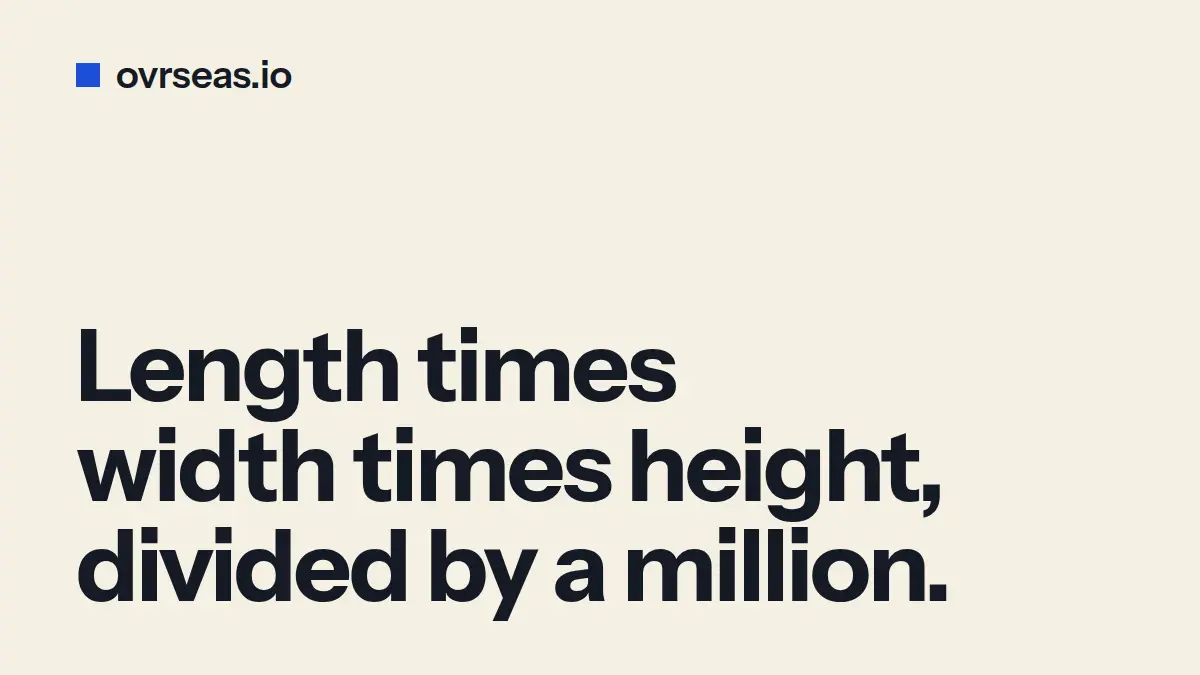
CBM = length × width × height in cm ÷ 1,000,000. Three worked examples (cm, inches, mixed shipment) and the rounding trap that skews totals.