
Volumetric Weight in Air Freight: Why Your 200 kg Shipment Gets Billed as 400 kg
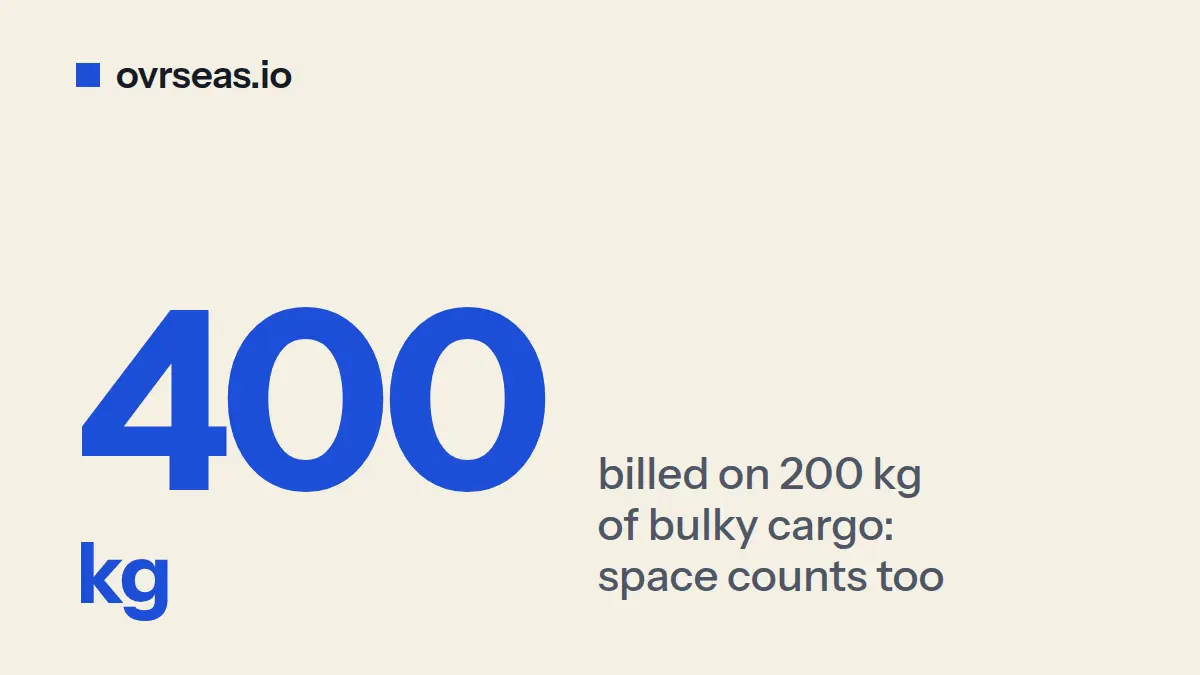
Your cargo weighs 200 kg on a scale. The airline invoices you for 400 kg. Both numbers are correct — and if you don't understand why, you're probably overpaying for air freight.
This guide explains how volumetric weight works, how to calculate it before you ship, and how to reduce costs without changing suppliers.
What is volumetric weight in air freight?
Volumetric weight (also called dimensional weight) is a calculated weight based on how much space your cargo occupies — not how heavy it is. Airlines use it because a plane can run out of space before it runs out of weight capacity.
According to the International Air Transport Association (IATA), the standard formula is:
(Length × Width × Height in cm) ÷ 6000 = Volumetric Weight in kg
Airlines compare your actual weight and volumetric weight, then charge whichever is higher. This is called the chargeable weight.
To check this before you book, our free CBM calculator converts box dimensions into cubic meters, volumetric weight and chargeable weight for air freight, express courier and sea freight in one pass. The 6,000 divisor is the IATA industry standard for general air cargo, while express carriers such as DHL Express commonly apply 5,000 — the same box comes out heavier, and more expensive, on the courier side. That is worth confirming before you compare two quotes that look alike (Aircargo.nl, Cargoplot).
Light, bulky cargo → billed by volumetric weight (space)
Heavy, compact cargo → billed by actual weight (mass)
The 6000 divisor is the IATA standard used by most airlines. Some express couriers like DHL, FedEx, and UPS use 5000 instead, which results in higher volumetric weights for the same box size.
How do you calculate volumetric weight for air freight?
Multiply length × width × height in centimeters, then divide by 6000. For multiple boxes, multiply by quantity. Compare this number to your actual weight — the higher one is your chargeable weight.
Here's a practical example:
Box size: 80 cm × 60 cm × 50 cm
Quantity: 10 boxes
Actual weight: 20 kg per box = 200 kg total
Volumetric calculation: (80 × 60 × 50) ÷ 6000 × 10 = 400 kg
Result: Your 200 kg shipment is billed as 400 kg because volumetric weight is higher.
At $3 per kg, that's $1,200 instead of $600 — a $600 difference for the same cargo.
How is air freight different from sea freight?
Sea freight and air freight use completely different conversion factors. Sea freight is far more forgiving for bulky cargo because ships have more space relative to weight capacity.
Air freight: 1 CBM = 167 kg (or ÷6000 formula)
Sea freight (LCL): 1 CBM = 1000 kg
Express courier: 1 CBM = 200 kg (or ÷5000 formula)
This means the same 2.4 CBM shipment would have a volumetric weight of:
Air: 2.4 × 167 = 400 kg
Sea: 2.4 × 1000 = 2,400 kg (but actual weight 200 kg is used)
For light, bulky items, sea freight almost always charges by volume (CBM), while air freight charges by volumetric weight. The math works differently, but the principle is the same: carriers charge for the space you use.
Why do buyers get surprised by volumetric weight?
Most first-time importers assume freight cost is based on weight alone. They weigh the cargo, get a rate per kg, and calculate expected cost. Then the invoice arrives 50-100% higher than expected.
Common scenarios where volumetric weight exceeds actual weight:
Plastic products — lightweight but bulky packaging
Furniture or fixtures — large boxes, low density
Electronics with foam padding — protective packaging adds volume
Textile goods — soft items that fill space
For lightweight, bulky items like these, volumetric weight almost always exceeds actual weight. If you're shipping anything other than dense metal or machinery, check both numbers before booking.
How can you reduce volumetric weight costs?
The most effective way to reduce air freight costs is to reduce the space your cargo occupies. This doesn't mean changing suppliers or products — it means optimizing packaging.
Request smaller boxes: Ask your supplier if they can pack more tightly. A 10% reduction in box dimensions can mean 27% less volume.
Eliminate excess padding: Protective packaging is necessary, but oversized boxes with filler material cost you money.
Consolidate shipments: Multiple small boxes often have more total volume than one optimized larger box.
Calculate before you book: Always run the volumetric formula before confirming air freight. If volumetric weight is significantly higher, consider sea freight for non-urgent items.
One buyer reduced their air freight cost by 35% simply by asking the supplier to use boxes 10 cm shorter on each side. The product was the same. The packaging was tighter. The invoice was lower.
Quick reference: Volumetric weight formulas
Air freight (IATA standard): (L × W × H cm) ÷ 6000 = kg
Express courier: (L × W × H cm) ÷ 5000 = kg
Sea freight (LCL): 1 CBM = 1000 kg
Chargeable weight: Higher of actual or volumetric
Before your next air shipment, run both calculations. The number that matters is the one you'll actually pay for.
Enter a shipment once. Get every document.
Commercial invoice, packing list, certificate of origin and more — filled from one shipment record, so the shared fields always match.
No credit card required · 14-day free trial

Related Articles
Air Waybill vs Bill of Lading: Differences and Control Gaps
An Air Waybill is non-negotiable by IATA design. It cannot control cargo release the way a Bill of Lading can. Here is what changes when you fly.
Incoterms for Air Freight: Why FOB Does Not Work at Airports
FOB applies to sea shipments only. For air freight, FCA is the correct term. Here is why the difference matters and how to avoid a costly mistake.