
How Many Boxes Fit in a 20ft or 40ft Container? Worked Numbers
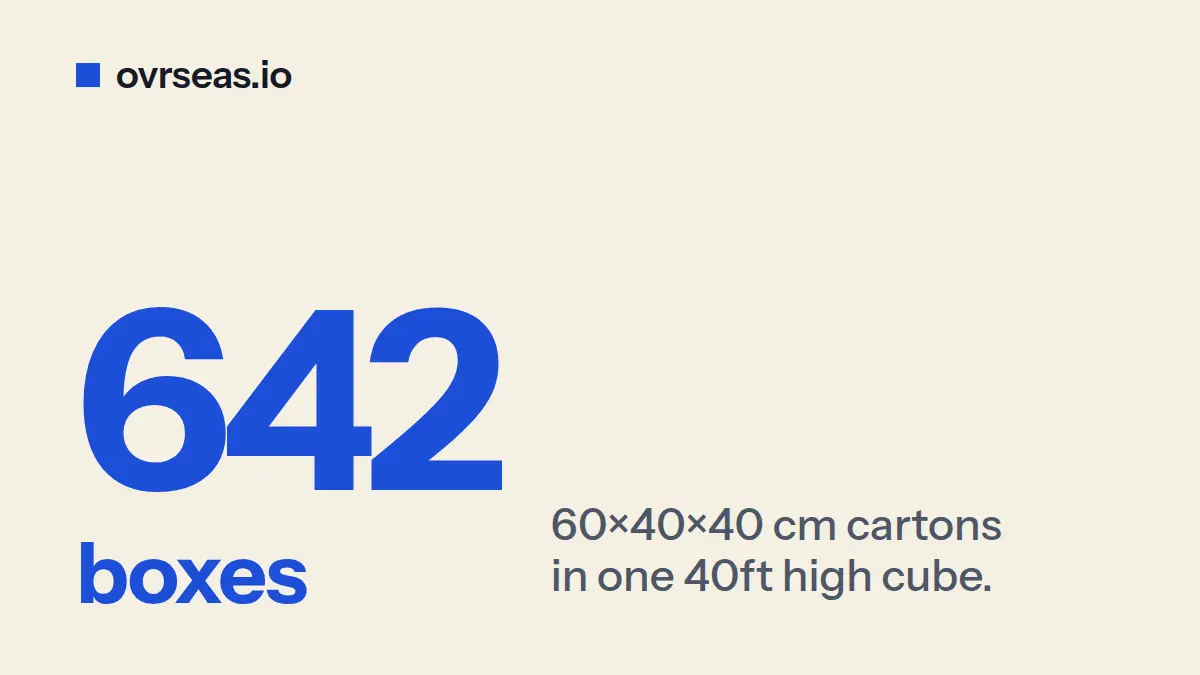
A 60 × 40 × 40 cm carton fits about 260 times in a 20ft container, 535 times in a 40ft and 642 times in a 40ft high cube. The quick answer you find online, "divide the container volume by the carton volume," gives about 342 for the 20ft. That gap is about 24%, and it is the difference between booking one container and finding out at the warehouse that you need two.
Below are worked numbers for three common carton sizes and two pallet types, in a 20ft, a 40ft and a 40ft high cube. Every count comes from our free container load planner, the same engine you can run on your own carton sizes.
The container sizes behind the numbers
The counts assume roughly 5.85 m × 2.35 m × 2.39 m of usable space in a 20ft. Carriers publish slightly different inside sizes, so the planner uses the smallest value across five carriers' spec sheets (Maersk, Hapag-Lloyd, CMA CGM, ONE and Evergreen). A plan that fits these sizes fits whichever box arrives. Two carriers' published figures:
- 20ft dry: inside about 5.90 m long × 2.35 m wide × 2.39 m high. Door opening about 2.34 m wide × 2.28 m high (ONE container specifications; Evergreen container information).
- 40ft dry: inside about 12.03 m × 2.35 m × 2.39 m. Same door size as the 20ft (ONE; Evergreen).
- 40ft high cube: inside about 12.03 m × 2.35 m × 2.69 m. Door about 2.59 m high (ONE; Evergreen).
The planner also keeps 50 mm free at the doors. Cargo pressed flat against the doors is a plan nobody can close.
Cartons: how many fit
Smaller cartons fit in the thousands: 1,072 cartons of 50 × 40 × 30 cm in a 40ft high cube, 1,392 of 45 × 35 × 30 cm. All cartons below are loaded "this side up" (turned around, never laid on their side) and stacked to the ceiling. Weight is not the limit in this table. We cover weight further down.
| Carton (cm) | 20ft | 40ft | 40ft high cube |
|---|---|---|---|
| 60 × 40 × 40 | 260 | 535 | 642 |
| 50 × 40 × 30 | 448 | 938 | 1,072 |
| 45 × 35 × 30 | 581 | 1,218 | 1,392 |
Compare the volume-only shortcut for the same cartons:
| Carton (cm) | 20ft by volume | Planner | Shortfall |
|---|---|---|---|
| 60 × 40 × 40 | 342 | 260 | 24% |
| 50 × 40 × 30 | 547 | 448 | 18% |
| 45 × 35 × 30 | 694 | 581 | 16% |
The shortfall is not waste you can plan away. Cartons are rigid. If the width is 2.35 m and your carton is 40 cm, five cartons take 2.00 m across and the last 35 cm stays empty. The same happens along the length and up to the ceiling. Volume division pretends those strips can hold slices of a carton.
Why a grid count is also wrong
The other shortcut is a straight grid: how many fit along, times across, times up. For 60 × 40 × 40 in a 20ft that gives 9 × 5 × 5 = 225. The planner finds 260 because it does not keep every carton facing the same way. It fills most of the floor one way, then turns the cartons in the leftover strip so they use space a grid leaves empty. That is 35 more cartons in the same box.
So the two common shortcuts point in opposite directions. Volume division promises too many. A simple grid often promises too few, which can push you into booking a second container you did not need.
If your cartons may lie on their side
Allowing cartons on their side adds about 6–8%. When the 60 × 40 × 40 carton may be tipped, the planner may turn some of them on their side to fill gaps an upright-only plan leaves empty:
- 20ft: 260 → 280
- 40ft: 535 → 575
- 40ft high cube: 642 → 683
Only allow this if the goods really can travel on their side. A "this side up" marking on the carton is an instruction to the loaders, not a suggestion.
When weight runs out before space
Heavy cartons hit the weight limit long before the container is full. Take the same 60 × 40 × 40 carton at 70 kg each (tiles, metal parts, liquids):
| Container | By space | By container rating | By typical US road limit |
|---|---|---|---|
| 20ft | 260 | 260 | 246 |
| 40ft | 535 | 378 | 285 |
| 40ft high cube | 642 | 375 | 285 |
Two things stand out. First, at this weight the high cube's extra height buys nothing. You pay for space you cannot fill. Second, the road can be stricter than the container. One US carrier's published guidance (not a law; limits vary by state and truck) gives typical US road limits of 17,236 kg for a 20ft and 19,958 kg for a 40ft (ACL payload guidelines). The container rating itself is higher (about 28 t for a 20ft and 26 t for a 40ft on the spec sheets above). Ask your trucker which limit applies on your route before you plan to the rating.
For the weight your terminal needs on paper, see our guide to VGM (verified gross mass).
Pallets
A 20ft takes 9 US pallets or 11 EUR pallets on the floor; a 40ft takes 20 or 23. These are pallets loaded to 1.5 m total height and not stacked on each other:
| Pallet (base) | 20ft | 40ft | 40ft high cube |
|---|---|---|---|
| US pallet, 1219 × 1016 mm | 9 | 20 | 20 |
| EUR pallet, 1200 × 800 mm | 11 | 23 | 23 |
The high cube adds nothing here, because the pallets are not stacked. Its extra 30 cm of height only helps when a second layer fits. If you ship on wooden pallets, check the ISPM 15 stamp before they leave.
What the numbers do not include
- Bulging cartons. A carton that is 41 cm tall after packing is not a 40 cm carton. Measure a packed carton, not the spec sheet.
- Securing. Airbags, dunnage and bracing take space. Leave room if your load needs them.
- Loading by hand. The last row at the door is the hardest to place. Real loads often come in a few cartons under the plan.
Treat the planner's count as the most you should book against, not a promise that every last carton will go in.
Run your own cartons
Enter your carton size, weight and quantity in the load planner. It shows how many fit in each container size, a layer-by-layer picture of the load, and whether weight or space runs out first. If you only need the CBM, start with how to calculate CBM.
How this was made: every count was computed on 2026-10-12 with the ovrseas load planner (block-by-block placement, checked for overlap and support), using the smallest inside sizes across five carriers' spec sheets and 50 mm door clearance. The volume shortcut is container volume ÷ carton volume. Drafted with AI assistance from the carrier and ACL pages linked above; published under Seungho Im's byline.
Enter a shipment once. Get every document.
Commercial invoice, packing list, certificate of origin and more — filled from one shipment record, so the shared fields always match.
No credit card required · 14-day free trial

Related Articles

LCL Freight Is Billed on Volume or Weight, Whichever Is Bigger
LCL is billed on the greater of volume (CBM) or weight (tonnes). Three worked examples show when weight wins, and what to ask your forwarder.
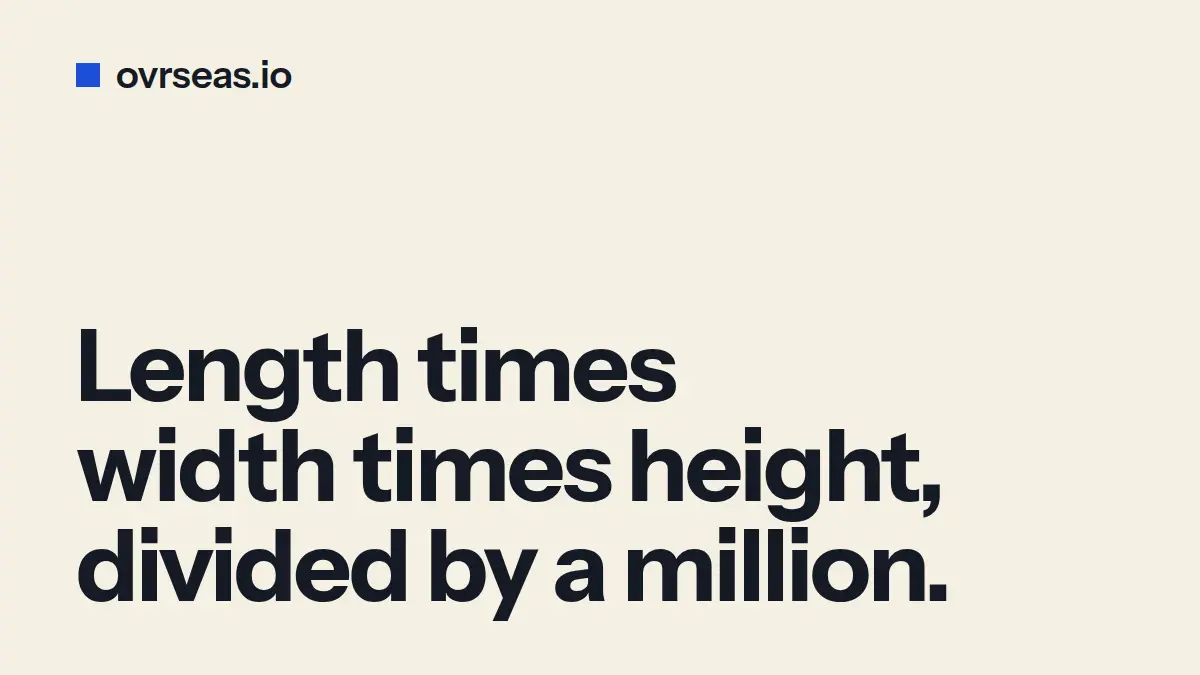
How to Calculate CBM: Formula and 3 Worked Examples
CBM = length × width × height in cm ÷ 1,000,000. Three worked examples (cm, inches, mixed shipment) and the rounding trap that skews totals.