
How to Find the Right HS Code for Your Product
You typed your product into a search engine and got a 6-digit code. That feels like the answer. It is not. HS classification is a legal decision made under six binding rules, and customs authorities hold the importer of record responsible for that decision — even when a supplier or broker provided the code. This guide walks through what HS codes are, why "the database said so" is not a defense, and the workflow used by professionals who have to defend their classifications.
What is an HS Code, and why does it matter legally?
An HS code is a 6-digit international product classification used by over 200 countries to determine duty rates, license requirements, and trade statistics. The first 6 digits are universal under the World Customs Organization. Countries add 2 to 4 more digits for their own tariff schedules — 10 digits total in the United States. Every cross-border shipment needs one.
The classification is not optional, and it is not informal. Under 19 U.S.C. § 1592, the importer of record must use "reasonable care" in classifying, valuing, and entering merchandise. The same principle applies to exporters in most jurisdictions: the party signing the export declaration is certifying the classification. According to Cornell Legal Information Institute, the statute imposes penalties for fraud, gross negligence, and negligence — and the level of culpability determines the size of the penalty.
Why can't you just trust the code your supplier or broker gave you?
Because the legal liability does not transfer with the code. The importer of record is responsible for what gets filed, regardless of who suggested the number. CBP, courts, and foreign customs authorities all apply this principle.
In February 2023, Samsung C&T America agreed to pay $1 million to settle False Claims Act allegations. According to the U.S. Attorney for the Southern District of New York, Samsung admitted that it provided its customs brokers with documentation, including invoices, that contained inaccurate information about the materials and construction of the imported footwear. Samsung admitted it had "failed to verify the accuracy of this information" before sending it to the brokers. The brokers filed the entries. Samsung paid the settlement.
The lesson is structural. If your supplier classifies a product wrong, and you accept that classification on your invoice or entry, you have made a false statement to customs. The supplier did not. You did. The same applies when a broker files based on details you provided.
What are the General Rules of Interpretation (GRI)?
The General Rules of Interpretation (GRI) are six rules published by the World Customs Organization that govern HS classification worldwide. They must be applied in sequence, starting with GRI 1. Only when GRI 1 cannot resolve the classification do you move to GRI 2, then GRI 3, and so on. They are legally binding in every country that signed the HS Convention.
A short overview of what each rule does:
GRI 1: Classify by the wording of the heading and any relevant Section or Chapter Notes. Most products end here.
GRI 2(a): An incomplete or unassembled article that has the essential character of the finished article is classified as the finished article. A bicycle without pedals is still a bicycle.
GRI 2(b): Mixtures and combinations of materials are classified by reference to GRI 3.
GRI 3(a): When multiple headings could apply, the heading with the most specific description wins.
GRI 3(b): When 3(a) does not resolve it, classify by the material or component that gives the goods their essential character.
GRI 3(c): When neither 3(a) nor 3(b) resolves it, use the heading that appears last in numerical order among those that equally merit consideration.
GRI 4: For products that fit no heading, classify them under the heading for goods most similar in kind.
GRI 5: Cases and packaging follow specific rules about whether they are classified with the goods inside.
GRI 6: The same logic that determines the heading is reapplied at the subheading level.
A search engine does not apply these rules. It returns text matches. The classifier — you — applies the rules.
How do you actually find an HS code step by step?
Use this workflow when you classify a product for the first time, or when you inherit a code you have not personally verified.
Step 1: Use the Schedule B Search Engine (Census Bureau, free)
The U.S. Census Bureau runs a free search tool at census.gov/scheduleb. It is the standard starting point for U.S. exporters. The engine asks guiding questions to narrow your product down to a 10-digit Schedule B number. The first 6 digits of that number are the HS code, which is the same in every WCO member country.
One important detail most users miss: when the engine returns a candidate, expand the "Assumed Characteristics" panel. The engine fills in defaults you may not have specified. According to the Census Bureau's own classification guide, if those defaults do not match your product, the result will be wrong.
Step 2: Read the heading text directly
Once the engine returns a candidate, do not stop there. Open the official Harmonized Tariff Schedule (hts.usitc.gov for U.S. imports, or the Schedule B publication for U.S. exports). Read the actual wording of the 4-digit heading and the 6-digit subheading. Read the Section and Chapter Notes that govern that area. Confirm the heading text describes your product. This is GRI 1 in practice.
Step 3: Search CROSS for similar rulings
CBP's Customs Rulings Online Search System at rulings.cbp.gov contains over 220,000 binding ruling letters issued since 1989. If CBP has already classified a product like yours, that ruling shows their interpretive position. Search by material, function, and intended use — not by generic product names.
Note that CROSS rulings are legally binding only on the importer who requested them. But they are highly persuasive evidence of how CBP will treat similar merchandise, and CBP expects ruling requesters to search CROSS first.
Step 4: When unclear, request a Binding Ruling
If your product does not match any existing ruling and the classification is genuinely ambiguous, file a request under 19 CFR Part 177. The eRuling template at CBP allows electronic submission. According to CBP, rulings that do not require a physical sample are typically issued within 30 calendar days. The ruling is legally binding on CBP at every port of entry, provided your product matches the description in the ruling.
When should you request a CBP Binding Ruling?
Request one when the classification could materially change the duty owed, when the product could fit two competing headings with different rates, or when the classification affects program eligibility — such as a free trade agreement preference. The cost is your time. The benefit is removing the audit risk for that product line.
A binding ruling is not required for every classification, but it is the strongest legal protection available. CBP expects requesters to first search CROSS to confirm no existing ruling already covers their product.
What are the penalties for getting it wrong?
Penalties under 19 U.S.C. § 1592 scale with the level of culpability. According to 19 CFR Appendix B to Part 171, the Customs penalty mitigation framework is:
Negligence (failure to use reasonable care): up to 2 times the lost duties, or up to 20% of the dutiable value if no duty was lost.
Gross negligence (actual knowledge or wanton disregard): up to 4 times the lost duties, or up to 40% of the dutiable value if no duty was lost.
Fraud (voluntary and intentional): up to the domestic value of the merchandise.
The statute of limitations gives CBP 5 years to recover lost duties. Recent enforcement makes this more than theoretical. According to the Department of Justice, fiscal year 2025 saw a record $6.8 billion in False Claims Act settlements and judgments. A dedicated Trade Fraud Task Force was formed in August 2025 specifically to coordinate cross-agency enforcement of customs fraud, including misclassification. The largest customs-related FCA settlement on record — $54.4 million with Ceratizit USA — was announced in December 2025.
What does a defensible HS classification look like?
Before signing any document with an HS code on it, run through this checklist:
Did I personally verify the heading text describes my product?
Did I check the Section and Chapter Notes for any exclusions?
If two headings could apply, did I apply GRI 3 — specificity, then essential character, then last in numerical order?
Did I check CROSS for similar rulings?
If the product is unusual or high-value, did I consider a Binding Ruling?
If a supplier or broker provided the code, did I do the same checks I would do for my own classification?
The code on your invoice is your legal statement. Not the search engine's. Not your broker's. Not your supplier's. Yours.

Related Articles
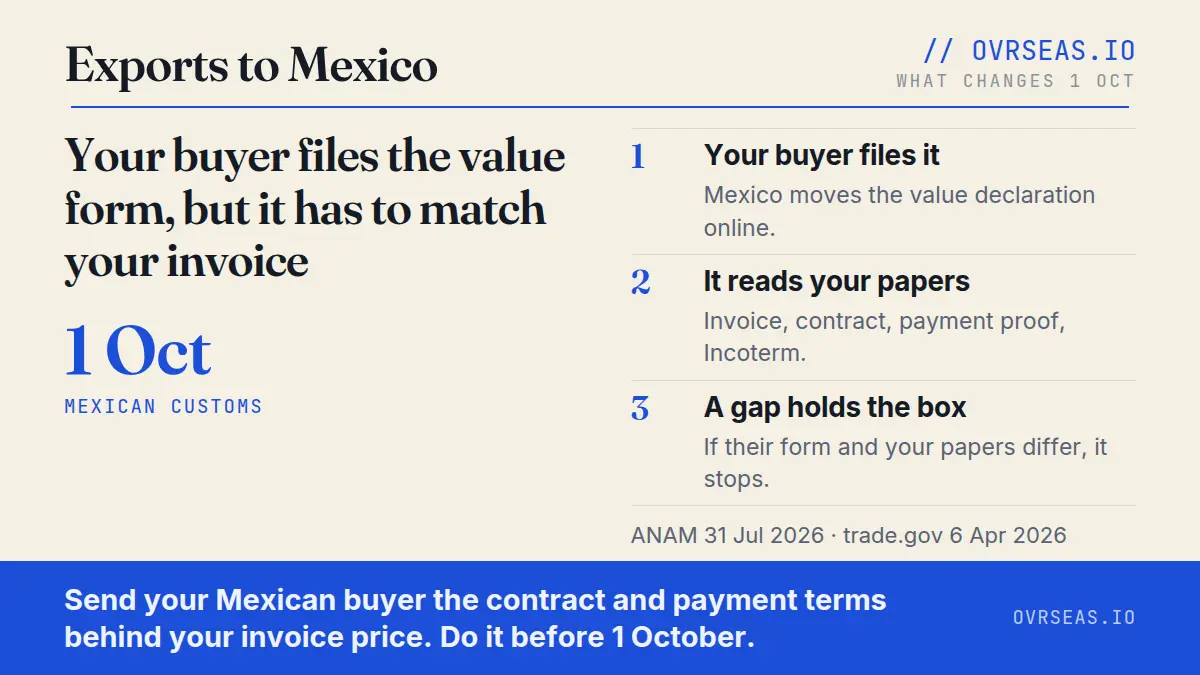
Mexico's Electronic Value Declaration Is Mandatory on 1 October — What Your Buyer Will Need From You
From 1 October 2026 your Mexican buyer files the customs value declaration electronically. Every input to that filing — invoice, contract, payment proof, Incoterm — comes from you.
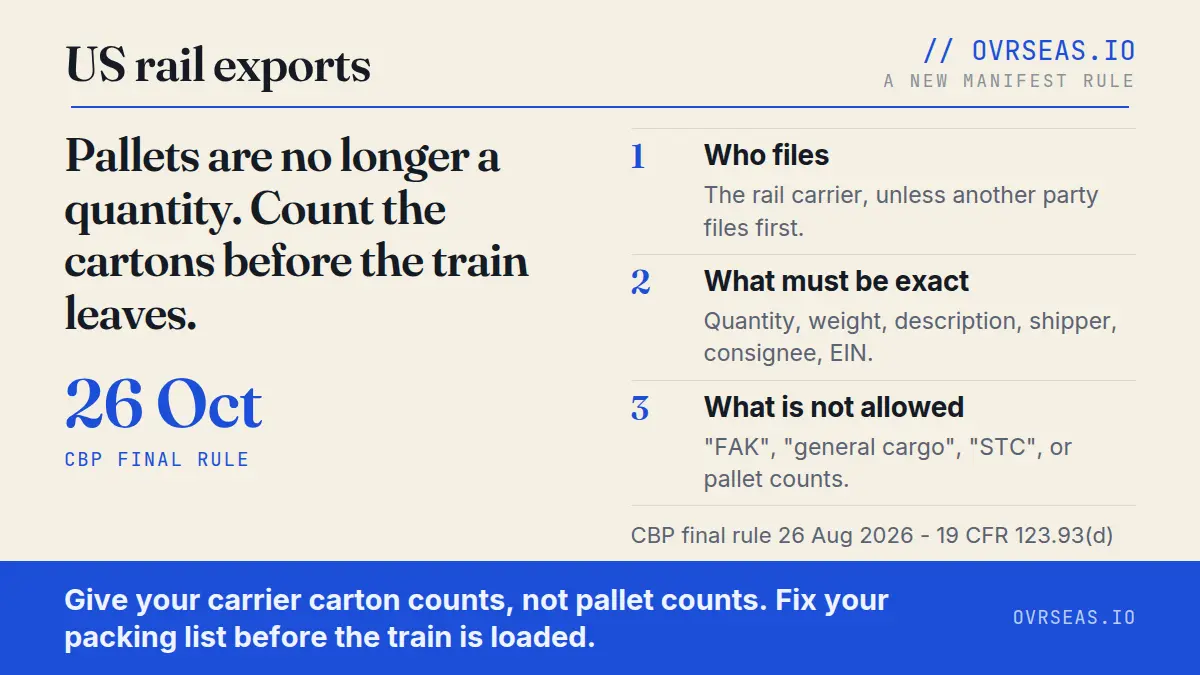
CBP's Rail Export Manifest Rule: What Has to Be Right 24 Hours Before Departure
CBP's final rule for rail export manifests takes effect 26 October 2026. The initial filing is due 24 hours before departure, and six of its seven mandatory fields come off your own shipment documents.
EU Direct-Transport Proof (July 2026): What US Exporters Must Now Show
From 1 July 2026, US goods claiming the EU's adjusted duty treatment must prove direct transport. Here's the document-consistency check for small exporters.
Ready to streamline your export documents?
Create Commercial Invoices, Packing Lists, and more in minutes. Enter data once, sync everywhere.
No credit card required · 14-day free trial