
India Customs 2.0 in 2026: What Changes for Exporters
For years, the stereotype of Indian customs was slow paperwork, unpredictable officers, and a fax-machine pace. In 2026, that picture is out of date. India's government is rolling out what it calls "Customs 2.0," a fully paperless, faceless, contactless clearance system, with a target of April 2026 for the full paperless workflow. The speed story is part of it — average clearance dropping from several days toward a 24-hour target — but the more important story for exporters is that the system is now unforgiving of errors, because it runs on automation.
If you ship to India, your documents are no longer reviewed by a sympathetic officer at the port. They are read by ICEGATE, cross-checked against databases, and flagged automatically when something does not match. This article walks through what Customs 2.0 actually is, what "paperless, faceless, contactless" means in practice, how ICEGATE's auto-flagging works, what Faceless Assessment changes, what Auto Out of Charge is, and what exporters should do to stay compliant.
What is India's Customs 2.0?
Customs 2.0 is the Indian government's initiative to fully automate customs clearance across all ports, logistics systems, and compliance platforms. According to DHL India's 2026 export documentation guide, the government is targeting the full automation of customs processes by April 2026, with a 100% paperless workflow that replaces physical document handling end to end.
The initiative builds on India's earlier reforms — Turant Customs, ICEGATE, SWIFT, eSANCHIT, and the Risk Management System — but ties them together into a single target: clearance that runs without human touchpoints for compliant shipments. A longer-term integration plan, linking ICEGATE, RMS, and the Indian Customs Electronic Data Interchange System (ICES) into one platform, is targeted for the 2026-27 budget cycle.
The shift matters for exporters because the compliance burden has moved. It is no longer about building a relationship with the right officer at the right port. It is about getting the data in your Bill of Entry, shipping bill, and supporting documents to match exactly what the system expects.
What does "paperless, faceless, contactless" actually mean?
These are the three pillars of the Turant Customs program, which Customs 2.0 extends and completes. Each pillar describes a different way the customs process has been stripped of physical and human touchpoints.
Paperless means every document is submitted electronically. Through eSANCHIT, the supporting-document upload system, invoices, packing lists, certificates of origin, and regulatory approvals are uploaded as PDFs and assigned a unique Image Reference Number (IRN). Customs officers access them through ICEGATE, not through physical files delivered to a port office.
Faceless means the officer assessing your Bill of Entry is not tied to the port of import. Bills flagged by the Risk Management System are assigned to Faceless Assessment Groups (FAGs) that operate anywhere in India. The officer reviewing a shipment arriving in Mumbai may sit in Chennai or Delhi. There is no in-person meeting.
Contactless means the entire process — filing, payment, assessment, clearance — runs through digital channels. Shipping lines file the Import General Manifest electronically. Duties are paid through ICEGATE banking integrations. Out of Charge is issued in the system. For compliant shipments, no one at the port needs to touch the paperwork.
How does ICEGATE auto-flag document errors?
ICEGATE cross-references every declaration against linked government databases in real time. According to DHL India's 2026 guide, even a single-digit error in an HS Code can trigger a "data mismatch" flag on ICEGATE, delaying the approval of international shipping documents. The same is true for mismatches between GSTIN, IEC, declared values, and the supporting documents uploaded through eSANCHIT.
This is a shift in how errors get discovered. In the old workflow, an officer would catch a mismatch during manual review and raise a query; the exporter would get a chance to explain or correct. In the new workflow, the system catches it first, automatically. Some flags can be resolved through clarification. Others trigger automated penalties, added to the Bill of Entry without officer review.
Three data points that must match across every document in an Indian export transaction:
The 8-digit HS code on the commercial invoice must match the shipping bill, and both must map correctly to the product description.
The GSTIN and IEC of the exporter must match DGFT and GSTN records.
The declared value must be consistent with the commercial invoice, packing list, and any letter of credit or payment terms referenced.
A mismatch on any of these is a likely auto-flag. Exporters who relied on the forgiving pace of manual review in the past are the most exposed to the new system.
What is Faceless Assessment and how does it work?
Faceless Assessment is a customs reform under the Central Board of Indirect Taxes and Customs (CBIC)'s Turant Customs program, in which Bills of Entry are assigned to Faceless Assessment Groups anywhere in India rather than being assessed only at the port of import. The officer handling your file may be in a different city, a different zone, and a different jurisdiction from the port where your cargo is sitting.
The workflow moves through two system filters before an officer sees a file. A Customs Broker files the Bill of Entry through ICEGATE. The Risk Management System evaluates risk signals — commodity type, importer history, valuation patterns, sensitive goods flags. If the system does not flag risk, the Bill is "facilitated" and can proceed straight to duty payment and clearance. If risk is flagged, the Bill is "non-facilitated" and assigned to a FAG for detailed assessment.
Two changes matter for exporters. First, the officer has no local context. They do not know the port, the broker, or the importer personally. The file is what the file is. Second, according to reporting on 2026 CBIC circulars, the agency has cracked down on frivolous queries in the Faceless Assessment system, limiting officers to a maximum of three queries per Bill of Entry. This was intended to prevent piecemeal delays, but it also means each query carries more weight — you get three chances to respond, not unlimited ones.
What is Auto Out of Charge?
Out of Charge (OOC) is the customs order that releases cargo from the port. Historically, even after documents were assessed and duties paid, an exporter or broker needed physical interaction with a customs officer to receive the OOC. The 2026 circular under Customs 2.0 expands Auto Out of Charge, where the system automatically issues the OOC once three conditions are met.
The conditions are straightforward. First, the documents must be clean — no open queries, no data mismatches, no missing eSANCHIT uploads. Second, the duty must be paid through ICEGATE. Third, if the shipment was selected for the Green Channel — the facilitated path for low-risk, compliant shipments — no physical examination is required. When all three conditions align, the system clears the goods automatically, and the exporter can coordinate with the shipping line or terminal to move the container.
The combination of pre-arrival Bill of Entry filing, facilitated risk assessment, electronic duty payment, and Auto OOC is what makes the 24-hour clearance target realistic. It also means the entire window from arrival to release happens without a human touching the paperwork — which is only a benefit if the paperwork is clean.
What should exporters do to stay compliant?
Four practical adjustments for anyone shipping to India.
First, treat HS code classification as the highest-risk step. A single-digit error triggers an auto-flag. Use DGFT and ICEGATE classification tools or advance rulings for ambiguous products rather than last-minute estimation. Lock the 8-digit HS code before finalizing the commercial invoice, and keep it identical across every document in the transaction.
Second, standardize document consistency checks before filing. Values, quantities, party details, and HS codes need to match across the commercial invoice, packing list, shipping bill, and eSANCHIT uploads. A discrepancy that would have been caught in conversation with an officer is now caught instantly by the system, with a flag attached.
Third, file Bills of Entry in advance. The 24-hour clearance target assumes pre-arrival filing. Importers submitting Bills only after arrival are defaulting to the old timeline. Build advance filing into your standard process, and confirm your Customs Broker is doing the same.
Fourth, prepare for three-query budget in Faceless Assessment. If your Bill is non-facilitated and queries come in, respond completely and clearly the first time. Partial answers or clarifications drawn out over multiple query cycles risk exhausting the three-query cap. Keep technical documentation, product specifications, and valuation support ready in advance.
Key takeaways
India is targeting 100% paperless customs clearance by April 2026 under the Customs 2.0 initiative.
Three pillars — Paperless, Faceless, Contactless — remove physical and human touchpoints from the clearance workflow.
ICEGATE auto-flags document mismatches. A single-digit HS code error is enough to trigger a data mismatch flag.
Faceless Assessment assigns Bills of Entry to officers anywhere in India, with a maximum of three queries per Bill.
Auto Out of Charge clears compliant shipments automatically when documents and duty payment align.
The 24-hour clearance target is realistic for clean paperwork and unforgiving of errors.

Related Articles
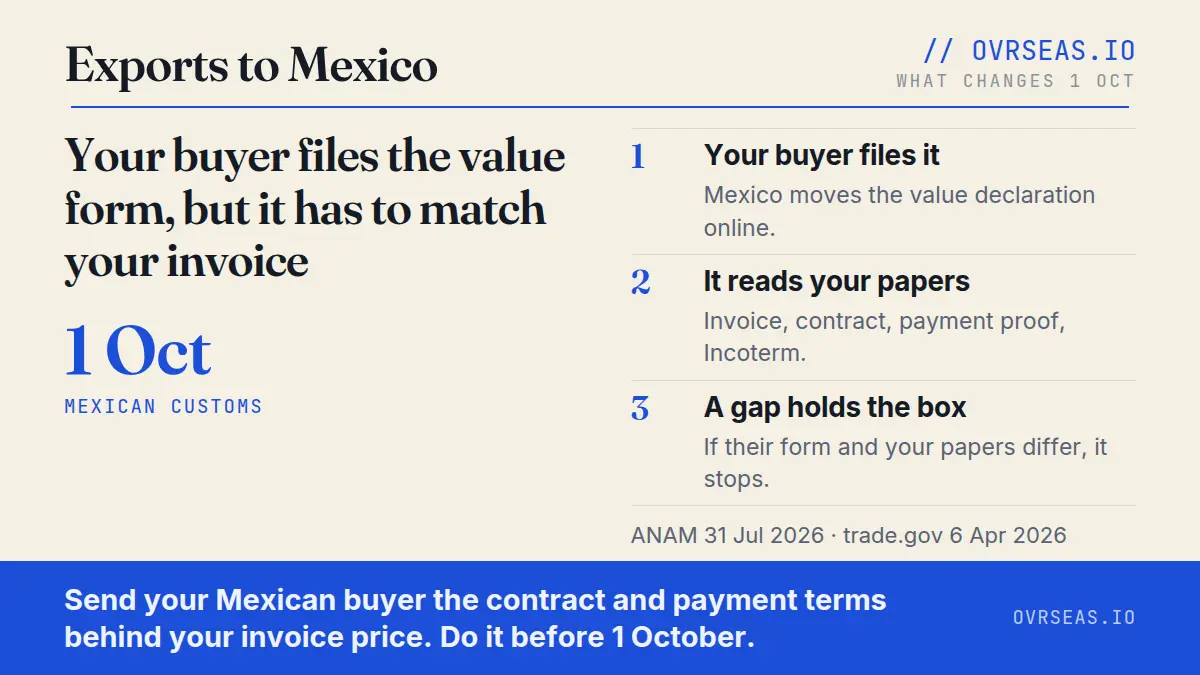
Mexico's Electronic Value Declaration Is Mandatory on 1 October — What Your Buyer Will Need From You
From 1 October 2026 your Mexican buyer files the customs value declaration electronically. Every input to that filing — invoice, contract, payment proof, Incoterm — comes from you.
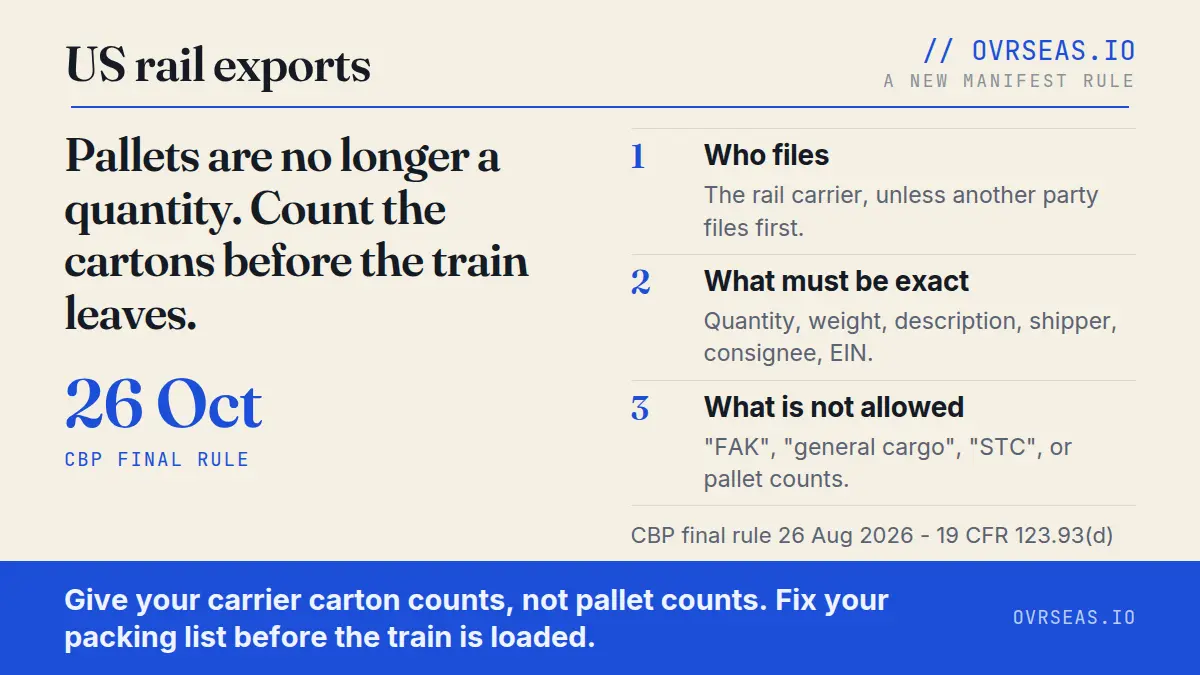
CBP's Rail Export Manifest Rule: What Has to Be Right 24 Hours Before Departure
CBP's final rule for rail export manifests takes effect 26 October 2026. The initial filing is due 24 hours before departure, and six of its seven mandatory fields come off your own shipment documents.
EU Direct-Transport Proof (July 2026): What US Exporters Must Now Show
From 1 July 2026, US goods claiming the EU's adjusted duty treatment must prove direct transport. Here's the document-consistency check for small exporters.
Ready to streamline your export documents?
Create Commercial Invoices, Packing Lists, and more in minutes. Enter data once, sync everywhere.
No credit card required · 14-day free trial