
USMCA Qualified Doesn't Mean Zero Tariff: 2026 Stack
You filed the USMCA certification, your product qualified, and the importer expected zero duty. Then the entry summary came back with a 50% tariff line item. This is not a mistake. The USMCA preference applies to one tariff — the MFN rate — and nothing else. The Section 232 tariffs on steel, aluminum, and copper, modified again on April 6, 2026 to apply to full customs value, do not have a USMCA exemption. This guide explains what USMCA actually exempts, what it does not, and how to map the real Mexico-to-US tariff stack in 2026.
What does USMCA preferential treatment actually cover?
USMCA preferential treatment removes the Most Favored Nation (MFN) tariff rate on qualifying goods. That is the column-1 rate listed in the Harmonized Tariff Schedule. Once a good is certified as originating under USMCA rules of origin, it enters at the rate shown in the "Special" subcolumn under SPI code "S" — typically 0%.
That preference does not extend to other tariff regimes. According to law firm BDO and Customs and Border Protection guidance, USMCA-qualifying goods are exempt from IEEPA Mexico and IEEPA Canada tariffs, and certain auto parts are exempt from Section 232 Auto/Auto Parts tariffs. Beyond those specific exceptions, USMCA does not remove other duties that may apply to the same product.
The practical consequence: a fully USMCA-qualified shipment can still face additional tariffs that significantly exceed the MFN rate the certification removed.
Why doesn't Section 232 honor the USMCA exemption on steel and aluminum?
Because Section 232 is a separate statutory authority based on national security, not a trade preference. Originally enacted in 1962, Section 232 of the Trade Expansion Act allows the president to impose tariffs when the Secretary of Commerce determines that imports threaten to impair national security. Free trade agreements like USMCA do not override Section 232 findings.
According to the Congressional Research Service, Canadian and Mexican steel and aluminum products have faced the 50% Section 232 tariff since June 4, 2025, the same date the rate doubled from 25%. The 2018-era country exemptions for Canada and Mexico have not been restored. The Section 232 tariffs apply to imports from nearly every country, with narrow special rates for the United Kingdom and a quota arrangement under negotiation.
What USMCA does help with on steel and aluminum: it makes the product eligible for IEEPA Mexico/Canada exemption, which removes one stacking layer. But the Section 232 metal duty itself stays.
What changed on April 6, 2026?
President Trump signed a proclamation on April 2, 2026 that took effect for entries on or after April 6, 2026 at 12:01 AM EDT. The change reshapes how Section 232 metal tariffs are calculated.
Per the White House proclamation, two structural shifts apply:
Full customs value assessment. Tariffs now apply to the full customs value of the imported product, regardless of metal content. Previously, importers could split a derivative product's value between metal and non-metal portions and pay duty only on the metal share. That split is eliminated.
New annex-based rate structure. Products are sorted into annexes that determine the applicable rate.
According to law firm White & Case, the rate structure is:
Annex I-A — 50% on full value. Aluminum, steel, and copper articles, plus certain derivatives made entirely or almost entirely of these metals.
Annex I-B — 25% on full value. Downstream derivatives substantially made of steel, aluminum, or copper.
Annex II — excluded. Roughly 247 HTSUS codes removed from Section 232 coverage entirely.
Annex III — 15% transitional through December 31, 2027. Metal-intensive industrial and electrical grid equipment.
The proclamation also introduces narrow special rates by origin: 25% (Annex I-A) or 15% (Annex I-B) for products made entirely with UK-origin metal, 10% for derivatives made entirely with US-smelted/cast/poured metal, and 200% for aluminum products of Russian origin or containing Russian-origin aluminum.
What does the math actually look like?
Take a Mexican-manufactured aluminum extrusion classified in HTS Chapter 76, valued at $1,000 customs value, certified as USMCA-originating.
USMCA preference (MFN rate): $0
Section 232 (50% on full customs value): $500
Total duty paid: $500
The USMCA certification did real work. It removed the MFN tariff line. It also exempts the shipment from the IEEPA Mexico tariff that would otherwise apply. But Section 232 sits on a separate authority, and the April 6 proclamation made the duty base the full $1,000, not just the metal portion.
For a derivative product in Annex I-B — say, a Mexican fabricated steel article like furniture frame components — the same logic applies at the lower 25% rate. A $1,000 article with USMCA cert pays $250 in Section 232 duty.
What does USMCA still exempt in 2026?
The exemption picture as of April 28, 2026:
IEEPA Mexico tariffs (currently 25%): USMCA-qualifying goods are exempt. According to law firm BDO, articles that qualify for USMCA preferential tariff treatment are not subject to IEEPA Mexico or IEEPA Canada tariffs.
IEEPA Canada tariffs (currently 35%): USMCA-qualifying goods exempt under the same guidance.
Section 232 Auto/Auto Parts (25%): Parts of passenger vehicles and light trucks that qualify for USMCA preferential treatment are not subject to the Section 232 Auto/Auto Parts tariff. According to recent industry analysis, this exemption is expected to end in mid-2026 when Commerce and CBP roll out a new valuation and certification regime that aligns parts treatment with finished vehicles.
Beyond these specific exemptions, USMCA-qualifying goods generally face the same Section 232 metal tariffs and Section 122 global tariff (10%, in effect until July 24, 2026) as goods from any other country. There is no general "USMCA = zero" rule.
Are there exceptions that lower the Section 232 hit?
Several. Each has narrow eligibility criteria.
De minimis exception. According to White & Case, products where the aggregate weight of applicable steel, aluminum, and copper inputs is less than 15% of total product weight are excluded from Section 232. This exception is not available for products classified in HTSUS Chapters 72, 73, 74, or 76.
US-origin metal reduction. Derivative articles made abroad with metal that is entirely smelted/cast/poured in the United States qualify for a 10% Section 232 rate instead of the 25% or 50% standard. Documentation of smelt/cast origin is required.
Annex II exclusion. Approximately 247 HTSUS codes were removed from Section 232 coverage in the April 6 proclamation. These products may now face only the 10% Section 122 tariff (until July 24, 2026) rather than Section 232 metal duties. The Annex II list is published with the proclamation.
Manufacturing drawback. Drawback claims under 19 U.S.C. 1313(a) and (b) are available for certain Annex I-B and Annex III articles when the goods originate from Trade Agreement Partners and meet specific smelt-and-pour requirements. This requires planning and documentation but can recover duty paid on inputs that are subsequently re-exported in finished products.
What should Mexico exporters and US importers do now?
Three actions matter most.
Map your bill of materials by HTSUS chapter. Section 232 exposure depends on what your product is, not where it was made. Products in Chapters 72 (iron and steel), 73 (articles of iron and steel), 74 (copper and articles thereof), and 76 (aluminum and articles thereof) face the highest exposure under Annex I-A. Derivatives in Annex I-B face 25% on full value. Anything in Annex II is now excluded entirely.
Verify smelt-and-cast origin documentation. The 10% reduced rate for US-origin metal and the 25%/15% UK-origin rates depend on documentary proof of where the metal was smelted/cast/poured — not where the derivative product was fabricated. Mills and metal suppliers can provide mill test certificates or smelt/cast affidavits, but only if asked. Importers who relied on USMCA cert alone may have no smelt-origin records on file.
Recalculate landed cost before signing the next purchase order. A USMCA-qualified Mexican aluminum extrusion that landed at a duty-inclusive cost of $1,030 in early 2025 (3% MFN) now lands at $1,500 (50% Section 232 on full value). For derivatives in Annex I-B, the same product lands at $1,250. Pricing models built on the assumption that USMCA cert = duty-free are now significantly off.
USMCA cert is still worth pursuing. It removes one tariff line and unlocks the IEEPA Mexico/Canada exemption. It does not, by itself, deliver zero-duty entry into the United States in 2026.

Related Articles

New U.S. Customs Rule: Your Export Filings Now Have to Match
From ~September 2026, CBP will require your home export declaration alongside the US entry — the 6 fields that must agree across your documents.
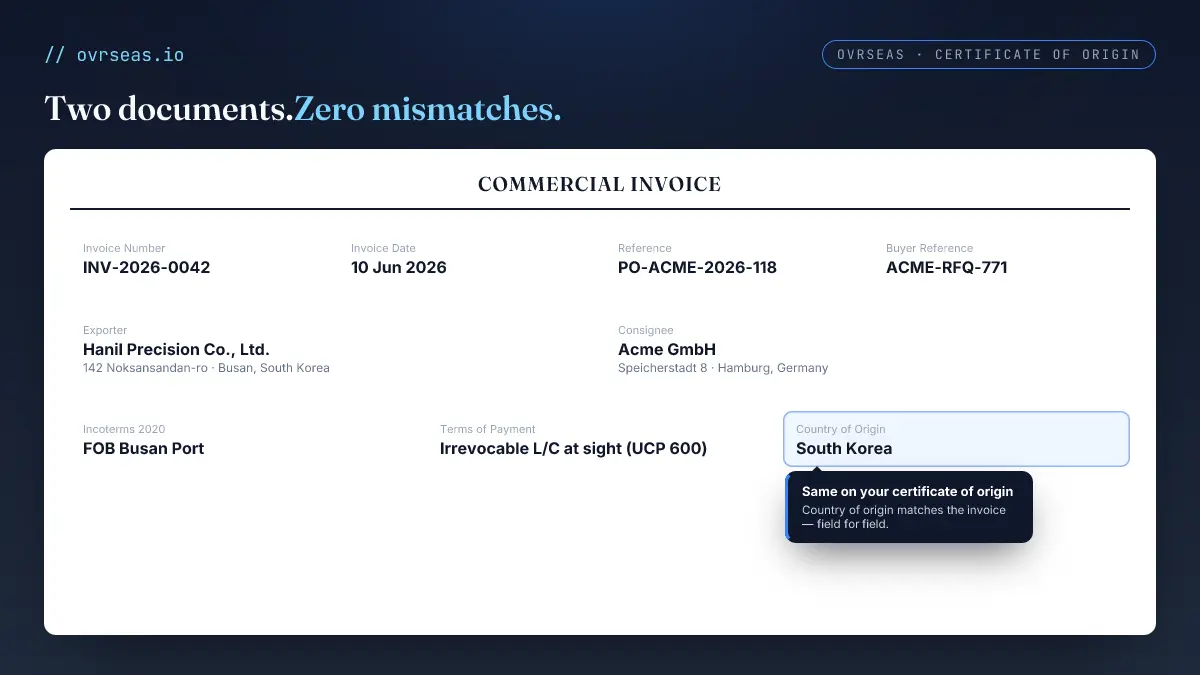
Certificate of Origin + Commercial Invoice: One Master File
Why a certificate of origin and commercial invoice must match — the shared fields, the customs risk, and how one master file keeps them consistent.

FTA Recordkeeping: How Long to Keep Your Origin Records
Across the main U.S. programs, FTA origin records run five years, from a different start date each, and a separate file per agreement.
Ready to streamline your export documents?
Create Commercial Invoices, Packing Lists, and more in minutes. Enter data once, sync everywhere.
No credit card required · 14-day free trial