
SOLAS VGM: Why the Shipper Signs, Not the Forwarder
If you ship packed containers by sea, somewhere in your paperwork flow there is a number called the Verified Gross Mass, or VGM. A forwarder usually calculates it. A terminal usually checks it. A carrier usually loads the box once it's received. But under SOLAS, only one party signs for that number — and it's not the forwarder, not the terminal, and not the carrier.
It is the shipper named on the Bill of Lading. That distinction is the heart of VGM compliance, and it is the part most commonly misunderstood. This article walks through what the SOLAS VGM rule says, who is legally responsible, how the two approved weighing methods work, why carriers are not expected to verify your number, what happens when the VGM is missing or wrong, and what shippers should actually do to stay compliant.
What is the SOLAS VGM requirement?
SOLAS, short for Safety of Life at Sea, is the international maritime safety treaty maintained by the International Maritime Organization (IMO). In November 2014, the IMO adopted amendments to SOLAS Chapter VI, Regulation 2 under Resolution MSC.380(94), requiring that every packed export container have a verified gross weight — the Verified Gross Mass — before it can be loaded onto a ship subject to SOLAS. The amendments took effect on July 1, 2016.
The VGM is the total weight of the packed container: cargo, dunnage, packaging, pallets, and the container's own tare weight. It is a safety-driven number. Misdeclared container weights had caused stowage errors, stack collapses, and vessel incidents for years, and the VGM rule was designed to remove guesswork from the loading plan.
SOLAS is signed by more than 160 states, making the VGM rule effectively global for international ocean shipping. National maritime authorities enforce the requirement locally, so the mechanics of enforcement vary country to country even though the rule itself is uniform.
Who is legally responsible for the VGM?
The shipper named on the Bill of Lading is the party legally responsible for providing the VGM to the ocean carrier and the terminal representative before vessel loading. That is the rule as written in SOLAS, and it is also how carriers and forwarders describe it in their own VGM policies.
This responsibility does not shift when someone else does the work. According to SEKO Logistics, if a shipper uses a forwarder to pack, weigh, and book the container, the forwarder may provide the weight, but the shipper still carries the legal responsibility for the VGM, because the Bill of Lading carries the shipper's name. The forwarder is acting under instructions. The accountability stays with the name on the paperwork.
One nuance: when a Non-Vessel Operating Common Carrier (NVOCC) issues its own House Bill of Lading and books the container under its own name with the ocean carrier, the NVOCC becomes the "shipper" as far as the ocean carrier is concerned. In that arrangement, the NVOCC is responsible for submitting the VGM to the ocean carrier, based on the data the underlying shipper provides. The underlying shipper is still the source of the weight — the NVOCC is not expected to independently verify it.
What are the two methods for calculating VGM?
SOLAS recognizes two weighing methods, and shippers must use one of them.
Method 1 is to weigh the packed container. After the container is loaded and sealed, the shipper or an authorized third party places the entire container on a calibrated weighbridge and records the total weight. The weighing equipment must meet the accuracy standards of the state where the weighing takes place.
Method 2 is to weigh the cargo and contents separately — including pallets, dunnage, packaging, and any securing materials — and then add the container's tare weight, which is marked on the door end of the container. Method 2 requires documented weights for every item in the container; bulk commodities like grain or scrap are typically ineligible because the individual-item requirement is not practical.
Two things are not permitted under either method. First, estimating the weight is prohibited. Second, the party packing the container cannot rely on weights provided by other shippers — every shipment needs its own documented weighing. Co-loaded containers are not exempt.
Why doesn't the carrier verify the weight?
Because SOLAS does not require them to. The rule places the verification duty squarely on the shipper. Carriers are expected to use the VGM the shipper provides when building the vessel's stowage plan; they are not expected to independently re-weigh every container that arrives at the terminal.
ZIM's published VGM policy states plainly that the carrier will not validate the weight provided by shippers in their VGM and will proceed with vessel planning based on that weight. Xeneta makes the same point in its guide: under the SOLAS framework, the carrier is not liable to verify the weight of the container or the accuracy of the VGM certificate provided by the shipper. The carrier's obligation is not to load a container that lacks a VGM, not to audit the VGM it receives.
This is why the responsibility question matters so much in practice. When a weight turns out to be wrong, there is no diligence chain that runs back through the carrier — the carrier was entitled to trust what it was given. The trail runs back through the paperwork to the name on the Bill of Lading.
What happens if the VGM is missing or wrong?
The immediate consequence is simple: no VGM, no load. SOLAS prohibits a carrier from loading a packed container without a VGM onto a vessel to which the convention applies. If the VGM is missing at the carrier's cutoff time, the container rolls to a later sailing, or the terminal returns it to the shipper. Either way, the shipper typically absorbs the storage, demurrage, rerouting, and administrative costs.
Some terminals operate a "No VGM – No Gate In" policy, meaning the container is not even admitted through the gate without a valid VGM submission. Other terminals admit the container but hold it until the VGM arrives. Both approaches create cost and delay, and both costs fall on the shipper.
Penalties for inaccurate or false VGM declarations are set at the national level. SOLAS leaves tolerance levels and specific fines to each signatory state's maritime authority, which means the financial exposure varies significantly by port of loading. Regardless of the specific fine, the paper trail points to the shipper on the Bill of Lading, and that is who the enforcement action targets.
What should shippers do to stay compliant?
Four practical steps.
First, know who signs. Identify the party named as shipper on your ocean Bill of Lading for every shipment. That party is the legal signer for VGM purposes. If you use an NVOCC and a House Bill, understand which entity is the "shipper" in each leg.
Second, document the weighing method. Decide whether Method 1 or Method 2 fits your cargo and facilities, and apply it consistently. For Method 1, keep the weighbridge certificate. For Method 2, keep the individual item weight records and the container tare reference. Both should be retained according to your country's statutory recordkeeping period.
Third, submit on time. Carriers publish VGM cutoff deadlines for each sailing. Missing the cutoff means your container will not be in the stowage plan — the carrier does not have time to accommodate a late VGM. Submission channels vary by carrier: EDI, web portals, API integrations, or email.
Fourth, confirm the signature on file. SOLAS requires a signed VGM declaration, with the signature of an individual authorized by the shipper. The signature can be electronic, but it must be a specific person — first and last name — not a generic company label. Check that your standard VGM template captures this.
Key takeaways
SOLAS Chapter VI, Regulation 2, as amended by IMO Resolution MSC.380(94), has required a Verified Gross Mass for every packed container since July 1, 2016.
The shipper named on the Bill of Lading is the party legally responsible for the VGM, regardless of who does the actual weighing.
Delegating the weighing to a forwarder does not delegate the SOLAS liability.
Carriers are not required to verify the VGM; they use the shipper's number as submitted.
Only two methods are permitted — weighing the packed container, or weighing cargo plus container tare. Estimates and borrowed weights are not allowed.
Missing or late VGM means the container is not loaded. Inaccurate VGM exposes the shipper to country-specific penalties.

Related Articles
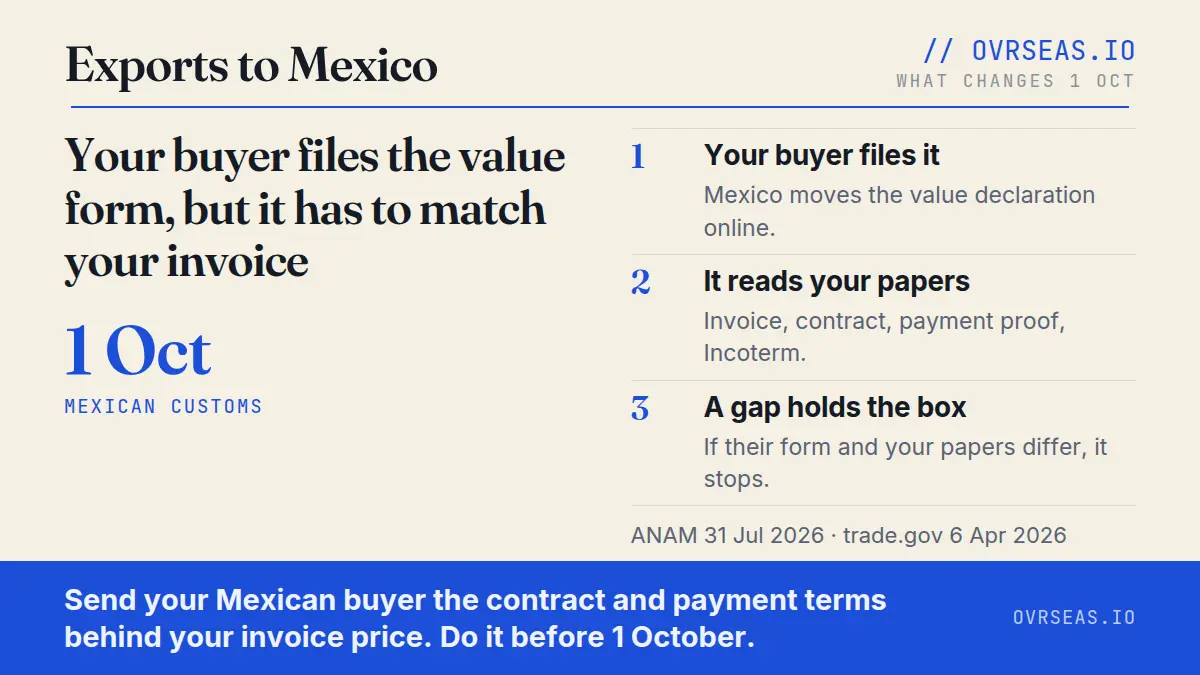
Mexico's Electronic Value Declaration Is Mandatory on 1 October — What Your Buyer Will Need From You
From 1 October 2026 your Mexican buyer files the customs value declaration electronically. Every input to that filing — invoice, contract, payment proof, Incoterm — comes from you.
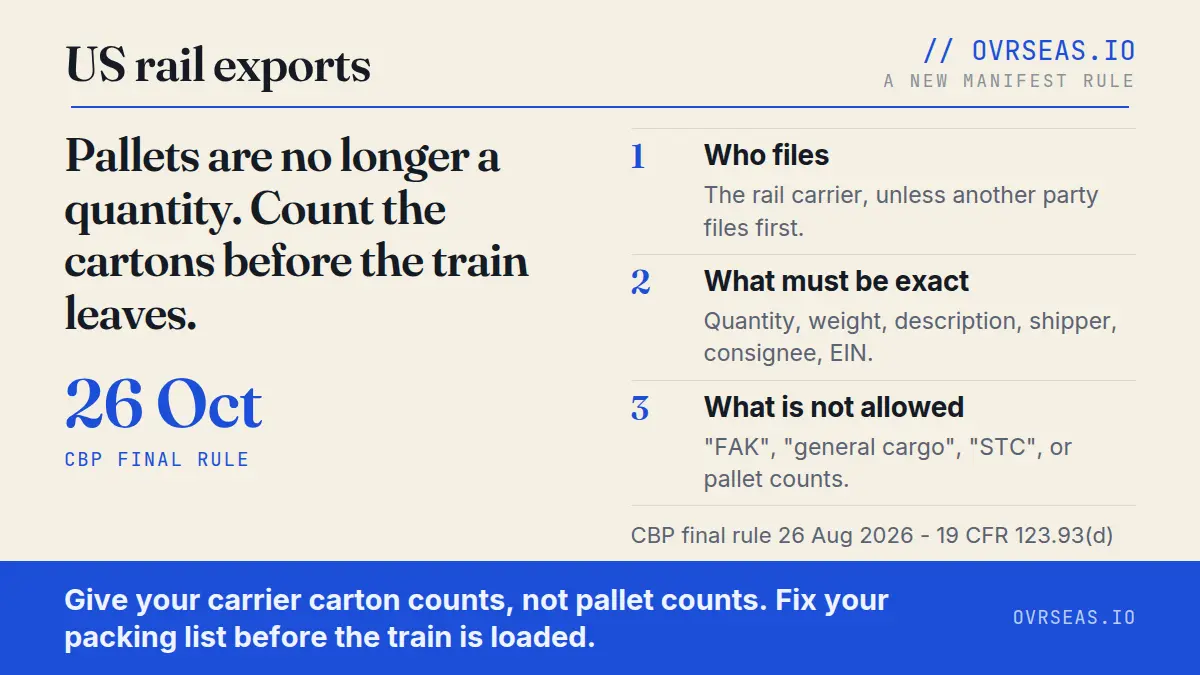
CBP's Rail Export Manifest Rule: What Has to Be Right 24 Hours Before Departure
CBP's final rule for rail export manifests takes effect 26 October 2026. The initial filing is due 24 hours before departure, and six of its seven mandatory fields come off your own shipment documents.
EU Direct-Transport Proof (July 2026): What US Exporters Must Now Show
From 1 July 2026, US goods claiming the EU's adjusted duty treatment must prove direct transport. Here's the document-consistency check for small exporters.
Ready to streamline your export documents?
Create Commercial Invoices, Packing Lists, and more in minutes. Enter data once, sync everywhere.
No credit card required · 14-day free trial