
Anti-Dumping Duty Explained: Same Country, 235% Tariff Difference
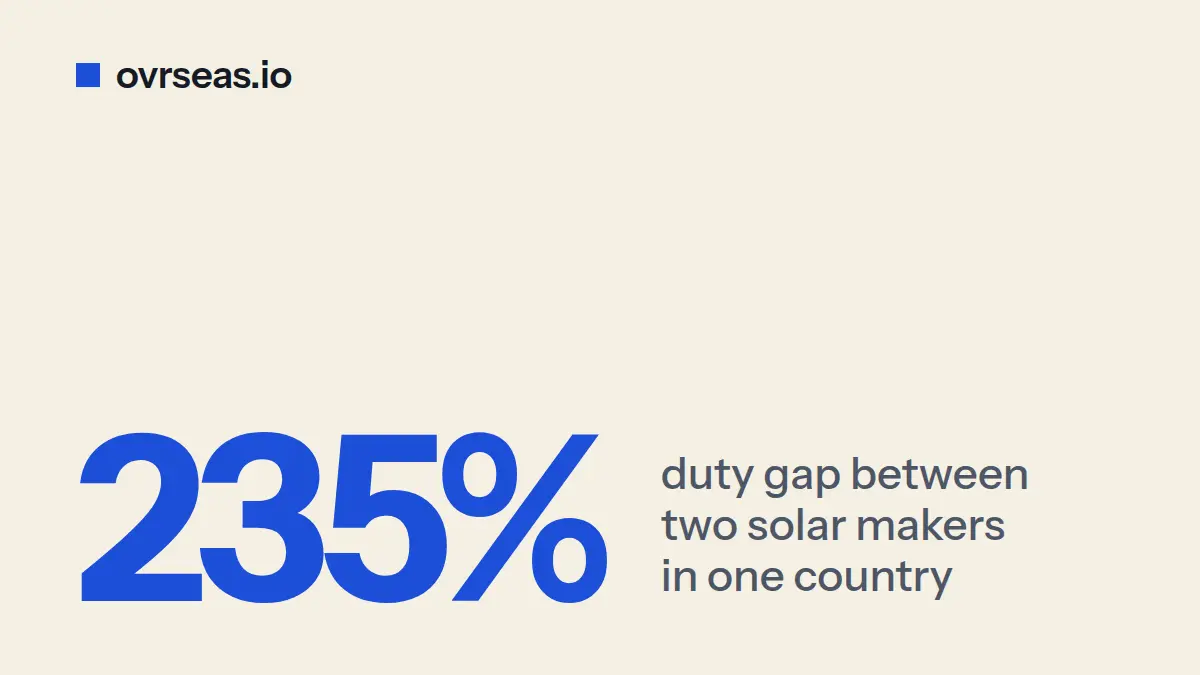
Two companies make solar panels in Malaysia. One pays 14.64% in duties. The other pays 250%. Same country. Same product. 235% difference.
The reason? Anti-dumping and countervailing duties don't just look at where a product is made. They look at who funded the factory.
This guide explains how AD/CVD duties work, why factory relocation doesn't always help, and what to verify before you import.
What are anti-dumping and countervailing duties?
Anti-dumping duty (AD) is a tariff imposed when a company sells products abroad cheaper than at home. Countervailing duty (CVD) offsets government subsidies that give foreign producers an unfair advantage. Both duties stack on top of normal tariffs.
According to the U.S. Department of Commerce, these duties protect domestic industries from unfair pricing and subsidized competition. When Commerce finds dumping or subsidies, it calculates a duty rate to offset the advantage.
In April 2025, Commerce announced final AD/CVD rates on solar panels from four Southeast Asian countries:
Cambodia: 125.37% AD + 3,403.96% CVD = 3,529% total
Thailand: 202.90% AD + 799.55% CVD = 1,002% total
Vietnam: 271.28% AD + 542.64% CVD = 813% total
Malaysia: 81.24% AD + 168.80% CVD = 250% total
These are country-wide rates. Individual companies can receive different rates based on their own circumstances.
Why did two Malaysian factories get different rates?
Hanwha Qcells, a Korea-headquartered company with manufacturing in Malaysia, received 0% AD and 14.64% CVD. The Malaysia country-wide rate was 81.24% AD and 168.80% CVD.
According to the Commerce Department press release from April 21, 2025, investigators found that companies in Cambodia, Malaysia, Thailand, and Vietnam were receiving subsidies from the Government of China, not just from their local governments.
Hanwha Qcells, as a Korean company, had a different funding structure. Same country. Different funding source. Different duty.
Why doesn't moving production to another country avoid the duties?
Many Chinese producers moved factories to Southeast Asia after the original AD/CVD orders on Chinese solar panels in 2011 and 2013. The strategy worked for a while. But Commerce adapted.
In a 2023 circumvention investigation, Commerce ruled that solar panels assembled in Southeast Asia using Chinese components still fall under the original China AD/CVD orders. The 2025 case went further, creating standalone AD/CVD orders on the Southeast Asian countries themselves.
According to pv magazine, Commerce found that even when production physically moved, the subsidies still originated from China. Factory location changed. Funding source didn't.
How widespread are AD/CVD measures in 2025?
Trade restrictions have reached historic levels. According to GMK Center analysis from October 2025:
62 countries have imposed 207 restrictions on Chinese steel products
The U.S. doubled Section 232 steel tariffs to 50% in June 2025
China exported 77.5 million tons of steel in January-August 2025, up 10% year-over-year
Regional responses in 2025 include Vietnam (27.83% AD on Chinese hot-rolled steel), South Korea (28-33% provisional AD on Chinese and Japanese HRC), and Taiwan (extended 38% AD on Chinese cold-rolled stainless steel through 2030).
What happens if you import without checking?
U.S. Customs and Border Protection actively investigates AD/CVD evasion. According to ASEAN Briefing analysis from October 2025, CBP has investigated 405 cases of alleged evasion since the Enforce and Protect Act took effect in 2016.
Consequences of non-compliance include:
Retroactive duties: Up to 90 days before preliminary determination
Back duties with interest: Calculated from original entry date
Civil penalties: Up to 4x the unpaid duties in fraud cases
Criminal prosecution: In transshipment cases with fraudulent documentation
How do you verify if your product is affected?
Before importing, check these sources:
ITA AD/CVD Orders Database: Search by HS code at trade.gov
CROSS Rulings Database: For product-specific classification rulings
Your customs broker: Should flag any AD/CVD exposure before filing
Questions to ask your supplier:
What is the true country of origin?
Where are major components manufactured?
Has your company received government subsidies or preferential financing?
Who owns the factory?
Quick reference: AD/CVD checklist
Search ITA database for your product's HS code
Verify country of origin, not just shipping country
Ask about component origins for assembled products
Ask about factory ownership and funding sources
Confirm your broker has checked for AD/CVD exposure
For high-value items, consider requesting a scope ruling
Same product. Same country. 235% difference. The funding source matters.
Make the invoice and packing list match
Enter the shipment once. Quantities, packages and weights come out the same on the commercial invoice and packing list, with the fields customs asks for.
No credit card required · 14-day free trial

Related Articles
New U.S. Customs Rule: Your Export Filings Now Have to Match
From ~September 2026, CBP will require your home export declaration alongside the US entry — the 6 fields that must agree across your documents.
Certificate of Origin + Commercial Invoice: One Master File
Why a certificate of origin and commercial invoice must match — the shared fields, the customs risk, and how one master file keeps them consistent.
USMCA Qualified Doesn't Mean Zero Tariff: 2026 Stack
USMCA preferences only the MFN rate. Section 232 steel, aluminum, and copper still hit at 50% on full value after the April 6, 2026 proclamation.