
Proforma Invoice vs Commercial Invoice: When to Use Each
 proforma invoice can't clear customs; the commercial invoice does" />
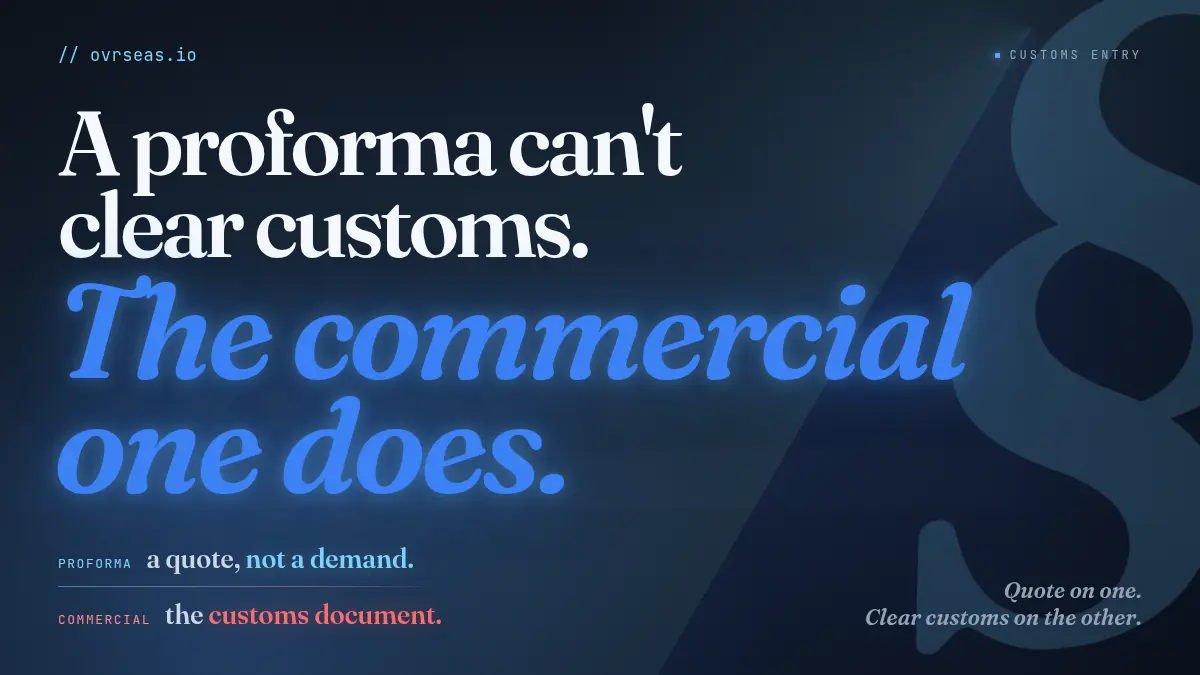
Short answer: Send a proforma invoice before the sale is final — to quote a buyer, to let them open a letter of credit, or to request an advance payment. Send a commercial invoice after you ship, because that is the document customs uses to clear the goods and assess duty. For a small exporter the trap is not knowing which is which — it is that the proforma you sent in week one and the commercial invoice you cut in week six describe the same shipment and have to agree, line for line. When they drift, a bank refuses payment or customs flags the entry.
What is a proforma invoice, and when do you send it?
A proforma invoice is a quote dressed as an invoice. It states the seller, the buyer, the goods, the unit prices, the Incoterm and the estimated total — but it is not a demand for payment and it does not record a completed sale. You send it before money or goods move, for three jobs:
- To quote the buyer a firm price and terms they can accept or use to apply for an import permit.
- To open a letter of credit. The buyer's bank issues the L/C against the figures on your proforma — parties, description, amount, currency and Incoterm. Whatever you write here becomes the credit's terms.
- To request an advance or a deposit, where the buyer pays a percentage before production starts.
Because it is preliminary, a proforma is not the document that clears customs. It carries no entry status on its own — it is an estimate, full stop.
What is a commercial invoice, and why does customs need it?
A commercial invoice is the legal record of a completed sale and the primary document customs uses to clear your goods and calculate duty. It is issued after — or as — the goods ship. For U.S. imports, the contents a commercial invoice must carry are set by regulation (19 CFR 141.86): the parties, a description of the goods, quantities, the price or value, the currency, the country of origin, and the terms of sale, among others. Miss a required field and the entry can stall.
The difference that matters operationally: the proforma is what you promise; the commercial invoice is what you delivered and billed. Customs, the bank and the buyer all cross-check the second against the first. (For the full field list, see our guide to U.S. customs commercial invoice requirements.)
Proforma vs commercial invoice: the differences at a glance
| Proforma invoice | Commercial invoice | |
|---|---|---|
| When | Before the sale is final (quote, L/C application, advance) | After goods ship / at the point of sale |
| Status | An estimate — not a demand for payment | A legal record of a completed sale |
| Customs | Not the entry document | The document customs clears goods against |
| Payment | Used to open an L/C or trigger a deposit | Presented to the bank to collect payment |
| Numbers | Estimated | Final and binding |
Can you clear customs on a proforma invoice?
Usually no — but there is a narrow exception worth knowing. U.S. Customs rules allow goods to be entered on a pro forma invoice when the required commercial invoice is not yet available, provided the importer posts a bond and produces the required invoice within a set deadline. Reported deadlines under the entry rules are 120 days from the entry filing, or 50 days when the invoice is needed for statistical purposes. This is a fallback, not a routine — and it shifts work and risk onto the importer, not you. Treat the commercial invoice as the document that actually clears the shipment. (Confirm the exact bond amount and day counts against 19 CFR 141.85 and 141.91 before relying on them — rules change.)
The real risk for small exporters: the two documents drift apart
Most "proforma vs commercial invoice" articles stop at the definitions. For a one-to-ten-person exporter shipping 5–30 containers a month off spreadsheets, the definitions are the easy part. The expensive part is that the proforma and the commercial invoice describe the same shipment weeks apart — and you re-type them.
Here is how the money leaks:
- L/C rejection. The bank opened the credit from your proforma. When you present the commercial invoice, examiners apply strict compliance under UCP 600: a goods description that reads "hydraulic cylinders, double-acting, 50 mm bore" on the proforma but "hydraulic actuators, 50 mm" on the commercial invoice is a discrepancy, and discrepancies get refused. A first-presentation rejection costs a fee and delays payment. (More in commercial invoice for a letter of credit.)
- Customs hold. If the quantity, value or party names on your commercial invoice don't match the rest of your shipment paperwork, the entry can be flagged for inspection — and the demurrage clock starts. (See how to avoid a customs hold.)
- Internal mismatch. The commercial invoice also has to agree with the packing list and bill of lading. (See what must match between a commercial invoice and packing list.)
A consistency checklist (run it before every commercial invoice)
The job isn't "know the difference" — it's "ship a commercial invoice that agrees with the proforma you already sent." Before you send the commercial invoice, confirm each field still matches the proforma (and the L/C, if there is one):
- Parties — seller and buyer names spelled exactly as on the proforma / credit ("Co., Ltd." ≠ "Company Limited").
- Goods description — same wording, not a paraphrase or reordering.
- Quantity and unit — same numbers, same units.
- Unit price, currency and total — final figures consistent with the quoted terms.
- Incoterm and named place — identical to the credit (e.g. "FOB Busan").
- Country of origin and HS code — unchanged from what you quoted.
If you maintain these by copy-paste across separate Word and Excel files, every re-key is a chance for one field to drift. That is the failure this checklist exists to catch.
How to keep them in sync without re-typing
The structural fix is to enter the shipment once and let every document read from it. That is what ovrseas does: you fill one shipment record — parties, goods, prices, Incoterm — and the proforma invoice, the commercial invoice, the packing list and the rest are generated from the same source. Change the price in one place and it updates everywhere, so the proforma you quoted and the commercial invoice you ship can't quietly disagree. It won't file your customs entry or screen your buyer — it removes the re-keying that makes the two invoices drift in the first place. Try it on your next shipment.
FAQ
Is a proforma invoice legally binding? No. It is a good-faith estimate of the terms of a sale, not a demand for payment or a record of a completed transaction. The commercial invoice is the binding document.
Can I use a proforma invoice for customs? Not as the routine entry document. U.S. rules allow entry on a pro forma in limited cases against a bond, with the required commercial invoice produced within a deadline, but the commercial invoice is what normally clears the goods.
Does the commercial invoice have to match the proforma exactly? The figures should be consistent. When a letter of credit is involved, banks apply strict compliance — any discrepancy between the commercial invoice and the credit (which was built from your proforma) can get the documents refused.
Which do I send first? The proforma, during negotiation or to open the L/C. The commercial invoice follows when the goods ship.
Written by Seungho Im, ovrseas.io. This article is general guidance on export documents, not legal or customs advice; verify current rules with the cited regulations or a licensed customs broker.

Related Articles
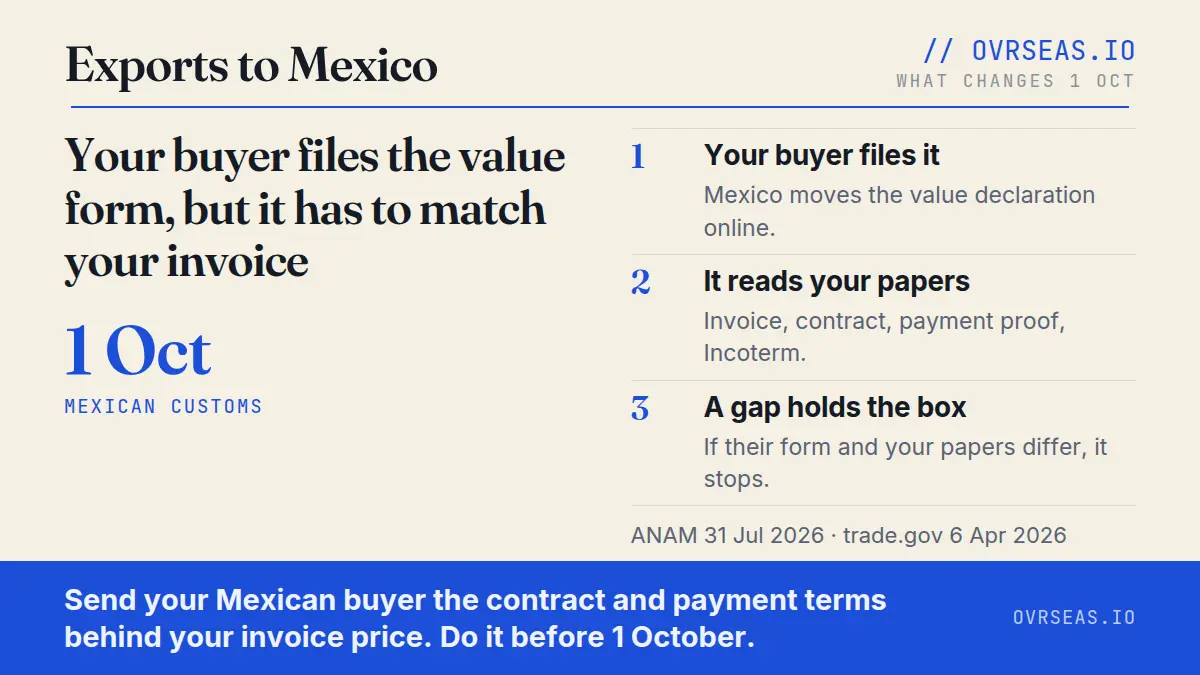
Mexico's Electronic Value Declaration Is Mandatory on 1 October — What Your Buyer Will Need From You
From 1 October 2026 your Mexican buyer files the customs value declaration electronically. Every input to that filing — invoice, contract, payment proof, Incoterm — comes from you.
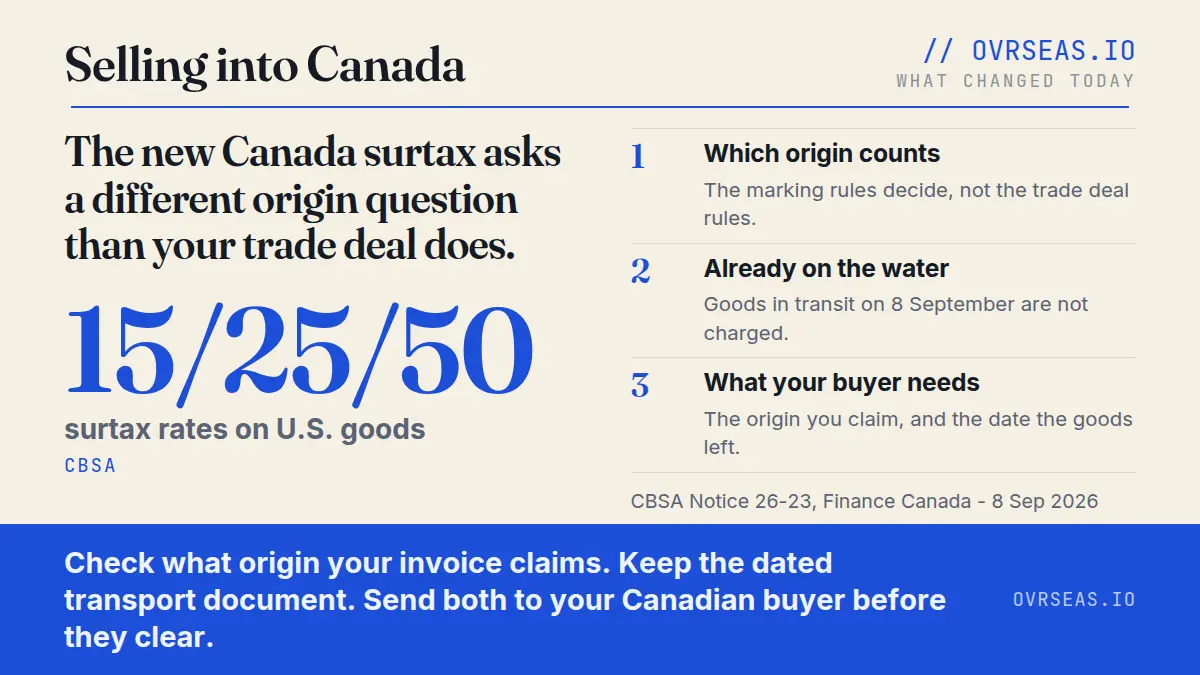
Canada's New Surtax on U.S. Goods: Which Origin Counts
Canada's 15/25/50% surtax on U.S. goods started 8 September 2026. It defines the goods by the marking rules, not your CUSMA preference claim — and the in-transit exception runs on dated transport documents.
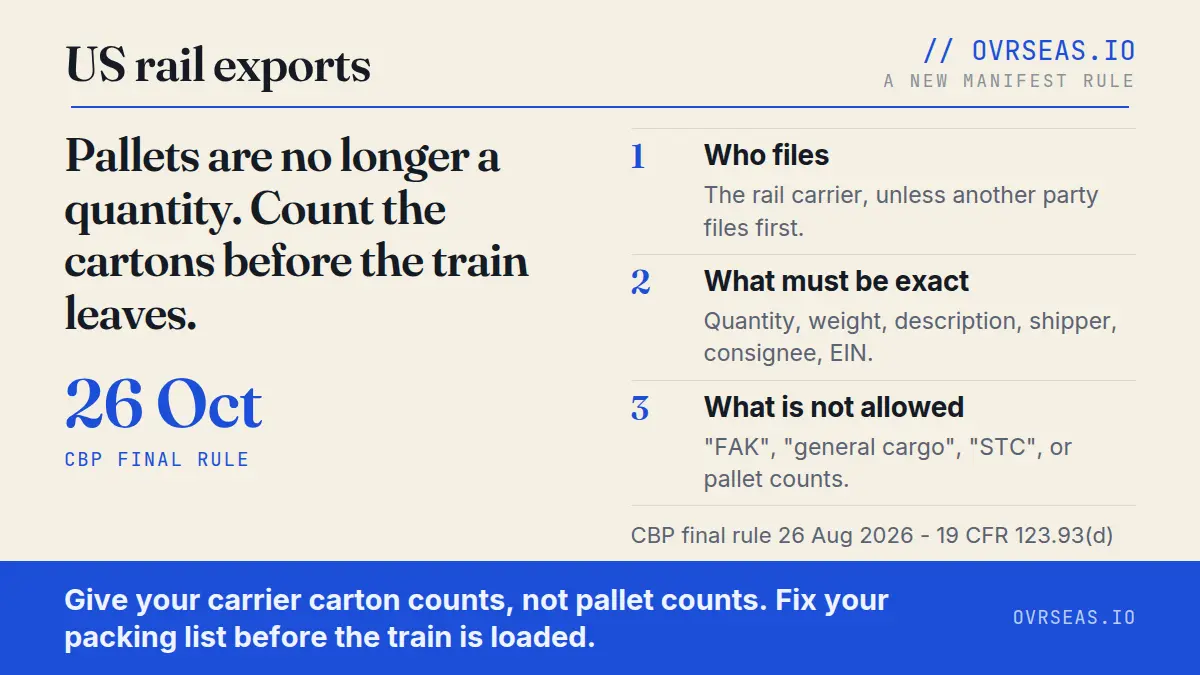
CBP's Rail Export Manifest Rule: What Has to Be Right 24 Hours Before Departure
CBP's final rule for rail export manifests takes effect 26 October 2026. The initial filing is due 24 hours before departure, and six of its seven mandatory fields come off your own shipment documents.
Ready to streamline your export documents?
Create Commercial Invoices, Packing Lists, and more in minutes. Enter data once, sync everywhere.
No credit card required · 14-day free trial