
IEEPA Tariff Refunds: Why Winning Doesn't Mean Getting Paid
The Supreme Court ruled 6-3 on February 20, 2026 that tariffs imposed under the International Emergency Economic Powers Act (IEEPA) are unlawful. Every dollar collected under IEEPA was collected without proper legal authority. According to the Penn Wharton Budget Model, the total refund exposure reaches up to $175 billion across more than 53 million customs entries.
But the Court did not order immediate refunds. It did not establish a process. And weeks later, most importers still have not received a cent. The gap between winning in court and getting your money back is filled with paperwork, deadlines, and system limitations that will determine who actually gets paid.
Why Hasn't CBP Started Issuing Refunds?
CBP's existing system cannot process refunds at this scale. According to a CBP declaration cited by Morgan Lewis, the Automated Commercial Environment (ACE) system is not built to handle the "unprecedented volume" of more than 53 million entries affected by the ruling. The system was designed for routine operations, not a one-time reversal of over a year's worth of tariff collections across virtually every product category and trading partner.
To solve this, CBP is developing a new dedicated tool called the Consolidated Administration and Processing of Entries (CAPE), designed specifically for IEEPA refunds. The estimated launch is roughly 45 days from the March announcement. According to CBP, the new system will require minimal importer submissions, use automated validations, and include a review period to resolve discrepancies before issuing payments.
On March 4, 2026, Court of International Trade Judge Richard Eaton issued an order directing CBP to begin paying refunds immediately to all affected importers. Two days later, on March 6, he suspended the immediate compliance portion of that order after CBP warned it could not comply. As SCOTUSblog reported, the refund process is now caught between judicial directives and administrative reality.
Meanwhile, interest on unpaid refunds is accruing at an estimated $650 million per month, according to SCOTUSblog's reporting on the CIT proceedings. More than 2,000 lawsuits seeking refunds have been filed at the CIT, including by major companies such as FedEx, Costco, and Nissan North America.
Who Is Eligible for an IEEPA Tariff Refund?
Refunds go to the importer of record — the entity whose name appears on the customs entry. This is established under 19 CFR §24.36, as noted by Skadden in its analysis of the ruling. Not the buyer. Not the freight forwarder. Not the end customer. If you are not the importer of record, you do not receive a direct refund from CBP.
Downstream purchasers who bore the cost of tariffs through higher prices have a different path. They would need to review supply contracts and potentially negotiate with the importer of record. Some contracts include tariff pass-through clauses that may create obligations to return refunds. Others do not. As Skadden noted, the CIT revised its filing forms in January 2026 to require plaintiffs to identify any third-party financing supporting their claim, likely in anticipation of disputes over who ultimately benefits from refunds.
This matters because many small and mid-sized exporters use third-party customs brokers or freight forwarders as their importer of record. If that is your situation, you need to confirm who filed the entries and who will receive the refund. Some companies, such as FedEx, have publicly stated they will return any refunds to customers who originally paid the tariffs.
What Documentation Do You Need to File a Refund Claim?
The single biggest documentation challenge is separating IEEPA duties from other tariffs on the same shipment. Many imports carry layered duties — IEEPA tariffs stacked on top of Section 232 (steel and aluminum) tariffs or Section 301 (China) tariffs. The Supreme Court ruling only invalidates IEEPA tariffs. Section 232 and 301 duties remain in full effect.
This means an importer who paid $100,000 in total duties on a shipment might have $40,000 in IEEPA duties and $60,000 in Section 232 duties. Only the $40,000 is eligible for a refund. But if your records do not clearly distinguish which portion came from which legal authority, filing a clean claim becomes significantly harder.
According to PwC's guidance following the ruling, importers should be:
Inventorying total IEEPA-related duties paid, categorized by whether entries are liquidated or unliquidated
Mapping Post Summary Correction (PSC) and protest deadlines to preserve refund rights
Updating ACH banking information with CBP, since all refunds will be issued electronically as of February 2026
Reviewing contractual tariff pass-through provisions that may require passing refunds to customers
If your entries have already liquidated — meaning they have been finalized by CBP — and you did not file a protest within the 180-day window, you may have lost the ability to claim a refund through the standard administrative process. Many importers filed protective actions at the CIT in late 2025 specifically to preserve this right.
What Is the Difference Between Liquidated and Unliquidated Entries?
An unliquidated entry is one that CBP has not yet finalized. These entries can still be corrected through the Post Summary Correction process, and IEEPA duties can potentially be removed and refunded without litigation. According to Clark Hill's analysis, roughly 19.2 million of 34 million IEEPA-covered entries remained unliquidated as of December 2025, based on Congressional Research Service data. That number has been shrinking as entries continue to liquidate daily.
A liquidated entry is finalized. Once liquidated, the only administrative path to a refund is filing a protest on CBP Form 19 within 180 days of liquidation. If that window has passed, the importer may need to pursue relief through CIT litigation, which adds cost and time.
This is why timing matters. Entries are continuously liquidating. Every day that passes without action means more entries cross from "correctable" to "protest-only" to "potentially lost."
What Replaced the IEEPA Tariffs?
On the same day as the Supreme Court ruling, President Trump issued a proclamation under Section 122 of the Trade Act of 1974, imposing a 10% "temporary import surcharge" on most goods entering the United States. This took effect on February 24, 2026, and runs for 150 days unless modified or extended by Congress, according to WilmerHale's analysis.
The administration also continued the suspension of duty-free de minimis treatment for all countries. Section 232 tariffs on steel and aluminum and Section 301 tariffs on Chinese goods remain in effect. The tariff landscape did not simplify after the ruling — it shifted to different legal foundations.
For importers, this means the documentation burden has actually increased. You need to track which tariffs apply under which legal authority, because each authority has different rules for exemptions, exclusions, and future challenges. An entry that was subject to IEEPA plus Section 232 now needs to be reclassified under the new Section 122 surcharge plus Section 232.
What Should Importers Do Right Now?
The refund process is not yet finalized, but the documentation window is closing for many entries. Here is what matters most:
Inventory every entry with IEEPA duties — dates, amounts, liquidation status
Separate IEEPA duties from 232 and 301 duties on each entry
Check protest deadlines for any entries that have already liquidated
Update your ACH information with CBP — electronic refunds are now the only method
Review contracts with customers and customs brokers for tariff pass-through clauses
Consult with your customs broker or trade counsel about whether to join CIT protective actions
The Supreme Court said the tariffs were unlawful from the beginning. But the refund is not automatic. It depends on your records, your deadlines, and your ability to prove exactly what you paid and under which authority. The companies that organized their documentation early will be first in line when the process finally opens.
Make the invoice and packing list match
Enter the shipment once. Quantities, packages and weights come out the same on the commercial invoice and packing list, with the fields customs asks for.
No credit card required · 14-day free trial

Related Articles
New U.S. Customs Rule: Your Export Filings Now Have to Match
From ~September 2026, CBP will require your home export declaration alongside the US entry — the 6 fields that must agree across your documents.

Certificate of Origin + Commercial Invoice: One Master File
Why a certificate of origin and commercial invoice must match — the shared fields, the customs risk, and how one master file keeps them consistent.
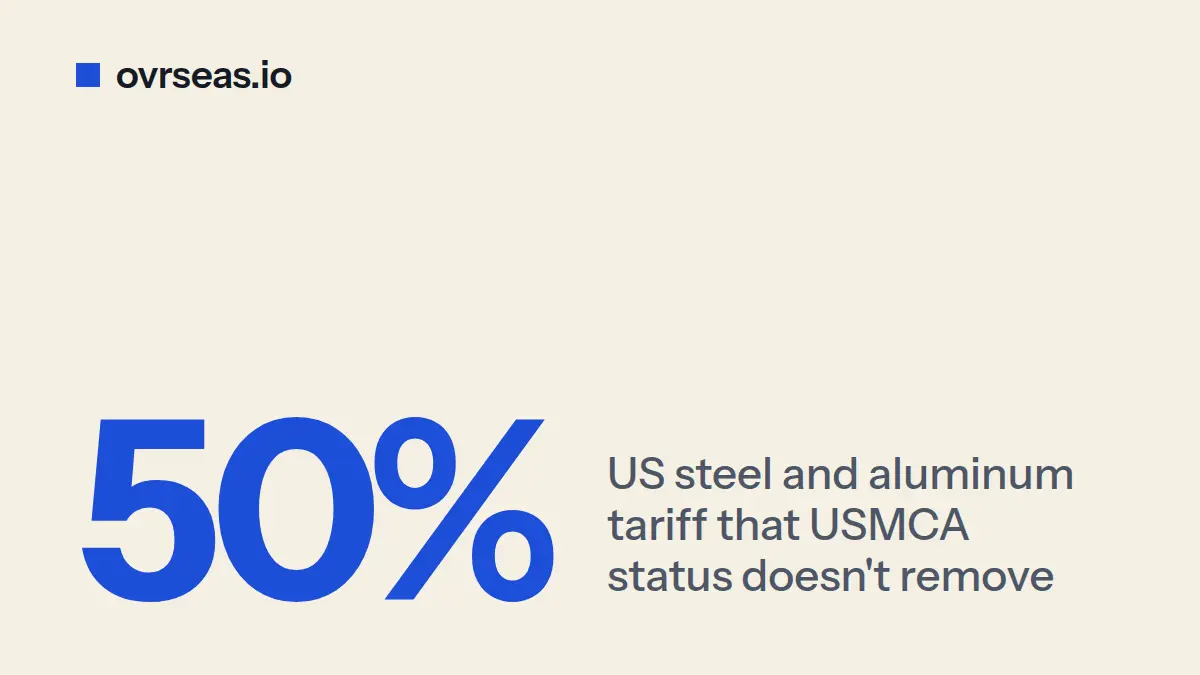
USMCA Qualified Doesn't Mean Zero Tariff: 2026 Stack
USMCA preferences only the MFN rate. Section 232 steel, aluminum, and copper still hit at 50% on full value after the April 6, 2026 proclamation.