
FTA Recordkeeping: How Long to Keep Your Origin Records
Claiming a free trade agreement (FTA) saves your buyer duty at the border. It also puts you on the hook to prove the goods qualified — for years after the container is gone. The short answer: across the main U.S. programs, the retention period is five years. The trap is that the five-year clock does not start at the same moment for every agreement, and if you ship the same product under more than one FTA, you are keeping more than one record set. This guide covers how long to keep FTA origin records, which records count, why multiple agreements multiply the work, and what makes a retained file survive a customs verification.
This is general information for U.S. exporters, not legal advice. The controlling text is the regulation behind each program, and the relevant sections are cited below so you can check them against your own shipments.
How long do you have to keep FTA origin records?
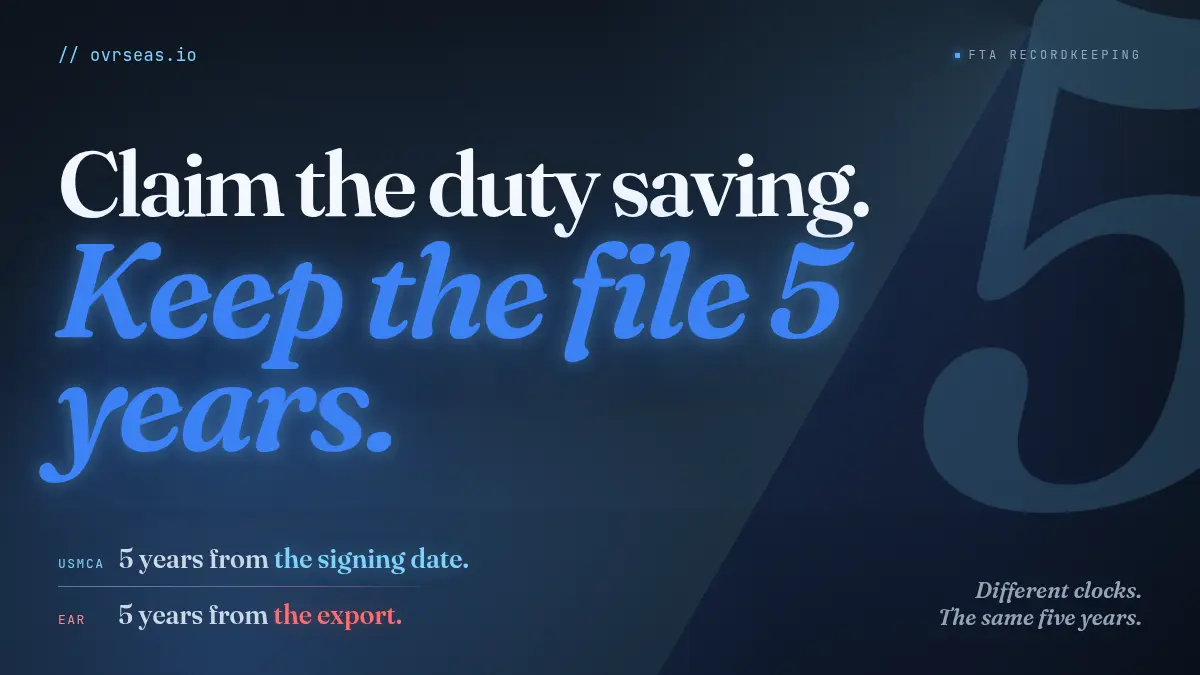
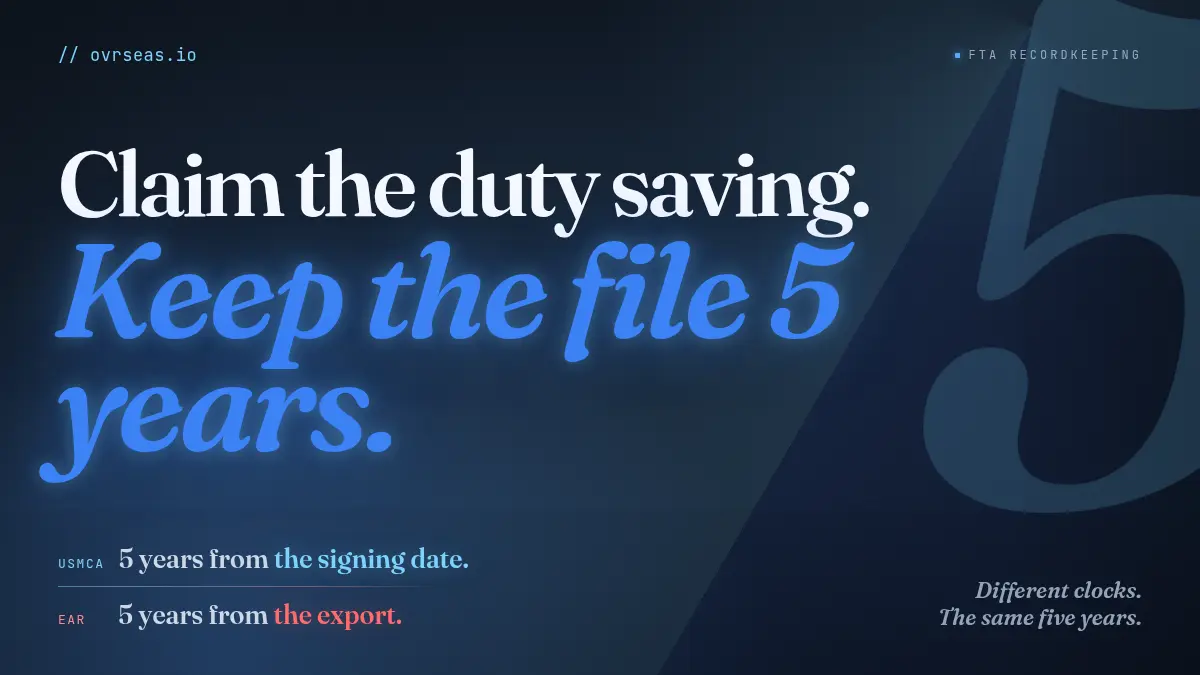
Five years, in every major U.S. case — but measured from a different event. USMCA runs five years from the date the certification of origin was signed. The Export Administration Regulations (EAR) run five years from the date of export (or a later event). The U.S.–Korea agreement (KORUS) also sets five years. Same number, three different start dates.
According to U.S. Customs and Border Protection, an exporter or producer who completes a USMCA certification of origin must keep the supporting records for five years from the date the certification was signed (19 CFR Part 182). Under KORUS, the exporter who issues the certification keeps records for five years as well (19 CFR §10.1009). And under the EAR, all parties to an export transaction — the U.S. principal party in interest, agents, and carriers — must keep records for five years from the latest of the export, any later reexport or transfer, or the termination of the transaction (15 CFR §762.6).
One more rule from the EAR is easy to miss: if another agency sets a longer retention period, the longer period wins. So treat five years as a floor, not a ceiling. For the broader picture of which export documents you must keep and for how long, see our guide to export recordkeeping requirements for U.S. exporters.
Which records actually count?
The certification itself is not enough. What customs wants is the evidence that the good actually met the origin rule — the cost, value, sourcing, and production records behind the claim. Keeping a clean copy of the certificate without the supporting file is the most common way a five-year archive fails.
For USMCA, CBP expects the certification plus records relating to the purchase, cost, value, shipping, and payment for the good; the same for every material used to produce it, including indirect materials; and records of the production of the good. The agency accepts these in various formats, including electronic. The point is coverage: if a verification letter asks how a part qualified, the answer has to be in the file.
For an FTA claim built on the regional value content or a tariff-shift rule, that means keeping the bill of materials, the origin status of each input, supplier statements, and the production math — not just the finished certificate. The nine USMCA data elements describe what goes on the certification; the supporting records are what proves each of those elements was true.
Why does claiming under multiple FTAs multiply the work?
Because each agreement is its own regime with its own origin rule, its own certification, and its own clock. Ship the same product to Canada under USMCA and to Korea under KORUS, and you are not keeping one record set — you are keeping two, qualified two different ways, retained from two different start dates.
The origin rule that made the good qualify can differ between agreements, so the supporting evidence differs too. A product that meets a USMCA tariff-shift rule might qualify under KORUS on a regional value calculation, which means a different set of cost records has to be on hand. The KORUS data elements are not the same list as the USMCA ones, and the duty you are claiming under each is governed by its own rule — the mechanics of claiming a preferential tariff sit on top of the recordkeeping.
Blanket certifications make this easier to issue but not easier to file. A blanket certification can cover up to twelve months of shipments of identical goods, so one document supports many entries — but the retention clock still runs from when that certification was signed, and the supporting records have to cover every shipment it certified.
What makes a retained file fail a verification?
Inconsistency. A verification does not just check that a document exists — it cross-reads the certification against the commercial invoice, the packing list, and the entry. If the description, quantity, value, or origin on one document contradicts another, the file undercuts its own claim, and the reviewer has a reason to deny the preference and reassess duty at the standard rate.
This is the quiet risk in a multi-agreement, multi-shipment archive: the documents are produced at different times, often re-typed from an older file, and small mismatches creep in. A certification that lists a product description the invoice does not match, a quantity that drifts between the packing list and the entry, a value that was updated on one document but not another — each is a thread a verification can pull.
The defense is consistency at the source. When the commercial invoice, packing list, and certification are all built from one shared shipment record instead of copied from last quarter's file, the retained set agrees with itself by construction. That is the slice of the problem document software for small exporters addresses — it keeps the documents you will have to retain consistent with each other; it does not file your records or judge your origin claim for you.
Your FTA recordkeeping checklist
- Set a five-year floor. Hold origin records at least five years, and longer if another agency’s rule applies to the same shipment.
- Date the clock correctly. USMCA runs from the certification’s signing date; the EAR runs from export or a later event. Tag each file with its own start date.
- Keep the evidence, not just the certificate. Cost, value, sourcing, supplier statements, and production records — for the good and its materials.
- Separate the file per agreement. A product shipped under two FTAs needs two record sets, qualified each agreement’s way.
- Reconcile before you retain. Check that the certification, invoice, and packing list agree on description, quantity, value, and origin.
- Store it so you can retrieve it. Electronic is fine; what matters is producing the full file if a verification letter arrives years later.
Frequently asked questions
How long must I keep USMCA records as an exporter?
Five years from the date you signed the certification of origin, under 19 CFR Part 182. That covers the certification and the cost, value, sourcing, and production records behind it.
Is the retention period the same for every FTA?
The major U.S. programs land on five years, but the start date differs. USMCA counts from the certification signing date; the EAR counts from export or a later event. If another agency requires longer, the longer period applies.
What records do I actually need to keep?
The certification plus the supporting evidence: purchase, cost, value, shipping, and payment records for the good and its materials, and the production records that show the origin rule was met — not just a copy of the certificate.
I ship the same product under two FTAs. Can I keep one file?
No. Each agreement has its own origin rule and certification, so you keep a separate, separately qualified record set for each, retained from each certification’s own date.

Related Articles
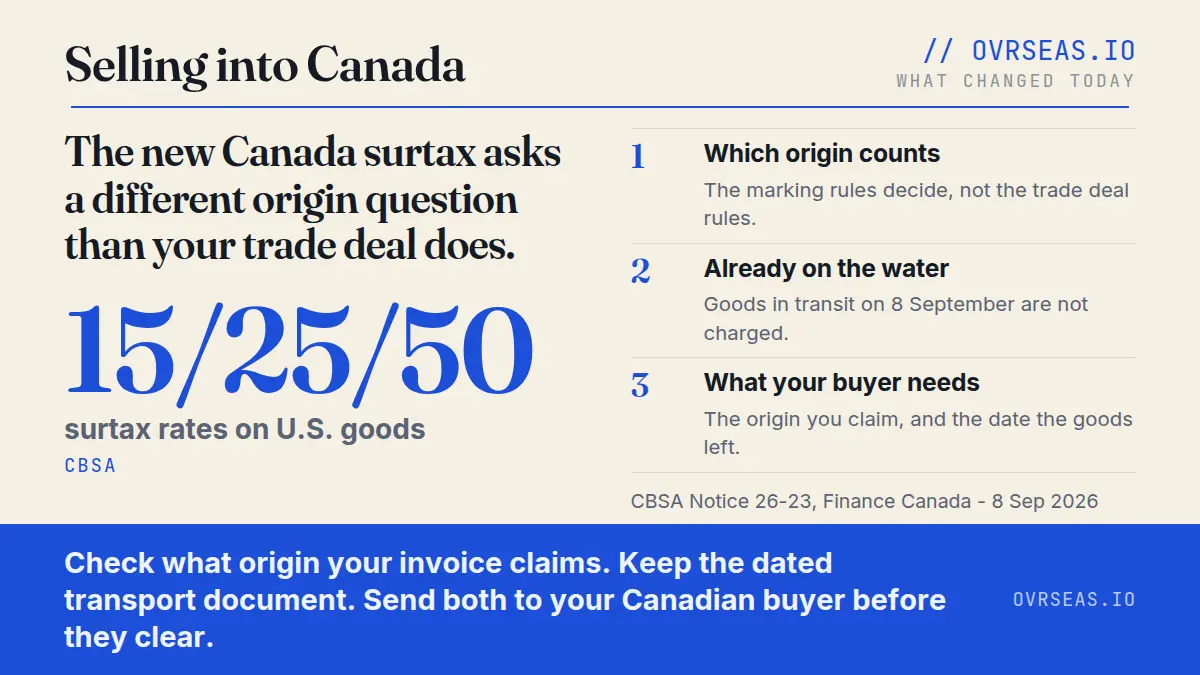
Canada's New Surtax on U.S. Goods: Which Origin Counts
Canada's 15/25/50% surtax on U.S. goods started 8 September 2026. It defines the goods by the marking rules, not your CUSMA preference claim — and the in-transit exception runs on dated transport documents.
EU Direct-Transport Proof (July 2026): What US Exporters Must Now Show
From 1 July 2026, US goods claiming the EU's adjusted duty treatment must prove direct transport. Here's the document-consistency check for small exporters.
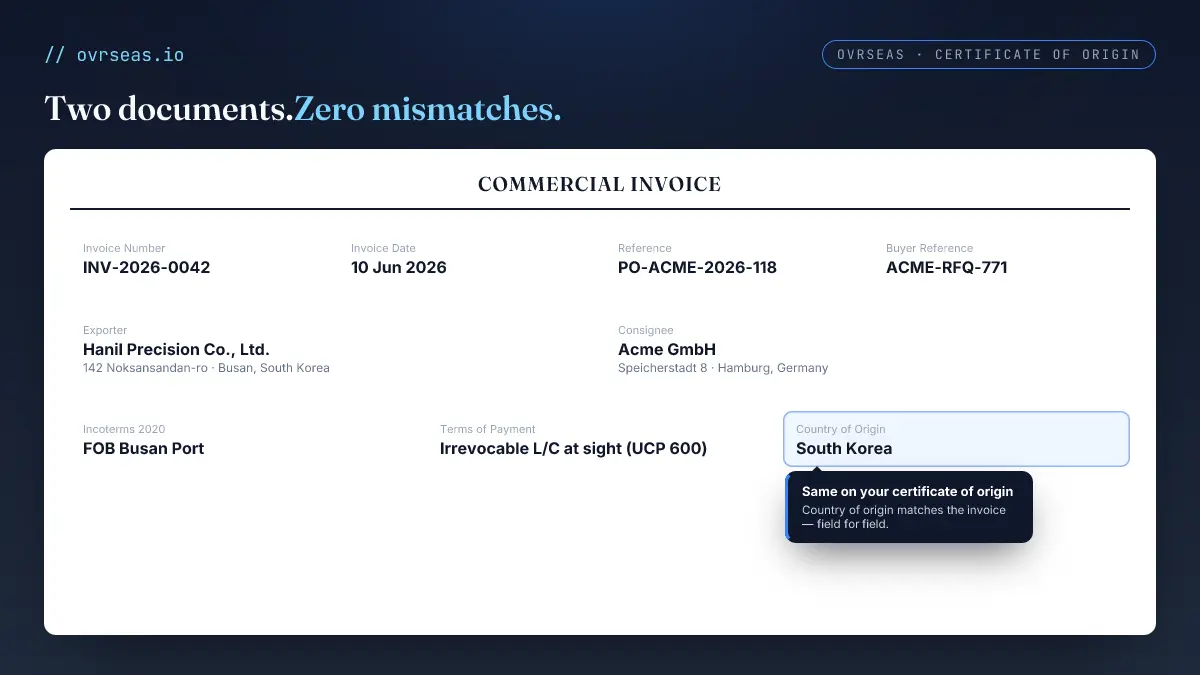
Certificate of Origin + Commercial Invoice: One Master File
Why a certificate of origin and commercial invoice must match — the shared fields, the customs risk, and how one master file keeps them consistent.
Ready to streamline your export documents?
Create Commercial Invoices, Packing Lists, and more in minutes. Enter data once, sync everywhere.
No credit card required · 14-day free trial