
FTA Preferential Tariffs: How to Claim Reduced Duty Rates
Your product qualifies for a free trade agreement. The tariff rate could be reduced or even zero. But customs charges the full rate anyway, because no one filed the right document.
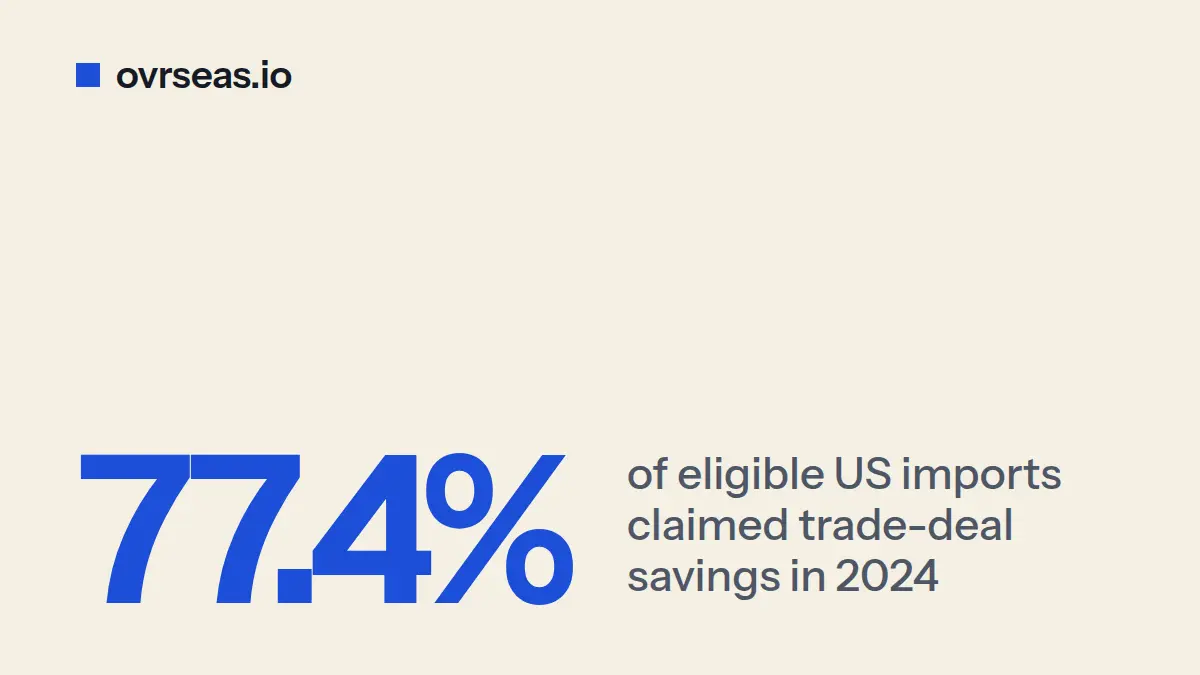
This happens more often than most traders expect. According to the U.S. International Trade Commission (USITC), only 77.4% of eligible U.S. imports claimed FTA preference in 2024. The rest paid the full most-favored-nation (MFN) rate. This guide covers what FTA preferential tariffs are, why so many companies miss them, and how to claim them on every shipment.
What is an FTA preferential tariff?
An FTA preferential tariff is a reduced or zero duty rate that applies when goods move between countries that have signed a free trade agreement. Instead of paying the standard MFN tariff, the importer pays a lower rate — sometimes nothing at all.
For example, under the U.S.-Korea Free Trade Agreement (KORUS), most industrial goods now enter the United States duty-free. Before KORUS, many of these products faced tariffs of 2.5% to 8%. According to U.S. Customs and Border Protection (CBP), KORUS eliminated duties on nearly 80% of bilateral trade in industrial and consumer goods when it took effect in 2012. The remaining tariffs were phased out over 10 years.
But here's the key point: these lower rates do not apply automatically. The importer must actively claim the preference at the time of entry. Without a claim, customs applies the standard MFN rate — no exceptions.
Why don't more companies claim FTA benefits?
Many eligible shipments enter at full duty simply because the importer never files for the preference. According to USITC data, the FTA utilization rate across all U.S. FTAs was 77.4% in 2024. That means roughly 1 in 5 eligible imports paid more duty than necessary.
In the European Union, the gap is even wider. According to a study by the Federation of German Industries (BDI), the average EU FTA utilization rate was 67% in 2021. Germany, responsible for 29% of extra-EU exports, had an even lower rate of 60%.
The BDI survey found that 53% of companies maintained trading relationships with FTA partner countries but did not use the agreements. The top reasons for skipping FTA benefits include:
Rules of origin complexity — each FTA has different qualifying criteria
Lack of internal capacity — no staff dedicated to trade compliance
Narrow tariff margins — the savings seem too small to justify the paperwork
Supplier doesn't provide origin documentation — the exporter never sends a Certificate of Origin
According to research published in ScienceDirect (2024), Switzerland — a country with one of the world's largest FTA networks spanning 33 agreements — sees over 25% of eligible imports enter without claiming preferences. That translates to approximately CHF 400 million in unrealized duty savings every year.
What documents do you need to claim FTA preference?
The core document is a Certificate of Origin (C/O). It certifies that the product meets the rules of origin under a specific free trade agreement. Without it, the importer cannot claim the preferential rate.
According to the International Trade Administration (ITA), the certificate must include specific data elements:
Name and contact information of the certifier
Product description and HS code (Harmonized System code)
The specific rule of origin the product meets (tariff shift, regional value content, or wholly obtained)
Blanket period if covering multiple shipments (up to 12 months)
Not all FTAs require a specific form. According to ITA, most U.S. FTA partners accept a written declaration containing the required data elements. However, the importer may request a specific format. The key is that the certificate must be on file when the preference claim is made.
For shipments under $2,500, the process is simpler. The exporter can indicate U.S. origin and FTA eligibility directly on the commercial invoice, according to CBP guidelines.
How do you check if your product qualifies under an FTA?
Qualifying for an FTA preference requires meeting the agreement's rules of origin (ROO). These rules confirm that the product was substantially produced or transformed within the FTA member countries. Each FTA has its own product-specific rules, and they vary by HS code.
There are three main types of origin criteria:
Wholly obtained or produced — the product is entirely grown, mined, or manufactured within the FTA region
Tariff shift — non-originating materials have been transformed enough to change their HS classification
Regional value content (RVC) — a minimum percentage of the product's value comes from within the FTA region
To check your product's eligibility, the U.S. Department of Commerce offers the FTA Tariff Tool at trade.gov. It covers all 14 active U.S. FTAs and shows the applicable preferential rate, the year tariffs phase out, and the product-specific rules of origin.
For a broader view, the International Trade Centre (ITC) offers the Rules of Origin Facilitator, which covers FTAs globally and is designed with small and mid-size businesses in mind.
According to WTO and ADB research, FTA preferences are rarely used when the tariff margin — the difference between the MFN rate and the FTA rate — falls below 5%. For products with margins above 5%, utilization rates are significantly higher. This suggests that companies should prioritize FTA claims on products with the largest duty gap first.
What happens if you miss the FTA claim at import?
If the importer does not claim FTA preference at the time of entry, customs applies the full MFN rate. But in many cases, you can still claim the benefit retroactively.
Under U.S. law, importers can file for a post-importation refund within one year of the original entry date. The process requires submitting the Certificate of Origin and a request for reliquidation to CBP. According to CBP regulations, the refund covers the difference between the MFN duty paid and the FTA preferential rate.
In the EU, the retroactive claim window varies by agreement but is typically up to three years from the date of import. The importer must provide a valid proof of origin issued at or before the time of export.
Key deadlines to remember:
United States — 1 year from date of entry for post-importation FTA claim
European Union — up to 3 years, depending on the specific FTA
South Korea — 1 year from date of import declaration, per Korean Customs Service regulations
Missing these deadlines means the overpayment becomes permanent. No appeal, no refund.
Checklist: How to claim FTA preferential tariffs
Identify whether an FTA exists between the origin country and the destination country
Check the product's HS code against the FTA's product-specific rules of origin
Determine which origin criterion applies: wholly obtained, tariff shift, or regional value content
Request a Certificate of Origin from the exporter or producer before shipment
Verify that the C/O contains all required data elements for the specific FTA
File the FTA preference claim at the time of import entry
Keep the C/O on file for at least 5 years for audit defense
If you missed the claim, file for a post-importation refund within the deadline
Fill the certificate of origin from your invoice
The goods, HS codes and parties on the certificate of origin come from the same shipment record as your commercial invoice and packing list.
No credit card required · 14-day free trial
Related Templates

Related Articles
EU Direct-Transport Proof (July 2026): What US Exporters Must Now Show
From 1 July 2026, US goods claiming the EU's adjusted duty treatment must prove direct transport. Here's the document-consistency check for small exporters.
FTA Recordkeeping: How Long to Keep Your Origin Records
Across the main U.S. programs, FTA origin records run five years, from a different start date each, and a separate file per agreement.
KORUS Certificate of Origin: Required Data Elements
KORUS has no official certificate of origin form. Here are the seven data elements (19 CFR 10.1004) needed to claim duty-free.