
USMCA Exemption Claims Surge to 85%: Why Filing Matters Now
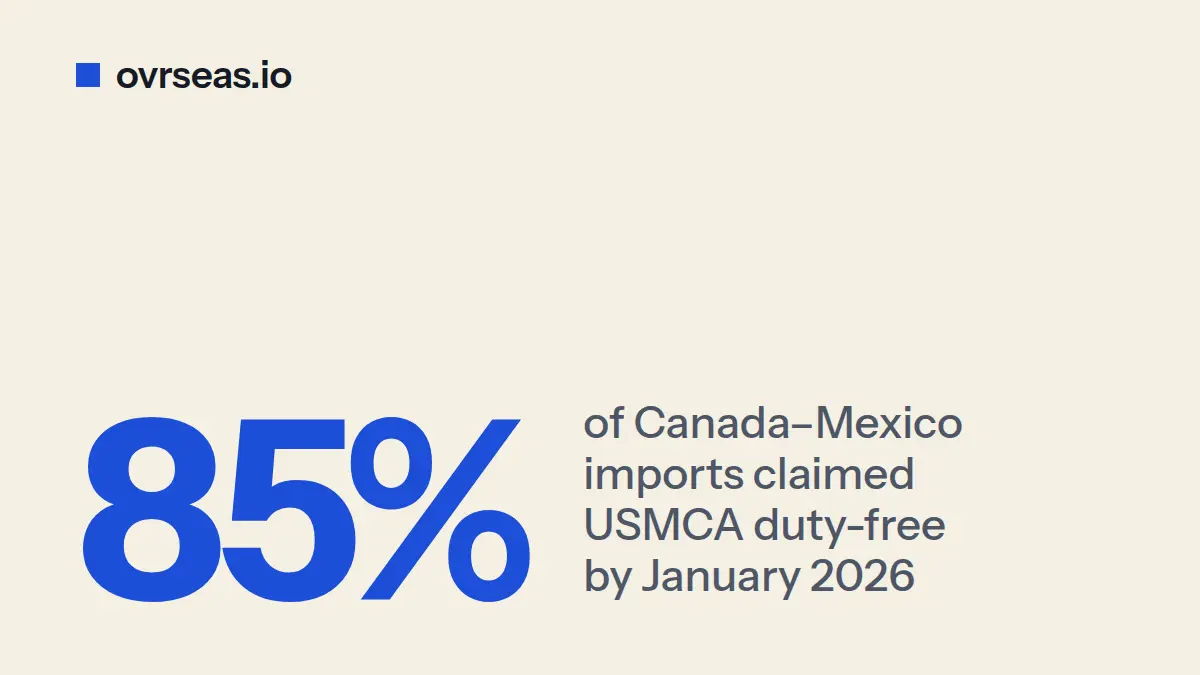
USMCA exemption claims have surged. By January 2026, 85% of all U.S. imports from Canada and Mexico claimed duty-free status under the United States-Mexico-Canada Agreement (USMCA), according to the Penn Wharton Budget Model. That share had been stable through late 2024 — likely under 40%.
The trigger was simple: tariffs on non-qualifying goods jumped more than fourfold in twelve months. Products that never justified the cost of a Certificate of Origin now save thousands per shipment. But the rush to file has created a second problem. CBP is increasing scrutiny, deploying AI targeting and False Claims Act enforcement against incorrect claims.
This guide covers why USMCA claims surged, what compliance actually requires, and how to avoid the penalties that come with getting it wrong.
Why Did USMCA Exemption Claims Surge to 85%?
USMCA exemption claims more than doubled because tariff rates on non-qualifying goods increased dramatically. The savings from filing became far larger than the compliance burden. Before the tariff hikes, the math often went the other way.
According to the Penn Wharton Budget Model (March 2026 update, based on USITC data), the share of U.S. imports from Canada and Mexico claiming USMCA exemption remained stable through late 2024. By January 2026, that share had reached 85% in aggregate.
BBVA Research reported a similar trajectory among Mexican exporters specifically: USMCA utilization jumped from 44.8% in January 2025 to 88.7% by November 2025, according to analysis published by Tetakawi.
On a $10 million annual import stream, the difference between qualifying for USMCA and not qualifying is now approximately $1 million per year under current tariff rates, according to Tetakawi's estimates. That number was a fraction of that before 2025.
What Changed in U.S. Tariff Rates?
The U.S. effective tariff rate rose from 2.3% in January 2025 to 10.3% by January 2026, according to the Penn Wharton Budget Model. That is a more than fourfold increase in twelve months. USMCA-qualifying goods maintained effective tariff rates below 5%, creating a widening gap between compliant and non-compliant imports.
The increase resulted from multiple overlapping tariff actions. Section 232 duties covered steel, aluminum, and semiconductors. IEEPA tariffs — later struck down by the Supreme Court in February 2026 and replaced by a 10% Section 122 surcharge — applied broadly to most imports. Section 301 duties on Chinese goods indirectly affected supply chains running through North America.
For importers, the math changed fast. A product with a 3% MFN rate that previously faced the same duty regardless of USMCA status might now carry an additional 10% surcharge if it does not qualify. On a $50,000 shipment, that is $5,000 in avoidable duty per entry.
Why Didn't Importers Claim USMCA Before?
Many importers chose not to file USMCA claims because the compliance cost exceeded the tariff savings. Preparing a Certificate of Origin requires determining rules of origin, calculating Regional Value Content (RVC), documenting sourcing, and maintaining records for five years. For products facing MFN duties of 2-3%, the duty savings on a typical shipment might be a few hundred dollars — not enough to justify the overhead.
According to legal firm Haynes Boone, importers may not have previously sought USMCA compliance because prior low rates of duty meant limited savings relative to compliance costs. The higher tariffs changed that calculation overnight.
The USMCA's rules of origin are also more complex than NAFTA's predecessor rules. Automotive parts require 75% Regional Value Content. Textiles must meet yarn-forward rules. Electronics may need to demonstrate tariff shifts at the heading or subheading level. Many small and mid-sized importers simply did not have the internal expertise to manage compliance cost-effectively — until the savings made it unavoidable.
What Happens If You File a USMCA Claim Incorrectly?
Incorrect USMCA claims can trigger penalties, back duties, loss of preferential treatment, and in serious cases, prosecution under the False Claims Act with potential treble damages. CBP has significantly expanded its enforcement capabilities heading into 2026.
According to ArentFox Schiff's 2026 customs outlook, five enforcement trends are converging: False Claims Act suits, civil penalties, criminal prosecutions, and AI-powered targeting. CBP is using AI supply chain mapping to detect transshipment and fraudulent origin claims.
The Department of Justice is also stepping up. Industry sources indicate that 2026 is expected to be the year of tariff enforcement, with the Trade Fraud Task Force specifically targeting misclassification, undervaluation, and improper USMCA claims, according to reporting by Sourcing Journal.
Even unintentional errors carry consequences. CBP can issue CF-28 requests for information on any entry. A failed origin verification can result in denial of preferential treatment retroactively across multiple shipments, plus interest and penalties. The more claims an importer files, the larger the potential exposure if documentation is incomplete.
What Does a Compliant USMCA Certificate of Origin Require?
A valid USMCA certification must include nine specific data elements listed in Annex 5-A of the agreement. These are: the type of certification, the certifier's identity, exporter information, producer information, importer information, a product description with its six-digit HS code (Harmonized System Code), the origin criteria claimed, the blanket period (if applicable), and an authorized signature with date.
Unlike NAFTA, the USMCA does not require a specific form. The certification can appear on an invoice, a letter, or any commercial document — as long as all nine elements are present and accurate. CBP provides an optional template, but it is not mandatory.
Key documentation requirements beyond the certification itself include:
Records supporting the rules of origin determination — bills of materials, production records, and sourcing documentation
Regional Value Content calculations where applicable
Supplier declarations confirming the origin of inputs
All records retained for five years from the date of importation in the U.S. (six years in Canada and Mexico)
Blanket certificates can cover multiple shipments of the same product over up to 12 months, reducing the per-shipment documentation burden. But the underlying origin analysis must be current and defensible for each covered period.
How Do You Know If Your Product Qualifies for USMCA?
A product qualifies for USMCA preferential treatment if it meets one of several origin criteria: it is wholly obtained or produced in a USMCA country, it meets the product-specific rule of origin (typically a tariff shift requirement, an RVC threshold, or both), or it qualifies under the de minimis rule allowing up to 10% non-originating content by value for most goods.
Product-specific rules are defined in USMCA Annex 4-B and vary significantly by category. Automotive parts require 75% Regional Value Content. Textiles must meet yarn-forward rules. Electronics may need tariff shifts at the heading or subheading level. Agricultural goods have their own set of criteria tied to production and harvesting location.
The critical distinction: "shipped from" a USMCA country is not the same as "originating in" one. A product assembled in Mexico from 100% Chinese components will not qualify simply because it was exported from Mexico. Substantial transformation must occur within the USMCA territory, and that transformation must meet the specific rule for that product's tariff classification.
For products with complex supply chains, a formal origin analysis is essential before filing any claim. CBP expects importers to perform due diligence and maintain documentation supporting their determination.
What Should Importers and Exporters Do Before Filing?
Start with an origin audit of your highest-volume products. Identify which items are likely to qualify based on their bill of materials, manufacturing location, and the applicable product-specific rule in Annex 4-B. Focus first on the products where the tariff savings are largest.
Build your documentation system before you file. Every claim must be supported by records that can withstand a CBP audit up to five years later. This includes supplier certifications, production records, RVC calculations, and the certification itself with all nine data elements.
Consider blanket certificates for products shipped repeatedly between the same parties. They reduce the per-shipment documentation burden while maintaining compliance. Update them annually or whenever sourcing changes.
Keep in mind that the USMCA's first six-year joint review is scheduled for July 1, 2026. Rules of origin may tighten, particularly for automotive, critical minerals, and electronics. Building a compliant process now protects against both current tariffs and future rule changes.
The window where ignoring USMCA was rational has closed. But the window where rushing a claim without proper documentation creates liability is wide open. Get the paperwork right before you file.
Frequently Asked Questions
What is the current USMCA exemption claim rate?
As of January 2026, approximately 85% of all U.S. imports from Canada and Mexico claim USMCA exemption, according to the Penn Wharton Budget Model based on USITC data. This share had been stable at a much lower level through late 2024.
Do USMCA-qualifying goods avoid the new tariff surcharges?
Yes. Goods that meet USMCA rules of origin are exempt from the additional tariffs imposed on Canadian and Mexican imports. Their effective tariff rate remains below 5%, compared to 10%+ for non-qualifying goods in January 2026 (Penn Wharton Budget Model).
What are the penalties for incorrect USMCA claims?
Penalties range from denial of preferential treatment and back duties to civil fines and, in cases of knowing fraud, treble damages under the False Claims Act. CBP can also impose heightened scrutiny on all future entries from the same importer.
How long must USMCA records be kept?
Importers in the United States must retain all records supporting USMCA claims for five years from the date of importation. In Canada and Mexico, the retention period is six years.
When is the USMCA review scheduled?
The first six-year joint review under the USMCA agreement is scheduled for July 1, 2026. The three countries will evaluate the agreement and decide whether to extend, modify, or allow it to enter a sunset period.
Fill the certificate of origin from your invoice
The goods, HS codes and parties on the certificate of origin come from the same shipment record as your commercial invoice and packing list.
No credit card required · 14-day free trial
Related Templates

Related Articles
Canada's New Surtax on U.S. Goods: Which Origin Counts
Canada's 15/25/50% surtax on U.S. goods started 8 September 2026. It defines the goods by the marking rules, not your CUSMA preference claim — and the in-transit exception runs on dated transport documents.

Certificate of Origin + Commercial Invoice: One Master File
Why a certificate of origin and commercial invoice must match — the shared fields, the customs risk, and how one master file keeps them consistent.
FTA Recordkeeping: How Long to Keep Your Origin Records
Across the main U.S. programs, FTA origin records run five years, from a different start date each, and a separate file per agreement.