
How to Fill Out a Commercial Invoice: Step-by-Step Guide for Exporters
Your commercial invoice is not just a billing document. It's the foundation for customs valuation, duty calculation, and regulatory compliance. One missing field or undeclared cost can trigger delays, audits, or penalties.
This guide walks you through each required field, explains why customs authorities care about them, and shows you how to avoid the most common mistakes.
What is a commercial invoice?
A commercial invoice is a legal document prepared by the exporter that records the transaction between the seller and buyer. Customs authorities use it to verify what's being imported, where it came from, and how much it's worth.
Unlike a proforma invoice (which is a preliminary quote), a commercial invoice reflects the actual sale. It serves three main purposes:
Customs clearance: Authorities use it to classify goods and calculate duties
Payment processing: Banks reference it for letters of credit
Record keeping: Both parties retain it as proof of the transaction
According to U.S. Customs and Border Protection (CBP), the commercial invoice must be prepared in the manner customary for a commercial transaction and contain information required under 19 CFR 141.86.
What information must a commercial invoice include?
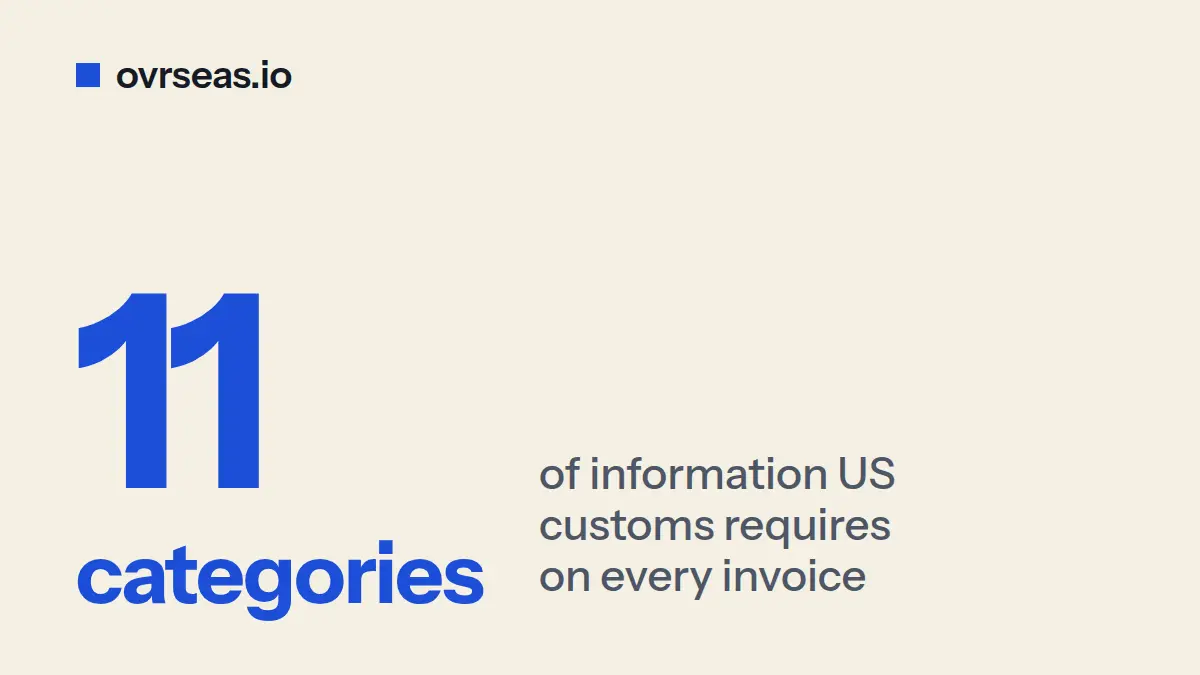
CBP regulations specify eleven categories of information that must appear on every commercial invoice. Missing any of these can delay your shipment or trigger additional scrutiny.
Here's what's required under 19 CFR 141.86:
Port of entry: The U.S. port where the goods will arrive
Seller information: Name and complete address of the foreign seller or shipper
Buyer information: Name and complete address of the purchaser or consignee
Detailed description: Commercial name, grade, quality, and identifying marks of each item
Quantity: Weights and measures (in the country of origin's units or U.S. units)
Purchase price: Price per unit in the currency of the transaction
Currency: The currency used for the transaction
Charges: Freight, insurance, packing costs, and any other charges
Rebates or discounts: Any allowances that reduce the price
Country of origin: Where the goods were manufactured or substantially transformed
Assists: Any goods or services furnished by the buyer for production, not included in the invoice price
That last item—assists—is where many importers run into trouble.
Why does the invoice price become the customs value?
Under the WTO Customs Valuation Agreement, the primary method for determining customs value is the transaction value. This is the price actually paid or payable for the goods when sold for export, plus certain adjustments.
According to the World Customs Organization (WCO), transaction value must be used as the customs value whenever possible. All WTO member countries apply this methodology.
The adjustments include:
Packing costs incurred by the buyer
Selling commissions paid by the buyer
Assists provided by the buyer
Royalties or license fees related to the goods
Proceeds from resale that accrue to the seller
This means your invoice price is only the starting point. If you provided tooling, materials, or design services to the manufacturer, those costs must be added to your declared customs value.
What are assists and why do they matter?
An assist is anything of value that you, the buyer, provide to the foreign supplier—free of charge or at reduced cost—for use in producing the imported goods. Under 19 CFR 152.103, assists must be added to the transaction value.
Common examples of assists:
Materials and components: Raw materials, parts, or packaging you ship to the factory
Tools, dies, and molds: Equipment you provide for manufacturing
Engineering and design: Drawings, specifications, or technical assistance
Development work: Prototyping or product development performed outside the country of import
Here's the problem: assists don't appear on the supplier's invoice. The factory only bills you for their services and the goods they ship. The mold you sent them six months ago? That's not on the invoice. But CBP expects you to declare it anyway.
According to the Braumiller Law Group, CBP Regulatory Auditors specifically look for undeclared assists by examining procurement records, shipping documents, and payments made outside regular invoice transactions.
Example: How undeclared assists add up
You send a $10,000 mold to your supplier in Vietnam. Over the next two years, they ship you $200,000 worth of finished goods. The mold never appears on any invoice.
If you apportion the mold value across all shipments, that's $10,000 in undeclared customs value. At a 10% duty rate, you owe $1,000 in unpaid duties plus interest.
Under 19 USC 1592, the penalty for negligence can reach 2 times the unpaid duties—so $2,000 on top of the $1,000 you already owe.
How to calculate and apportion assists
The value of an assist is generally its acquisition cost plus transportation to the production site. For a $10,000 mold shipped from the U.S. to Vietnam with $500 in freight, the assist value is $10,500.
You can apportion this value over:
The first shipment (pay all duties at once)
Units produced up to the first shipment
The entire anticipated production run
For example, if the mold will produce 10,000 units and your first shipment is 1,000 units, you could add $1,050 to that shipment's value, or $1.05 per unit across all shipments. The method must be consistent and documented.
What mistakes trigger customs issues?
Commercial invoice errors are among the most common causes of customs delays and penalties. Here are the most frequent problems:
Vague product descriptions
Terms like "goods," "samples," or "merchandise" are insufficient. CBP requires specific product names that match Harmonized Tariff Schedule classifications. A description like "electronic components" should be "integrated circuits, memory chips, part number XYZ-123."
Mismatched documents
When the quantity on your commercial invoice says 500 units, your packing list says 520, and your bill of lading says 500, customs flags the shipment for inspection. Cross-reference all documents before shipping.
Undeclared assists
As noted above, assists don't appear on supplier invoices. If you provide tooling, materials, or design work, you must track and declare these costs separately. CBP can audit entries up to five years back.
Incorrect country of origin
Country of origin refers to where goods were manufactured or substantially transformed—not where they shipped from. Declaring the wrong origin can result in incorrect duty rates or loss of free trade agreement benefits.
Missing signatures
Each commercial invoice must identify a responsible employee of the exporter who has knowledge of the transaction. A missing signature or responsible party name can cause CBP to reject the invoice.
What are the penalties for errors?
Under 19 USC § 1592, penalties depend on culpability and whether there was a loss of duty revenue.
If there is unpaid duty
Negligence: Up to 2 times the unpaid duties
Gross negligence: Up to 4 times the unpaid duties
Fraud: Up to the full domestic value of the merchandise
If there is no duty loss
Negligence: Up to 20% of the dutiable value
Gross negligence: Up to 40% of the dutiable value
Example calculation
You underdeclare $50,000 in customs value over 3 years. The duty rate is 10%, so you owe $5,000 in unpaid duties.
Negligence penalty: up to $10,000 (2x unpaid duties)
Gross negligence penalty: up to $20,000 (4x unpaid duties)
Plus interest from the original entry dates
Importers must keep all documentation—invoices, contracts, product specifications, and broker communications—for at least five years. Organized records make it easier to respond to CBP inquiries and demonstrate reasonable care.
Checklist: Before you send your commercial invoice
Use this checklist before finalizing any commercial invoice:
Seller and buyer names and addresses are complete and accurate
Product descriptions match the Harmonized Tariff Schedule classification
Quantities match the packing list and bill of lading
Unit prices and total value are correct and in the stated currency
Country of origin reflects where goods were manufactured, not shipped from
All assists (tooling, materials, designs) are documented and declared
Incoterms are clearly stated and consistent with the sales contract
A responsible party from the exporting company is named
The invoice is signed and dated
All information matches other shipping documents
The commercial invoice is the document customs authorities trust most. Getting it right protects both the exporter and importer from delays, audits, and penalties. When in doubt, verify with your customs broker before shipping.
Make the invoice and packing list match
Enter the shipment once. Quantities, packages and weights come out the same on the commercial invoice and packing list, with the fields customs asks for.
No credit card required · 14-day free trial
Related Templates

Related Articles
Mexico's Electronic Value Declaration Is Mandatory on 1 October — What Your Buyer Will Need From You
From 1 October 2026 your Mexican buyer files the customs value declaration electronically. Every input to that filing — invoice, contract, payment proof, Incoterm — comes from you.
Canada's New Surtax on U.S. Goods: Which Origin Counts
Canada's 15/25/50% surtax on U.S. goods started 8 September 2026. It defines the goods by the marking rules, not your CUSMA preference claim — and the in-transit exception runs on dated transport documents.
CBP's Rail Export Manifest Rule: What Has to Be Right 24 Hours Before Departure
CBP's final rule for rail export manifests takes effect 26 October 2026. The initial filing is due 24 hours before departure, and six of its seven mandatory fields come off your own shipment documents.