
Section 122 Tariff: Why You Still Pay 10% After SCOTUS
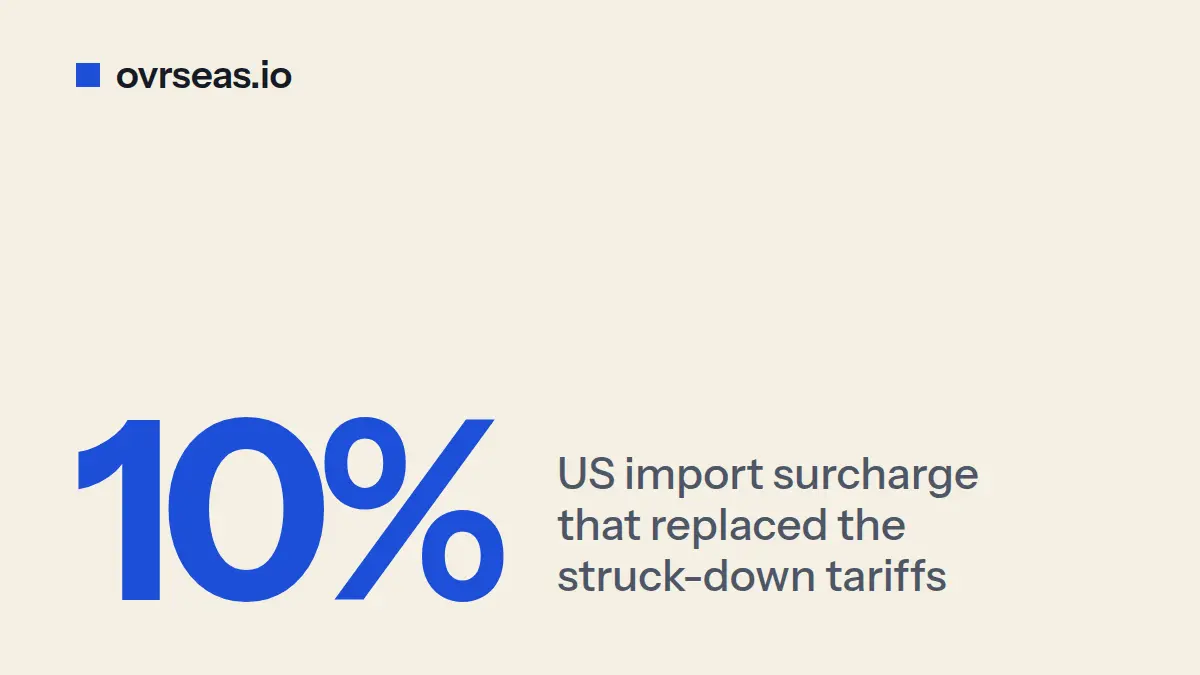
On February 20, 2026, the Supreme Court struck down every tariff imposed under the International Emergency Economic Powers Act (IEEPA). Within hours, the White House replaced them with a new 10% global surcharge under Section 122 of the Trade Act of 1974. If you import goods into the United States, you are still paying additional duties — just under a different legal authority.
This article explains what Section 122 is, how it differs from IEEPA, which products are exempt, and what happens when the surcharge expires on July 24, 2026.
What Is the Section 122 Import Surcharge?
Section 122 of the Trade Act of 1974 (19 U.S.C. § 2132) authorizes the President to impose a temporary import surcharge when the United States faces a serious balance-of-payments deficit. The surcharge is capped at 15% ad valorem and limited to 150 days unless Congress votes to extend it.
According to the White House Fact Sheet (February 20, 2026), the proclamation imposed a 10% ad valorem duty on articles imported into the United States, effective February 24, 2026. The stated justification was the country's large and persistent trade deficit and balance-of-payments pressures.
As of April 2026, the rate remains at 10%. President Trump announced an intent to raise it to the statutory maximum of 15%, but according to the Fleischer Group (March 30, 2026), no formal proclamation has been issued to implement the increase.
Why Did Section 122 Replace IEEPA?
The Supreme Court's decision in Learning Resources, Inc. v. Trump (No. 24-1287, February 20, 2026) held in a 6-3 ruling that IEEPA does not authorize the President to impose tariffs. This invalidated the entire IEEPA tariff regime — including the reciprocal tariffs, the fentanyl-related tariffs on Canada, Mexico, and China, and the country-specific rates that had been negotiated through bilateral trade deals.
The administration responded within hours. According to Snell & Wilmer, the administration invoked Section 122 because it specifically contemplates tariff authority, unlike IEEPA, which the Court found did not. Section 122 provided a rapid, legally defensible mechanism to maintain import duties while the administration developed longer-term tariff strategies under Sections 301 and 232.
How Does Section 122 Differ from IEEPA Tariffs?
Section 122 differs from the invalidated IEEPA tariffs in three fundamental ways, each of which directly affects how importers calculate landed costs.
Uniform rate, no country-specific targeting. Under IEEPA, rates varied widely by country. According to Snell & Wilmer, Chinese imports faced rates as high as 145%, while countries with bilateral agreements had negotiated lower rates. Section 122 requires "broad and uniform application" — the same 10% applies to imports from every country.
Rate cap and time limit. IEEPA had no statutory cap on rates and no built-in expiration. Section 122 is capped at 15% ad valorem and expires after 150 days. The current surcharge expires on July 24, 2026, unless Congress passes legislation to extend it.
No stacking with Section 232. Products already subject to Section 232 tariffs — steel (50%), aluminum (50%), automobiles (25%), semiconductors (25%) — are exempt from the Section 122 surcharge. Under IEEPA, duties stacked on top of Section 232 tariffs, creating combined rates that exceeded 50% for many products.
Which Products Are Exempt from Section 122?
The proclamation includes several categories of exemptions, detailed in Annex I and Annex II. According to CBP's CSMS guidance (February 23, 2026), the following are not subject to the 10% surcharge:
USMCA-qualifying goods. Articles entering duty-free under the United States-Mexico-Canada Agreement remain exempt, provided the importer properly claims USMCA preferential treatment. This makes USMCA qualification more valuable now than at any point since the agreement took effect.
Section 232 products. Steel, aluminum, copper, lumber, automobiles, automobile parts, and semiconductors already subject to Section 232 duties are excluded. The surcharge does not stack on top of existing Section 232 rates.
Annex I and II products. These include pharmaceuticals, certain critical minerals, energy products, fertilizers, civil aircraft and parts, and specific agricultural goods. According to Global Trade Alert, over 90% of the Annex II exemptions mirror those that were previously exempt under the IEEPA tariff regime.
CAFTA-DR textiles. Qualifying textile and apparel products from Costa Rica, Dominican Republic, El Salvador, Guatemala, Honduras, and Nicaragua are exempt.
What Happens When Section 122 Expires on July 24?
Section 122 authority is strictly time-limited. The 150-day clock started on February 24, 2026, and expires on July 24, 2026. Congress must vote to extend the surcharge beyond that date — and according to Plante Moran (March 2026), extension faces significant political hurdles given bipartisan concern about consumer price inflation.
The administration has signaled its next moves. According to White & Case (March 2, 2026), the two-stage strategy uses Section 122 for rapid short-term action while developing Section 301 tariff orders, which require more time but face no practical time or rate constraints once enacted.
As of mid-March 2026, the administration is running two sweeping Section 301 investigations covering structural excess manufacturing capacity (targeting 16 major trading partners) and forced-labor enforcement (covering 60 economies). Additionally, according to Plante Moran, there are 12 active or recently initiated Section 232 investigations covering metals, vehicles, and manufactured products.
The practical implication: the 10% flat rate may expire, but what replaces it could be higher and more targeted.
What About IEEPA Refunds?
If your company paid IEEPA duties during 2025 or early 2026, you may be entitled to refunds. According to Plante Moran, on March 4, 2026, the Court of International Trade (CIT) issued an order requiring CBP to liquidate all unliquidated entries without IEEPA duties and re-liquidate any liquidated entries still within the 180-day protest period. These overpayments flow back through the normal liquidation or re-liquidation refund mechanism.
The relief applies broadly to all importers. However, Section 122 duties paid going forward do not carry the same refund pathway — unless the Section 122 surcharge itself is later ruled invalid by a court. Two lawsuits challenging the surcharge are currently pending at the CIT, with oral arguments scheduled for April 10, 2026.
What Should Importers Do Before July 24?
The 150-day window creates urgency. Here is what to prioritize:
Review USMCA qualification for every product sourced from Canada or Mexico. USMCA-qualifying goods are exempt from the 10% surcharge, making qualification worth more now than under the previous IEEPA regime.
File IEEPA refund claims if your entries are within the protest window. The CIT order covers all importers, but you need to confirm your entries qualify.
Model landed costs under multiple scenarios — Section 122 expiration, Section 301 replacement tariffs, expanded Section 232 coverage. The flat 10% may be replaced by targeted rates that are higher for specific products or countries.
Audit HTS classifications. Under a uniform 10% rate, classification errors have a smaller financial impact. Under targeted Section 301 or 232 tariffs, the wrong HTS code could mean a dramatically different duty rate.
Key Takeaways
Section 122 surcharge: 10% ad valorem on most imports, effective February 24, 2026.
Statutory limits: 15% rate cap, 150-day maximum, expires July 24, 2026.
Exempt: USMCA goods, Section 232 products, Annex I/II items, CAFTA-DR textiles.
IEEPA refunds: CIT ordered CBP to process refunds for all affected importers.
What comes next: Section 301 and 232 investigations are ongoing; replacement tariffs could be higher and product-specific.
Enter a shipment once. Get every document.
Commercial invoice, packing list, certificate of origin and more — filled from one shipment record, so the shared fields always match.
No credit card required · 14-day free trial

Related Articles
BIS Affiliates Rule 2026: Why CSL Screening Alone Won't Work
The BIS Affiliates Rule snaps back on November 10, 2026. CSL screening alone won't cover 50%-owned affiliates. Here's what changes and what to do.
EU Customs Reform 2026: What Changes for Exporters
The EU just agreed to its biggest customs reform since 1968. Here's what changes for exporters shipping to Europe.
HS 2028 Update: 299 Amendments Changing Your Product Codes
HS 2028 brings 299 amendments to the global trade classification system. Here's what exporters need to check before January 1, 2028.