
Mexico's Electronic Value Declaration Is Mandatory on 1 October — What Your Buyer Will Need From You
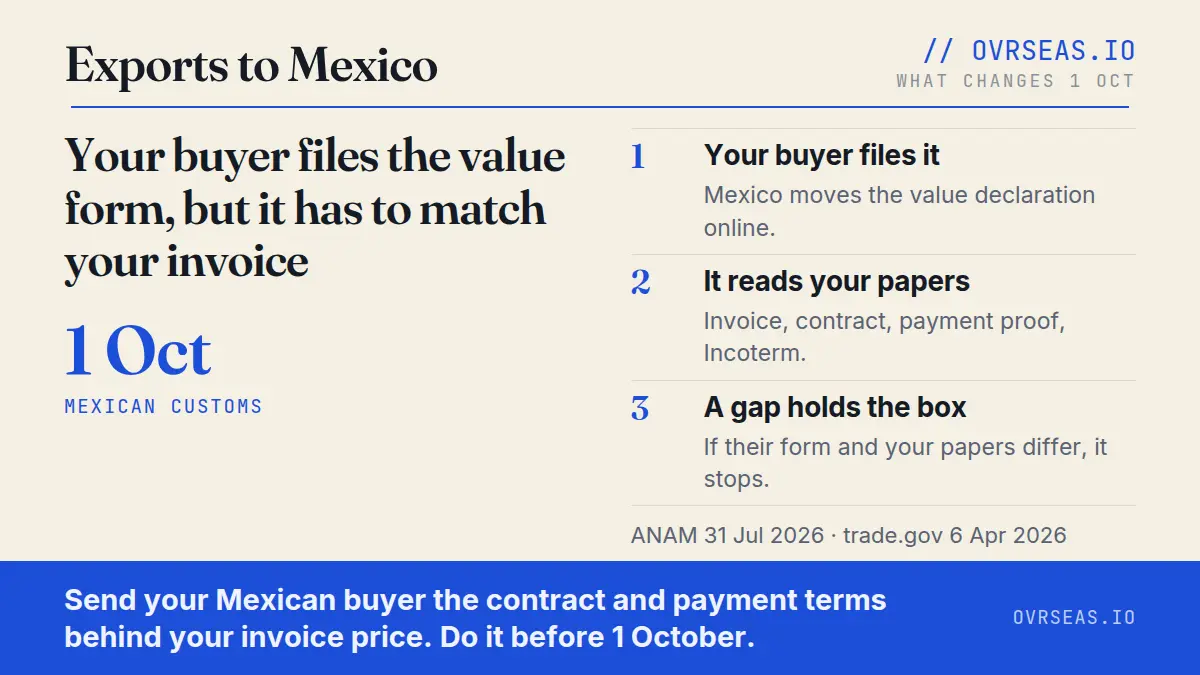
On 1 October 2026, Mexico stops accepting the old way of declaring customs value. From that date the Manifestación de Valor — the declaration that explains how the customs value of an import was arrived at — has to be transmitted electronically. It is called the MVE, for Manifestación de Valor Electrónica.
Read that and it sounds like somebody else's problem. The MVE is filed by the Mexican importer. You are the exporter. You do not touch the form.
That is exactly why it is worth ten minutes of your time. The filing is your buyer's. The paperwork it is checked against is yours. If the numbers your buyer declares do not line up with the invoice and contract you sent them, the container that gets held is the one you shipped.
What actually changes on 1 October 2026?
Mexico's tax authority (SAT) and its customs agency (ANAM) announced on 31 July 2026 that the deadline was being pushed back again. The official joint release says, in Spanish: "el plazo para presentar la Manifestación de Valor Electrónica (MVE) se amplía al 30 de septiembre de 2026" — the deadline to file the MVE is extended to 30 September 2026. (ANAM, joint press release, 31 July 2026.)
The practical reading is the one Holland & Knight published three days later: the deadline "has been extended until September 30, 2026", with mandatory electronic transmission postponed to 1 October 2026 (Holland & Knight, 3 August 2026).
The change itself is not new law about what value has to be declared. Mexican importers have always had to be able to justify the customs value. What changes is that the justification becomes a structured electronic filing instead of a document kept in a folder. Structured filings get compared to other structured filings. That is the whole point of moving it online.
One honest caveat: this date has moved before. It has been postponed more than once during 2026, and the relief has always arrived through amendments to Mexico's General Foreign Trade Rules published on the SAT portal. If you are reading this well after September 2026, check whether another extension landed before you act on the date.
Who has to file it — and why does it reach you?
The obligation sits with the importer of record in Mexico. Your buyer, or their customs broker, transmits it.
But the MVE is not a summary. It is a reconstruction of the commercial deal. The US International Trade Administration describes the content plainly: Mexico "requires importers to submit an Electronic Value Manifest (MVE) … before goods enter Mexico, containing customs value, Incoterms, payment terms, contracts, and proof of payment" (trade.gov market intelligence, 6 April 2026).
Look at that list again. Customs value. Incoterms. Payment terms. Contracts. Proof of payment. Your buyer does not originate a single one of those. Every item on that list is something you wrote, signed, or agreed to. Your buyer is being asked to declare, in a government system, the contents of documents that live on your side of the transaction.
What will my Mexican buyer ask me for?
The same US government page spells out what it expects exporters to be able to hand over:
- "Commercial invoices with precise valuation" — not a round number, and not a figure that drifts from the contract.
- "Formal sales contracts or purchase agreements" — the written basis for the price, including how it was set.
- "Proof of payment (wire transfers or credit instruments)" — evidence the money actually moved the way the invoice says.
- "Detailed Incoterm definitions" — which costs are inside the price and which are not.
If you sell to Mexico on open account with a one-page invoice and a purchase order by email, that is where this bites. Nothing about that is illegal. It is just that a pile of informal documents is hard to reconcile against a structured filing, and reconciliation is now automatic.
What goes wrong when the documents disagree?
The ITA page states the failure mode directly: "Inconsistencies between U.S. export documentation and the Mexican importer's MVE may result in the holding of shipments, customs audits, or entry delays." The same page puts fines at up to MXN 106,970 per transaction under Mexico's Customs Law.
Note who absorbs each consequence. The fine lands on the importer. The held container, the missed delivery date, the customer who stops ordering — those land on you. This is the asymmetry that makes the MVE an exporter problem even though it is an importer obligation.
The disagreements that cause this are usually small and boring:
- The invoice shows a net price after a discount; the contract shows the gross price and the discount as a separate clause.
- Freight and insurance are inside the price under one Incoterm on the invoice, and itemised separately on the packing documents.
- A commission or royalty is paid outside the invoice and never appears in any document your buyer holds.
- The parties are related and nobody said so.
- Partial shipments are invoiced against a single contract, and the quantities no longer add up to the contract total.
None of these are fraud. They are the ordinary untidiness of documents written at different times by different people, which is invisible until something reads them side by side.
Is there any relief before the deadline?
Yes, and it is worth knowing about because it changes what you need to send.
Through 31 December 2026, importers may submit Form E15 — "Information on Contracts Associated with the Customs Value Declaration" — carrying general information about the transaction's contracts, instead of transmitting the complete contracts. Holland & Knight quotes the provision: importers may choose to submit Form E15 "including the general information related to the transaction's contracts, without the need to transmit the complete contracts."
The ANAM release adds a second relief in the same window: transport documents, origin documentation and guarantee evidence need not be transmitted separately when they are already attached to the customs entry filing.
What this means for you: between 1 October and 31 December 2026, your buyer needs the key terms of your contract in a form they can retype into a government field — parties, dates, price basis, payment terms, Incoterm. After that window, expect requests for the documents themselves.
What should I do before 1 October?
Four things, none of which require a lawyer.
1. Pull your last three invoices to Mexico and read them next to the contract or PO they came from. Do the price, currency, quantity, Incoterm and payment terms match, word for word? If you have to explain a difference out loud, your buyer will have to explain it to customs.
2. Write down where each number comes from. If your price includes freight to a named place, say which place. If there is a discount, say what it is for. The MVE asks how the value was determined, not just what it is.
3. Ask your buyer what they still need. One email: "You will be filing the MVE from 1 October. What do you need from us that you do not already have?" Their broker will have a list. It is cheaper to answer that email now than to answer it with a container at the border.
4. Fix the source, not the copies. If your invoice, packing list and certificate of origin are three separate files that each get edited by hand, they will drift — not because anyone is careless, but because three files always drift.
Where ovrseas fits
That last point is the part we built for. In ovrseas, a shipment is one master record: parties, terms, Incoterm, items, values. The commercial invoice, packing list, proforma and certificate of origin all read from that record, so the price on the invoice and the price your buyer quotes back to customs come from the same place instead of from three files that were last edited on different days.
It does not file anything in Mexico, and it does not decide your customs value for you. It removes one specific failure — the version of a number that only exists in one document — which happens to be the failure the MVE is built to catch.
Sources: ANAM / SAT joint press release, 31 July 2026 · US International Trade Administration, Mexico Customs Valuation Enforcement, 6 April 2026 · Holland & Knight, 3 August 2026. This is general information about a documentation change, not customs or legal advice; your Mexican importer and their broker own the filing.

Related Articles
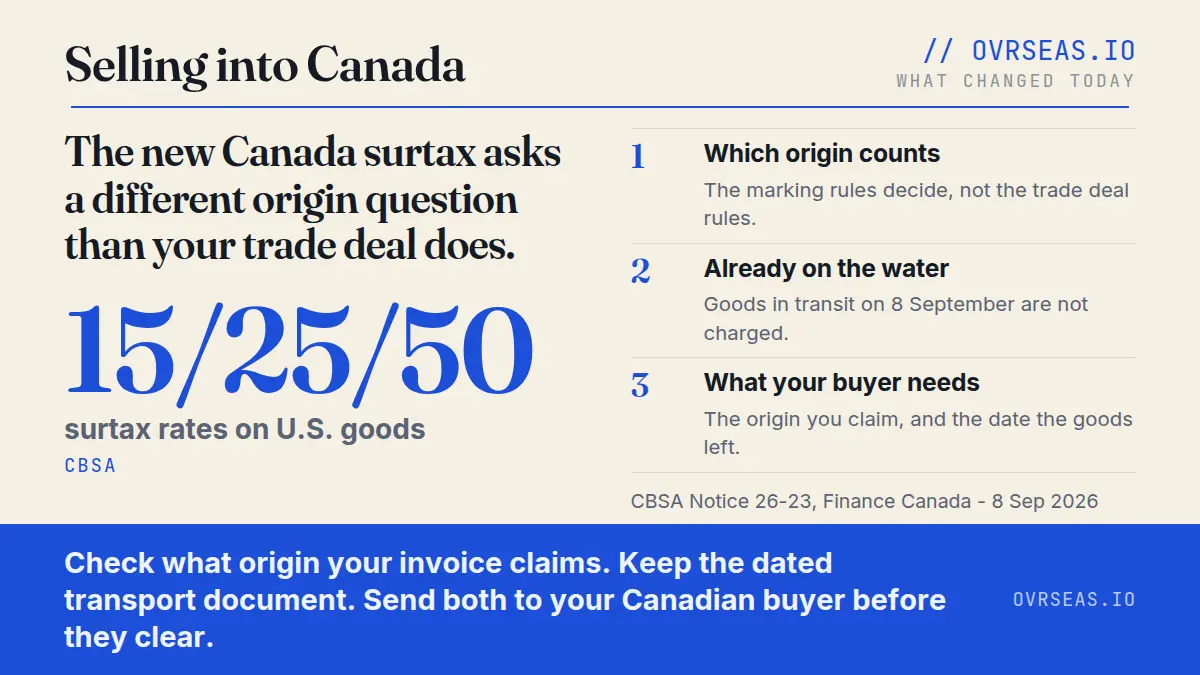
Canada's New Surtax on U.S. Goods: Which Origin Counts
Canada's 15/25/50% surtax on U.S. goods started 8 September 2026. It defines the goods by the marking rules, not your CUSMA preference claim — and the in-transit exception runs on dated transport documents.
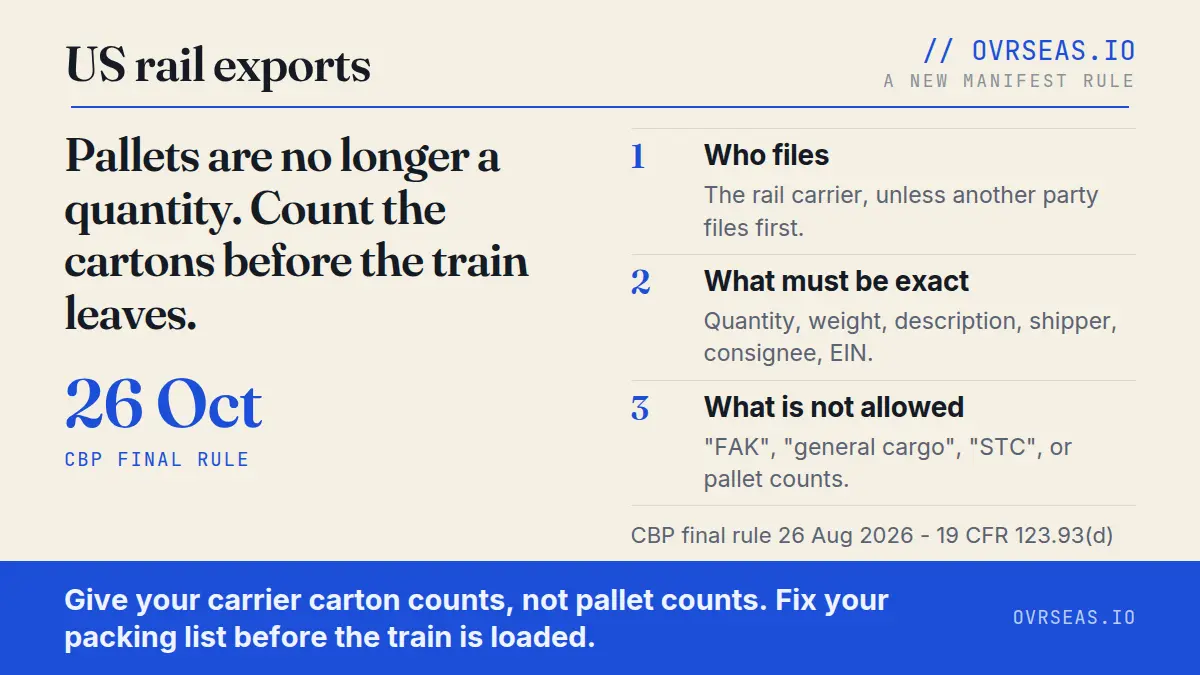
CBP's Rail Export Manifest Rule: What Has to Be Right 24 Hours Before Departure
CBP's final rule for rail export manifests takes effect 26 October 2026. The initial filing is due 24 hours before departure, and six of its seven mandatory fields come off your own shipment documents.
EU Direct-Transport Proof (July 2026): What US Exporters Must Now Show
From 1 July 2026, US goods claiming the EU's adjusted duty treatment must prove direct transport. Here's the document-consistency check for small exporters.
Ready to streamline your export documents?
Create Commercial Invoices, Packing Lists, and more in minutes. Enter data once, sync everywhere.
No credit card required · 14-day free trial