
L/C Document Rejection: Common Discrepancies and Prevention
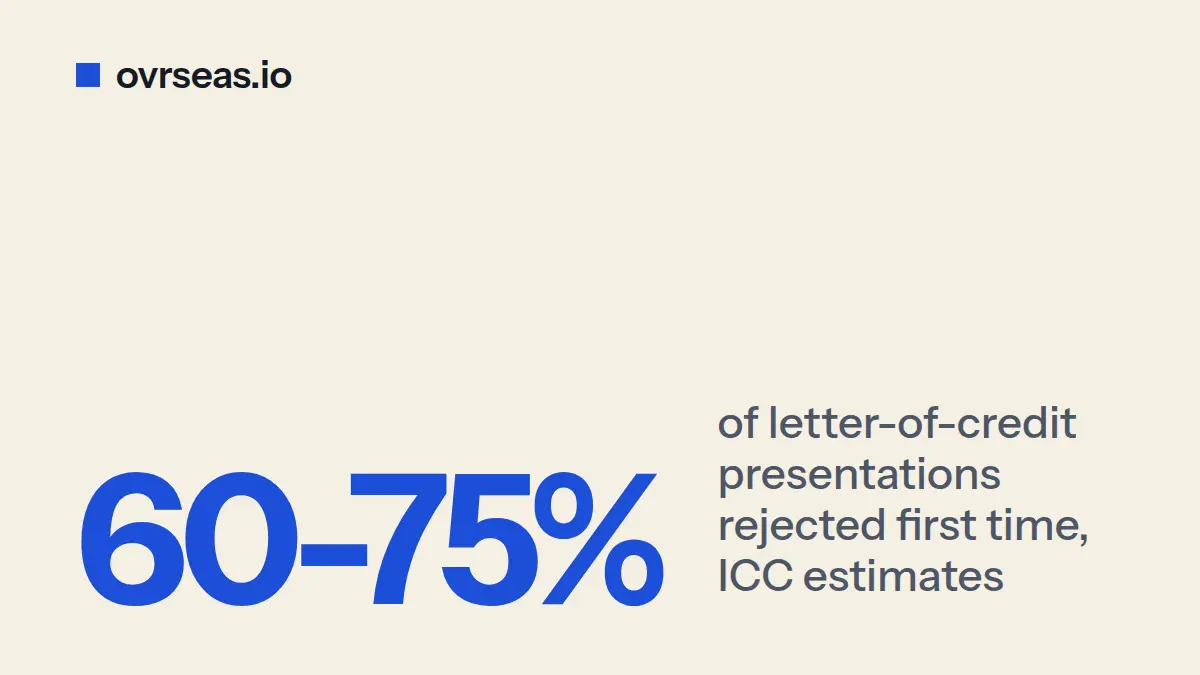
You shipped the goods. You submitted every document the letter of credit required. Then the bank refused your presentation. Not because something was missing — because something didn't match. According to ICC estimates, 60-75% of L/C document presentations are rejected on first submission. That means most exporters don't get paid on the first try. This article explains why banks reject L/C documents, what the most common discrepancies are, and how to prevent them.
What Does "L/C Document Rejection" Mean?
When a seller ships goods under a letter of credit (L/C), the seller must present a set of documents to the bank. These typically include a commercial invoice, packing list, bill of lading, and certificate of origin. The bank then checks whether every detail in those documents matches the terms of the L/C — exactly.
If something doesn't match, the bank issues a refusal notice listing the discrepancies. This is not a judgment call. Under UCP 600 — the ICC rules governing documentary credits — banks apply what's called strict compliance. They don't interpret intent. They match data. A singular noun versus a plural noun. A period versus a comma in an address. A unit price that's off by one cent. Any of these can trigger rejection.
Rejection doesn't always mean you won't get paid. But it does mean delays, extra bank fees, and — in the worst case — your buyer now decides whether to waive the discrepancy or walk away.
How Often Do L/C Documents Get Rejected?
According to ICC estimates, between 60% and 75% of documentary credit presentations are refused on first submission. The ICC Academy puts the range at 65-75%. Dave Meynell, ICC Banking Commission Senior Technical Advisor, has cited figures as high as 65-80% depending on the region. These numbers have remained consistent for decades.
One of the most striking facts: UCP 600 came into effect in 2007, replacing UCP 500. The new rules were supposed to simplify documentary requirements and reduce discrepancies. According to Meynell, writing in Documentary Credit World in 2024, the rejection rate has not improved since UCP 600 was introduced.
The ICC 2015 Global Trade Finance Survey found that 34.4% of respondents reported an increase in refusal rates. The problem isn't getting better.
Why Do Banks Reject L/C Documents?
Banks reject documents for one reason: the presentation does not comply with the terms of the credit. Under UCP 600, compliance means exact data matching across every document. Here are the most common causes of rejection.
Inconsistent data between documents. Your commercial invoice describes goods as "stainless steel bolts, Grade A." Your packing list says "SS bolts, Gr. A." Your bill of lading says "steel bolts." To a human, these describe the same product. To a bank examiner applying strict compliance, these are three different descriptions — and that's a discrepancy.
Quantity or weight mismatches. Your invoice says 10,000 units. Your packing list says 10,000 units. But the total net weight on the packing list doesn't match the weight stated on the bill of lading. Even if the difference is caused by rounding, the bank will flag it.
Late presentation. Under UCP 600, documents must be presented within 21 days of the shipment date, unless the L/C specifies otherwise. Miss that window — even by one day — and the bank will refuse the entire presentation.
Missing or incorrect signatures. A draft without a signature. A certificate of origin not stamped by the correct chamber. An invoice not issued on the beneficiary's letterhead. These seem like formalities, but under strict compliance, they are grounds for rejection.
Transport document errors. The bill of lading shows a port of loading that doesn't match the L/C requirement. Or the B/L indicates "freight collect" when the L/C specifies "freight prepaid." Or the notify party details are wrong. Each one is a discrepancy.
What Happens After Your Documents Are Rejected?
When a bank refuses your presentation, you have three options under UCP 600. None of them is free.
Option 1: Correct and resubmit. If the discrepancy is something you can fix — a revised invoice, a corrected certificate — you can amend the documents and present them again. But you must still meet the L/C expiry date and the presentation deadline. If time has run out, this option disappears.
Option 2: Request a waiver. You can ask the nominated bank to contact the issuing bank and request that the buyer (applicant) waive the discrepancies. If the buyer agrees, the bank honors the payment. But now your payment depends on your buyer's goodwill — the exact risk the L/C was supposed to eliminate.
Option 3: Send documents on approval. You forward the documents to the issuing bank and hope they accept. This is the riskiest path. If the buyer doesn't waive, you've shipped goods with no guarantee of payment.
Every option adds days or weeks to your payment timeline. Bank fees for handling discrepant documents typically add $50-$250 per presentation. And the reputational cost — being known as a seller who can't present clean documents — can affect future L/C terms.
Why Does This Matter More Than Customs Delays?
Most exporters focus on customs compliance when they think about document accuracy. And that makes sense — customs delays cost money in demurrage, storage, and missed delivery windows.
But L/C discrepancies hit differently. A customs delay slows your shipment. An L/C rejection delays — or blocks — your payment. The goods may have already arrived at the destination port. The buyer may already have the cargo. But you still don't have your money.
For small and mid-size exporters, cash flow is everything. A two-week payment delay caused by a discrepant L/C presentation can create a chain reaction: late supplier payments, missed production schedules, strained banking relationships.
The SITPRO study estimated that documentary discrepancies under letters of credit cost UK exporters £113 million in the year 2000 alone (SITPRO Ltd, 2003). That figure covered just one country in one year. The global cost is far higher.
What Are the Most Common L/C Discrepancies?
Industry sources and ICC opinions consistently identify the same recurring problems. Here are the discrepancies that appear most often.
Description of goods mismatch. The product description on the invoice must match the L/C word for word. Abbreviations, synonyms, or reworded descriptions all count as discrepancies. If the L/C says "100% cotton t-shirts, white, size M," your invoice must say exactly that — not "white cotton tees" or "medium white t-shirts."
Document amounts don't reconcile. The total invoice value must match the L/C amount. If the L/C allows partial shipment, the math must still add up — unit price times quantity must equal the line total, and line totals must equal the invoice total. A one-cent rounding error can trigger rejection.
Inconsistent data across documents. UCP 600 requires that data in one document must not conflict with data in any other document presented under the same credit. This means the shipper name, consignee, port of loading, weight, and quantity must be consistent across your invoice, packing list, B/L, and every other document.
Late shipment or late presentation. If the L/C specifies a latest shipment date and your B/L shows a date one day later, that's a discrepancy. Same for the presentation deadline — 21 days from shipment, or whatever the L/C states.
Missing required documents. The L/C may require documents you don't normally prepare — an inspection certificate from a specific agency, a fumigation certificate, or a beneficiary certificate with specific wording. If any required document is missing, the entire presentation fails.
How Do You Prevent L/C Document Rejections?
The root cause of most L/C discrepancies is not carelessness. It's the workflow. When each document is created separately — invoice in one spreadsheet, packing list in another, B/L details dictated over email — data inconsistencies are inevitable.
Check the L/C before production. Read every field of the L/C as soon as you receive it. Compare it to your sales contract. If anything is unclear, ambiguous, or impossible to comply with, request an amendment before you ship. Fixing an L/C before shipment is cheap. Fixing documents after rejection is expensive.
Use a single data source. The most effective way to prevent discrepancies is to enter your shipment data once and let it flow into every document. When your invoice, packing list, and B/L all pull from the same data, mismatches become structurally impossible. This is the principle behind tools like ovrseas.io — fill once, sync all.
Cross-check before presentation. Before you submit documents to the bank, compare every data point across all documents. Check product descriptions character by character. Verify quantities, weights, and amounts. Confirm that dates, ports, and party names are identical everywhere.
Know the common traps. Singular vs. plural. Abbreviations vs. full names. Rounding differences in weight or value. Freight terms (prepaid vs. collect). Notify party details. These are the fields where most discrepancies hide.
Present early. Don't wait until the last day of the presentation period. Submit documents early enough to allow time for corrections if the bank finds issues.
Key Takeaways
Document accuracy under a letter of credit is not the same as document accuracy for customs. Banks apply strict compliance — exact data matching with zero tolerance for interpretation. ICC estimates that 60-75% of L/C presentations fail on the first try. The best defense is a workflow where data is entered once and synchronized across every document automatically. Check your L/C terms before you ship, cross-verify every field before you present, and never assume that "close enough" will pass a bank examiner's review.
Make every L/C document say the same thing
Enter the shipment once. The commercial invoice, packing list and B/L instructions take the same description, quantities and weights from it — so they don’t drift apart before the bank checks them.
No credit card required · 14-day free trial

Related Articles
Mexico's Electronic Value Declaration Is Mandatory on 1 October — What Your Buyer Will Need From You
From 1 October 2026 your Mexican buyer files the customs value declaration electronically. Every input to that filing — invoice, contract, payment proof, Incoterm — comes from you.
CBP's Rail Export Manifest Rule: What Has to Be Right 24 Hours Before Departure
CBP's final rule for rail export manifests takes effect 26 October 2026. The initial filing is due 24 hours before departure, and six of its seven mandatory fields come off your own shipment documents.
EU Direct-Transport Proof (July 2026): What US Exporters Must Now Show
From 1 July 2026, US goods claiming the EU's adjusted duty treatment must prove direct transport. Here's the document-consistency check for small exporters.