
De Minimis Ended: Why Every Shipment Needs Customs Docs Now
Until August 2025, packages worth $800 or less entered the U.S. without duties, HS codes, or formal customs entry. That exemption — known as de minimis — is gone. The U.S. suspended de minimis treatment for all countries on August 29, 2025. Now every shipment, regardless of value, must go through full customs clearance. This guide explains what changed, why it matters for exporters, and what documents you need now.
What Was the De Minimis Rule?
De minimis was a customs exemption under Section 321 of the Tariff Act of 1930. It allowed goods valued at $800 or less to enter the U.S. without paying duties or taxes. Shipments did not need a formal customs entry, an HS code, or detailed commercial documentation. A tracking number and a carrier label were enough.
The threshold started at just $1 in 1938. Congress raised it to $200 in 1993, then to $800 in 2016 under the Trade Facilitation and Trade Enforcement Act. The goal was straightforward: collecting a few dollars in duties on a $20 package costs more than the revenue it brings in.
But the $800 threshold changed how global trade worked. According to U.S. Customs and Border Protection (CBP), de minimis shipments grew from 134 million in 2015 to over 1.36 billion in FY2024. That is more than 4 million packages crossing into the U.S. every day — most of them without any customs documentation at all.
E-commerce platforms built entire business models around this exemption. But it also meant CBP had limited visibility into what was actually entering the country. According to the White House Fact Sheet (July 2025), 90% of all cargo seizures in FY2024 originated from de minimis shipments, including 98% of narcotics seizures.
Why Did the U.S. End De Minimis?
The U.S. ended de minimis because the exemption had become a security risk, a revenue gap, and a competitive imbalance. The decision came in two stages.
On May 2, 2025, the U.S. suspended de minimis for shipments from China and Hong Kong under Executive Order 14256. Chinese e-commerce platforms had been shipping an estimated 600,000 packages per day to U.S. consumers using the de minimis pathway.
Then on July 30, 2025, President Trump signed Executive Order 14324 — "Suspending Duty-Free De Minimis Treatment for All Countries." The global suspension took effect on August 29, 2025.
The administration cited three reasons. First, national security: de minimis shipments were used to smuggle fentanyl and synthetic opioids. CBP reported that fentanyl seized from international mail averaged over 90% purity. Second, revenue loss: an estimated $3–4 billion per year in uncollected duties. Third, unfair competition: foreign sellers enjoyed duty-free access while U.S. businesses paid full tariffs on their imports.
Congress reinforced the decision. The One Big Beautiful Bill Act, signed July 4, 2025, permanently repeals the statutory basis for de minimis effective July 1, 2027. The executive order accelerated implementation by nearly two years.
The result: as of August 29, 2025, no commercial shipment entering the U.S. qualifies for duty-free de minimis treatment, regardless of value or country of origin.
What Documents Does Every Shipment Need Now?
Before August 2025, a $50 sample shipment to the U.S. needed almost nothing. Now that same shipment requires the same documentation process as a full commercial container. Here is what CBP requires for every import.
A 10-digit HTSUS code. Every product must be classified under the correct Harmonized Tariff Schedule code. This determines the duty rate. Getting the code wrong triggers incorrect duty calculations and potential penalties from CBP.
A commercial invoice with declared value. The invoice must show the accurate transaction value, detailed product description, country of origin, and buyer/seller information. Vague descriptions like "general merchandise" or "accessories" will trigger customs holds.
A customs entry filed through ACE. All shipments must be filed electronically in the Automated Commercial Environment. Formal entry (Entry Type 01) is required for shipments valued over $2,500. Informal entry (Entry Type 11) applies to most shipments under that threshold.
Applicable duties and taxes paid. Every shipment is now subject to the relevant tariff rate based on its HS code and country of origin. This includes Section 301, Section 232, and Section 122 tariffs where applicable. Multiple tariff layers can stack on a single shipment.
Country of origin documentation. CBP needs to know where the goods were manufactured — not just where they shipped from. Misrepresenting origin can trigger penalties and additional duties.
For international postal shipments, there was a temporary flat-rate duty provision during the initial transition period. After that window, standard ad valorem rules apply to all shipments.
How Does This Affect Exporters?
If you export to the U.S., this change affects you directly — even though de minimis is technically an import rule. The reason is simple: your buyer's customs broker needs accurate documentation from you.
Before August 2025, your buyer could receive a $200 sample shipment without any customs paperwork. Now their broker needs a commercial invoice with the correct HS code, product description, value, and country of origin. That information comes from you, the exporter.
Here is where exporters get caught.
Wrong HS code on your commercial invoice. Your buyer's broker uses your HS code to file the customs entry. If the code is wrong, the duty rate is wrong — and your buyer pays the difference, plus potential penalties.
Vague product descriptions. "Plastic parts" or "metal components" is not specific enough anymore. CBP wants details: material composition, function, and intended use. If your invoice lacks this, the shipment gets held at customs.
Missing or incorrect country of origin. If you assemble products in one country using materials from another, the origin determination gets complicated. A wrong origin statement can trigger anti-dumping duties or deny FTA benefits that your buyer expected to claim.
The practical impact: your buyers may start asking for documents they never needed before. Sample shipments, spare parts, small reorders — all of these now require the same commercial invoice and packing list accuracy as a full container shipment.
What Should Exporters Do Next?
Start with your commercial invoice. Make sure every invoice — even for samples — includes accurate HS codes, detailed product descriptions, unit values, and country of origin. If your buyer's broker cannot determine the correct duty from your invoice alone, the shipment will be delayed.
Talk to your buyers. They may not realize that the documentation burden has shifted. If they are used to receiving small shipments without customs paperwork, they now need to set up a customs broker relationship — and they need your documents to do it.
Review your HS codes. If you have been using approximate or generic codes for low-value shipments, now is the time to get them right. A binding ruling from CBP can protect both you and your buyer from classification disputes.
Standardize your documents. The same commercial invoice format should work for a $50 sample and a $50,000 order. Consistency reduces errors and speeds up your buyer's customs clearance.
The de minimis rule made small shipments invisible to customs. Now every shipment is visible — and your documents are the first thing customs sees.
Frequently Asked Questions
Does de minimis still apply for personal gifts?
Personal gifts valued under $100 and personal travel items under $200 remain exempt from duties. But all commercial shipments — regardless of value — must go through full customs clearance with proper documentation.
Do I need to file customs documents if I am the exporter?
The customs entry is filed on the import side by your buyer or their customs broker. However, they need accurate documents from you — a commercial invoice, packing list, HS codes, and country of origin statement — to file correctly. If your documents are wrong, their entry is wrong.
What happens if my buyer's shipment gets held at customs?
CBP may hold shipments that have incorrect HS codes, vague product descriptions, or missing origin information. Your buyer may face storage fees, demurrage charges, and delivery delays until the documentation is corrected. In some cases, the shipment may be returned to the sender.
Does this apply to shipments from all countries?
Yes. As of August 29, 2025, de minimis treatment is suspended for all countries. The suspension first applied to China and Hong Kong on May 2, 2025, then expanded globally. No country of origin is exempt for commercial shipments.

Related Articles
EU Direct-Transport Proof (July 2026): What US Exporters Must Now Show
From 1 July 2026, US goods claiming the EU's adjusted duty treatment must prove direct transport. Here's the document-consistency check for small exporters.
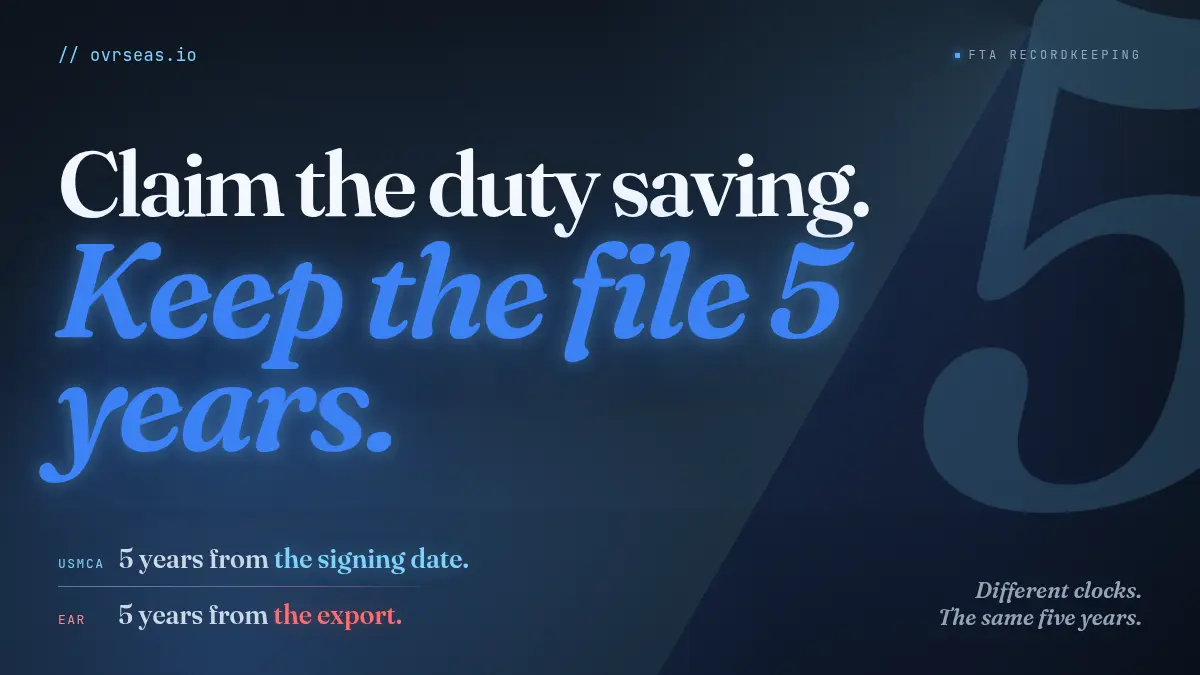
FTA Recordkeeping: How Long to Keep Your Origin Records
Across the main U.S. programs, FTA origin records run five years, from a different start date each, and a separate file per agreement.
EU De Minimis 2026: The Customs Data Small Parcels Need
The EU removes its €150 duty exemption on July 1, 2026. Every small parcel now needs a commercial invoice, HS code, and proof of origin.
Ready to streamline your export documents?
Create Commercial Invoices, Packing Lists, and more in minutes. Enter data once, sync everywhere.
No credit card required · 14-day free trial