
Packing List vs Commercial Invoice: Why Mismatched Numbers Trigger Customs Inspection
Your commercial invoice says 500 units. Your packing list says 520. Your bill of lading says 500. Each document looks correct on its own. But when customs reviews them together, the mismatch triggers an inspection.
This guide explains which fields must match between your packing list and commercial invoice, why discrepancies flag your shipment, and how to avoid unnecessary customs holds.
What is the difference between a packing list and commercial invoice?
A commercial invoice is a bill for the goods from seller to buyer. It declares the transaction value for customs duty calculation. A packing list details how goods are physically packed—box counts, dimensions, weights. According to the U.S. International Trade Administration, customs officials use the packing list to verify that cargo matches the commercial invoice and bill of lading.
The commercial invoice answers: What did you sell and for how much?
The packing list answers: What is physically in the shipment and how is it packed?
Both documents describe the same goods. The numbers must align.
Which fields must match between packing list and commercial invoice?
According to Flexport's customs documentation guidelines, the information on the commercial invoice must match the corresponding fields on the packing list. Specifically, the quantity of units for each product should be identical on both documents.
Fields that must match exactly:
- Product quantity — Total units per SKU
- Product description — Same terminology, same detail level
- Gross weight — Total weight including packaging
- Net weight — Weight of goods only
- Number of packages — Carton or case count
Fields that differ by design:
- Unit price and total value — Only on commercial invoice
- Package dimensions — Only on packing list
- Carton-level detail — Packing list shows contents per box
Why do quantity discrepancies trigger customs inspection?
U.S. Customs and Border Protection examines only 3-5% of cargo entering the country, according to industry logistics sources. CBP uses a risk-scoring algorithm to select which shipments to inspect. Document discrepancies are one of the factors that increase a shipment's risk score.
When your commercial invoice shows 500 units but your packing list shows 520, customs officers see a red flag. According to Alfares Cargo's customs clearance guide, differences in quantity, weight, or product description between the invoice and packing list raise red flags and lead to additional inspections and delays.
The discrepancy could indicate:
- Underreporting to reduce duties
- Smuggling additional undeclared goods
- Simple clerical error
Customs cannot tell which scenario applies without examining the cargo. So they examine it.
What does a customs inspection cost?
Once your container is selected for examination, costs accumulate quickly. According to Freightos, demurrage charges range from $75 to $300 per container per day while your goods sit at the terminal waiting for inspection.
Inspection types and their costs:
- X-ray exam (VACIS) — $80-$300, completed within hours
- Tailgate exam — $300-$500, visual inspection at the dock
- Intensive exam — $1,000-$2,500, full unload and inspection, takes 5-7 days according to FreightRight
A 7-day intensive exam with demurrage at $150/day adds $1,050 in demurrage alone. Combined with the exam fee, total unexpected costs can exceed $3,500 per container.
According to CBP's December 2024 update, the agency processed over 2.8 million entry summaries that month. Even at a 3% inspection rate, that means roughly 84,000 shipments faced examination. Document discrepancies contributed to that selection.
How do packing list and commercial invoice discrepancies happen?
Most mismatches are not intentional. They result from different people creating documents at different stages of the shipment.
Common causes:
- Warehouse adds samples — Packing team includes 20 extra units as samples. Packing list reflects 520. Sales invoice stays at 500.
- Last-minute order changes — Buyer reduces quantity from 520 to 500. Invoice is updated. Packing list is not.
- Unit of measure confusion — Invoice shows 500 pieces. Packing list shows 50 boxes of 10. Someone misreads it as 50 units.
- Copy-paste errors — Previous shipment data carried forward without updating quantities.
- Rounding differences — Net weight rounded differently on each document.
None of these are fraudulent. All of them can trigger inspection.
How do you prevent document discrepancies before shipping?
The fix is simple: cross-check all shipping documents against each other before the container leaves. According to the U.S. International Trade Administration, the commercial invoice should reflect the information shown on the packing list.
Pre-shipment checklist:
- Line up commercial invoice, packing list, and bill of lading side by side
- Compare total quantity on all three documents
- Compare gross weight and net weight
- Compare number of packages or cartons
- Verify product descriptions use identical terminology
- Check that HS codes match across documents
If any number does not match, identify the source of the discrepancy before shipping. Update the incorrect document. Do not assume customs will overlook small differences.
What if you discover a discrepancy after shipping?
If your shipment is already in transit and you notice a document mismatch, contact your customs broker immediately. Brokers can sometimes file a post-entry amendment or provide an explanation letter to CBP before the shipment arrives.
According to Mohawk Global, corrective action—which may include advising U.S. Customs of the error—is required when discrepancies exist between documented and actual values. Proactive disclosure is typically treated more favorably than discrepancies discovered during examination.
The earlier you flag the issue, the better your chances of avoiding a full inspection.
Quick reference: Packing list vs commercial invoice
- Commercial invoice — Declares value for duty calculation, required for customs entry
- Packing list — Details physical packing, used to verify cargo matches invoice
- Must match — Quantity, weight, description, package count
- Inspection trigger — Any mismatch raises risk score in CBP algorithm
- Inspection cost — $75-$300/day demurrage plus $80-$2,500 exam fees
- Prevention — Cross-check all documents before container leaves origin
Three documents. Same numbers. That's the standard. Miss it, and you join the 3-5% facing inspection.

Related Articles
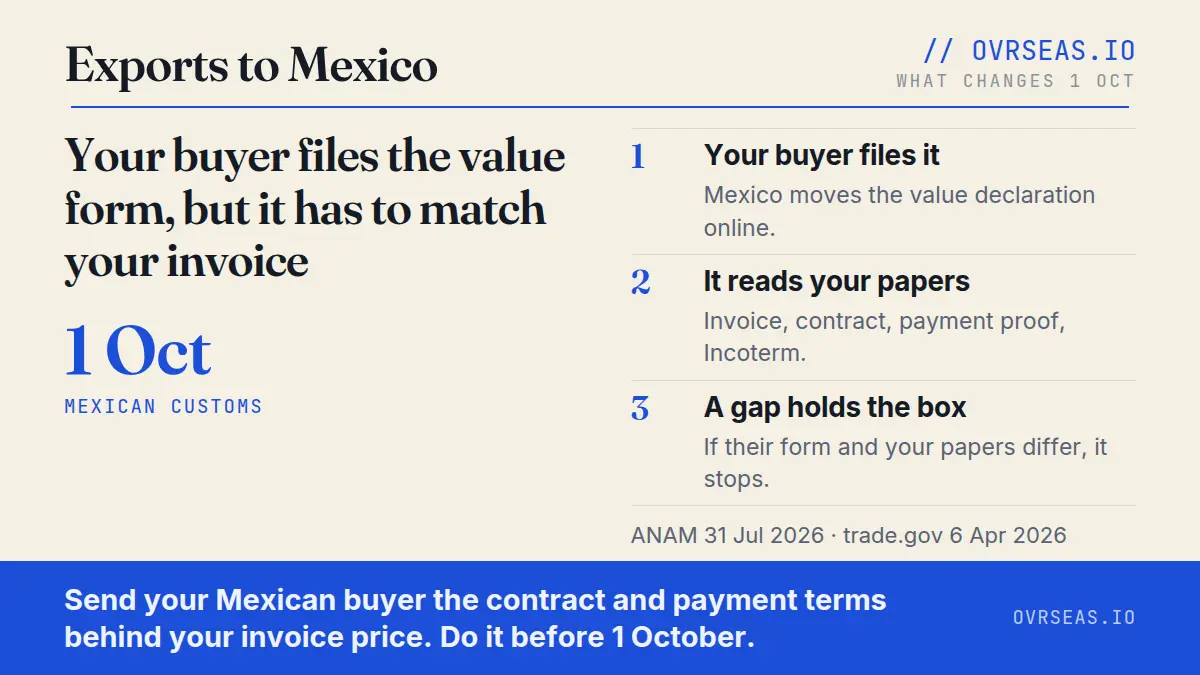
Mexico's Electronic Value Declaration Is Mandatory on 1 October — What Your Buyer Will Need From You
From 1 October 2026 your Mexican buyer files the customs value declaration electronically. Every input to that filing — invoice, contract, payment proof, Incoterm — comes from you.
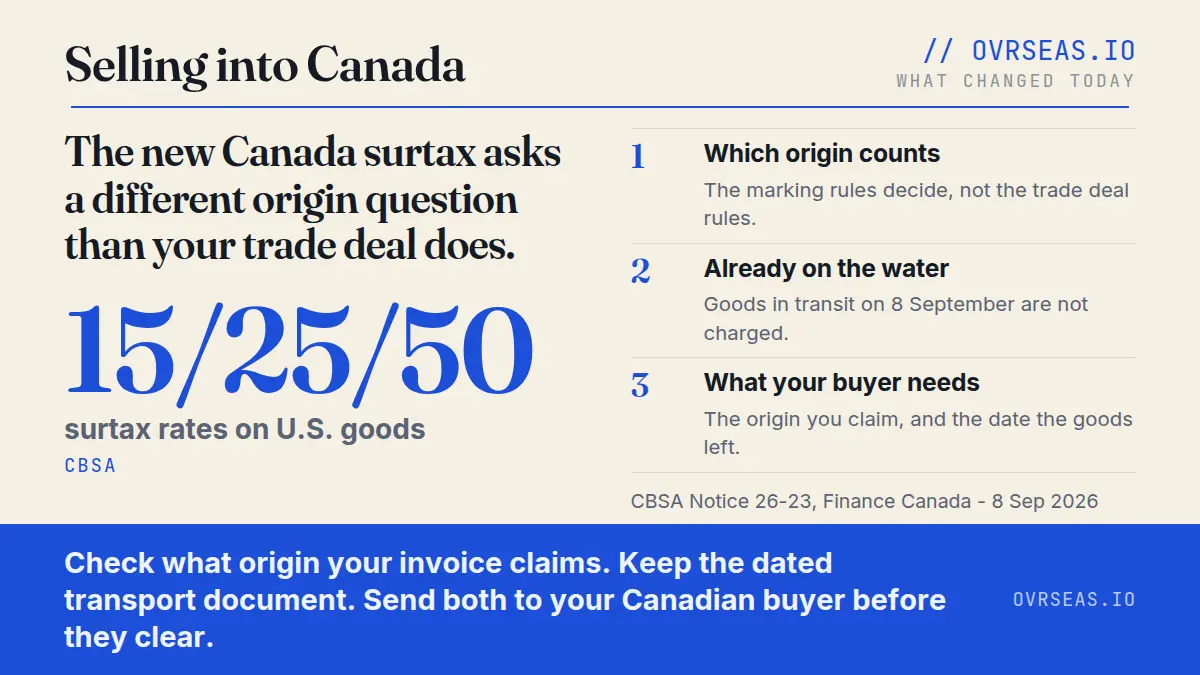
Canada's New Surtax on U.S. Goods: Which Origin Counts
Canada's 15/25/50% surtax on U.S. goods started 8 September 2026. It defines the goods by the marking rules, not your CUSMA preference claim — and the in-transit exception runs on dated transport documents.
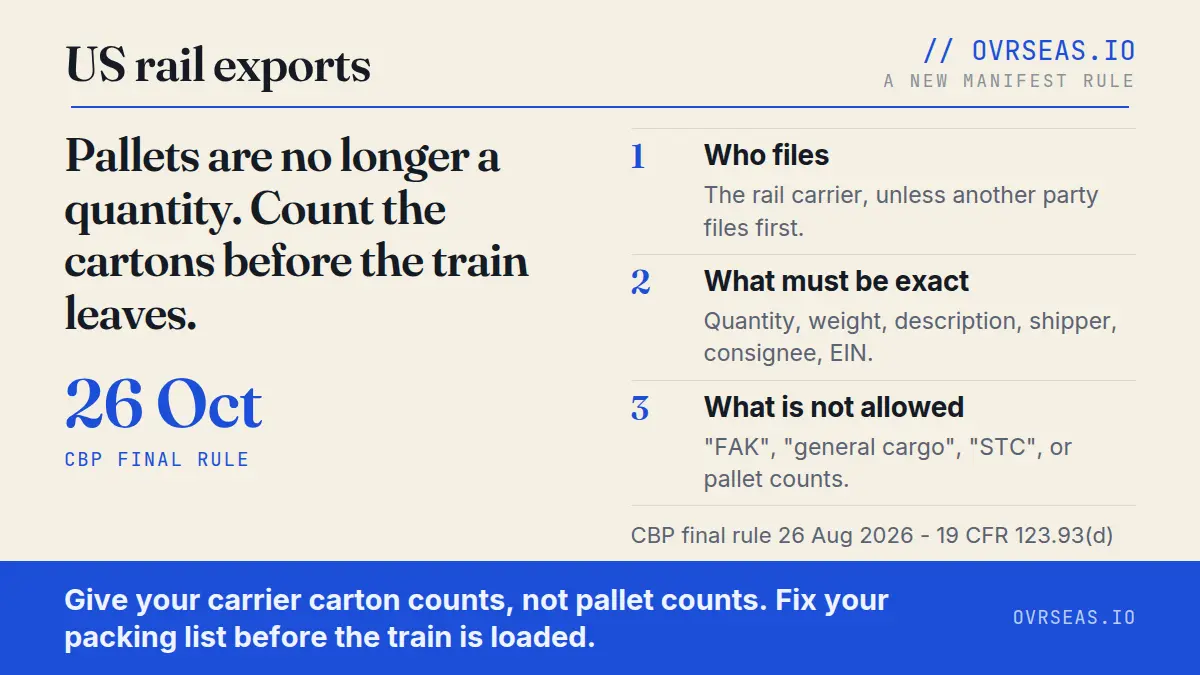
CBP's Rail Export Manifest Rule: What Has to Be Right 24 Hours Before Departure
CBP's final rule for rail export manifests takes effect 26 October 2026. The initial filing is due 24 hours before departure, and six of its seven mandatory fields come off your own shipment documents.
Ready to streamline your export documents?
Create Commercial Invoices, Packing Lists, and more in minutes. Enter data once, sync everywhere.
No credit card required · 14-day free trial