
Fake Freight Forwarder Scams: Why Working Tracking Doesn't Mean Real Shipment
You paid for your shipment. The tracking number works. The website shows "in transit." Then an email arrives asking for more money—and the tracking page confirms the story.
This is how modern freight forwarding scams work. The tracking is real. The shipment isn't.
How do fake freight forwarder scams work?
Scammers create complete digital facades that mimic legitimate logistics companies. They register similar domain names, copy branding, and build functional tracking pages that display whatever status supports their story. When you enter the tracking number, it returns "in transit" or "held at customs"—because the scammers control what the page shows.
According to Truckstop.com, double brokering complaints have increased 400% since 2022. A Cloudflare survey found that Fortune 500 companies report up to 10 impersonation incidents per month. The Transportation Intermediaries Association reports freight fraud rose 27% in 2024 alone.
These aren't random phishing emails. They're coordinated operations designed to extract multiple payments from a single victim.
What happened in a real case?
According to KOTRA (Korea Trade-Investment Promotion Agency), a Korean company found a US chemical supplier through an online marketplace. The price was competitive. They agreed on CIF terms—meaning shipping costs were included in the quoted price.
The buyer wired $7,000. Days later, a logistics company emailed: "Your cargo is transshipping through Turkey. It's been flagged as a high-risk chemical. Pay €4,000 for certification to clear customs."
The buyer checked the tracking number on the logistics company's website. The status matched the email exactly: "Held at Turkish customs. Certification pending."
It looked legitimate. It wasn't.
KOTRA's investigation confirmed:
The logistics company was impersonating a real freight forwarder
The website was a fake built specifically for this scam
The US supplier was likely part of the same fraud operation
The €4,000 request was a second extraction attempt
The initial $7,000 was lost. But KOTRA's intervention blocked the second payment.
Why does this scam work so well?
The scam exploits a reasonable assumption: if tracking works, the shipment exists. Most people don't consider that scammers can build fake tracking pages that return fabricated data.
It also exploits the complexity of international shipping. Terms like "transshipment," "high-risk classification," and "customs certification" sound plausible to anyone unfamiliar with how freight actually moves.
Under CIF (Cost, Insurance, and Freight) terms, the seller is responsible for shipping costs to the destination port. The buyer shouldn't receive separate freight invoices after paying the agreed price. Under CIF the seller already paid freight to the destination port, so a new freight fee during transit is a red flag.
What are the warning signs of a fake logistics company?
Several patterns appear consistently in freight forwarding scams:
Tracking only works on one website — Legitimate carriers use standardized tracking systems that work across multiple platforms
Mid-shipment fee requests under CIF — If shipping is included, you shouldn't pay extra
Supplier redirects you to logistics company for payment — They're likely the same operation
Unexpected transshipment countries — "Your cargo is routing through [country]" when that wasn't in the original plan
Recently registered domain — Scam websites often have domains registered within the past few months
Urgency + specific payment method — "Pay within 48 hours by wire transfer"
How do you verify a logistics company before paying?
Verify independently before sending any additional payment. Don't use contact information from the suspicious email—find it yourself.
Search separately — Open a new browser and search for the company name. Compare the website URL
Check domain age — Use WHOIS lookup to see when the domain was registered. Scam sites are usually weeks or months old
Call the official number — Find the phone number through an independent search, not from the email
Verify with trade agencies — Organizations like KOTRA, US Commercial Service, or local trade associations can help confirm legitimacy
Review your Incoterms — If you're buying CIF, the seller already paid for shipping. Additional freight requests should go back to them
According to Truckstop's 2025 review, more than 10,000 identity checks failed during carrier onboarding. Many of these cases began with small details that didn't match—a phone number that couldn't be verified, authority information that seemed off.
Quick reference: Fraud prevention checklist
Verify supplier through official business registries before payment
Request VAT number or business registration and cross-check independently
Under CIF, refuse new freight fees from parties you can't verify. Check duty and port fees with the carrier's own agent
Check domain registration date for any logistics company website
Verify tracking through carrier's official website, not links from emails
If tracking only works on one site, treat it as suspicious
Contact trade promotion agencies (KOTRA, US Commercial Service) to verify companies
Document all communications for potential fraud reporting
Working tracking doesn't guarantee a real shipment. A professional-looking website doesn't guarantee a real company. In international trade, independent verification isn't optional.
Enter a shipment once. Get every document.
Commercial invoice, packing list, certificate of origin and more — filled from one shipment record, so the shared fields always match.
No credit card required · 14-day free trial

Related Articles
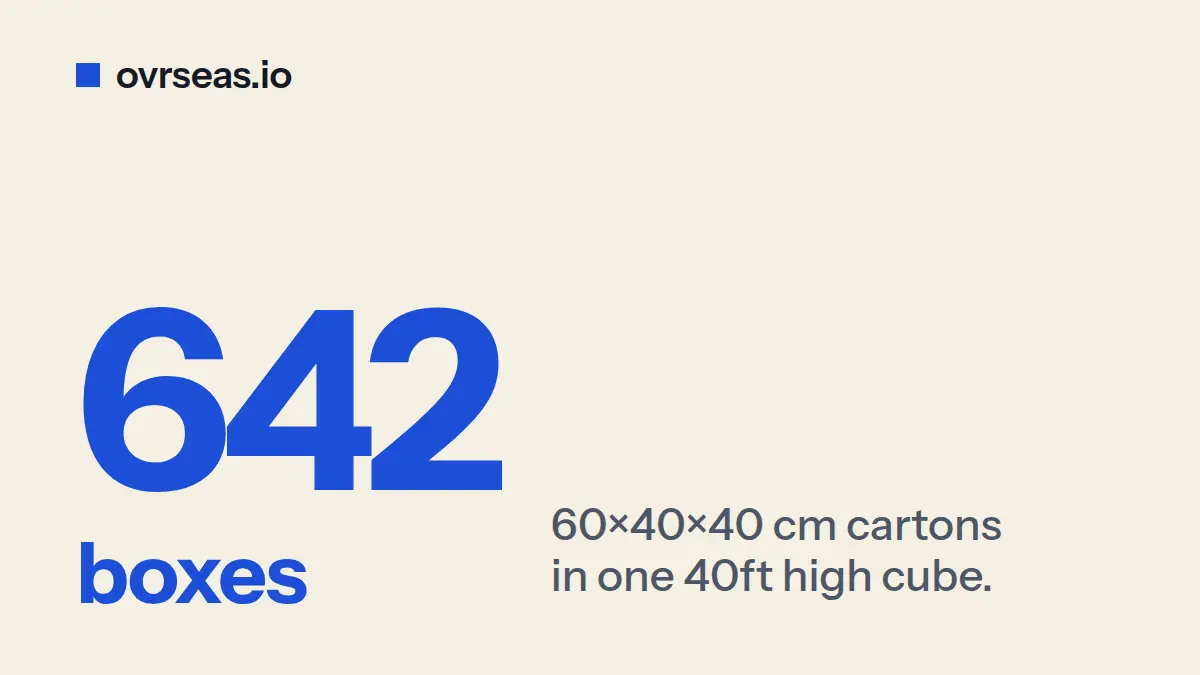
How Many Boxes Fit in a 20ft or 40ft Container? Worked Numbers
A 60×40×40 cm carton fits 260 times in a 20ft, 535 in a 40ft and 642 in a 40ft high cube. Worked numbers for cartons, pallets and heavy loads, and why the volume shortcut overstates.

LCL Freight Is Billed on Volume or Weight, Whichever Is Bigger
LCL is billed on the greater of volume (CBM) or weight (tonnes). Three worked examples show when weight wins, and what to ask your forwarder.

How to Calculate CBM: Formula and 3 Worked Examples
CBM = length × width × height in cm ÷ 1,000,000. Three worked examples (cm, inches, mixed shipment) and the rounding trap that skews totals.