
Certificate of Origin: Why the Same Document Has Different Rules Under Each FTA
Your buyer asks for a Certificate of Origin. You contact your local chamber of commerce. They issue the document. But when the shipment arrives, your buyer says customs rejected it.
The problem: that FTA only accepts self-certification. The authority-issued certificate you provided doesn't qualify.
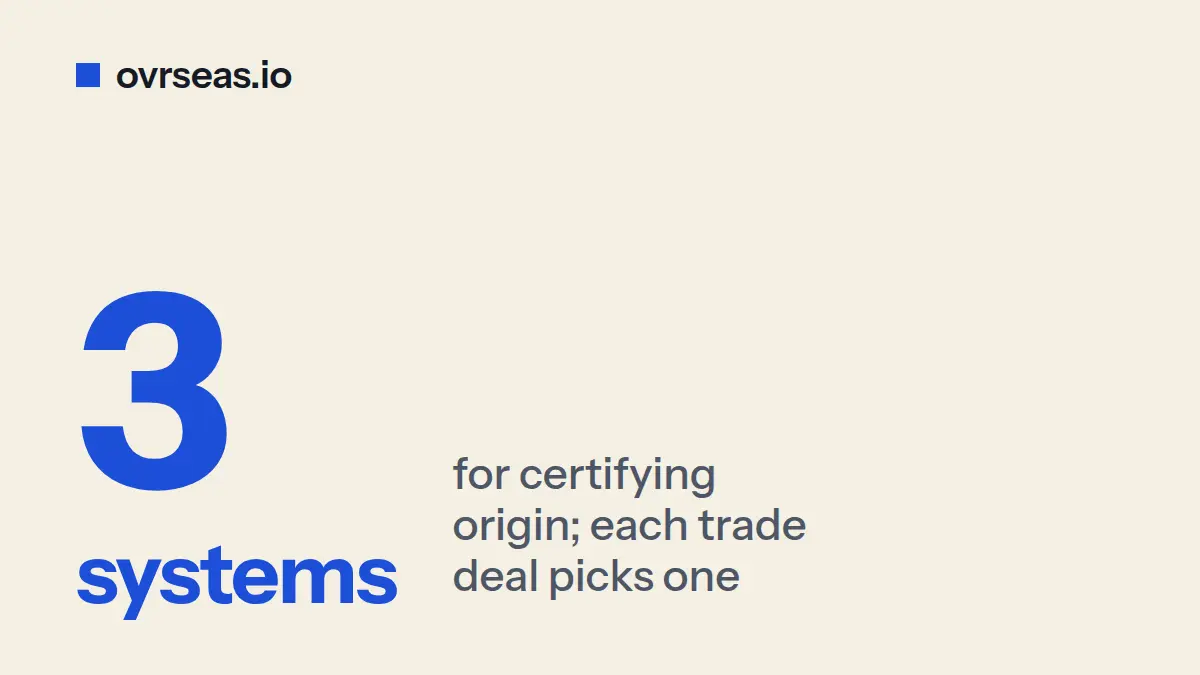
This guide explains the three main systems for certifying origin under FTAs, and how to identify which one applies to your shipment.
What are the three ways to certify origin under FTAs?
Free Trade Agreements use three different systems for certifying the origin of goods: authority-issued certificates, Approved Exporter self-certification, and open self-certification. The method you need depends entirely on which FTA your buyer is claiming.
According to the German Federation of Industries (BDI), the administrative cost of proving origin averages 2% to 6% of the goods' value. Using the wrong method doesn't just waste time—it can cost you the tariff benefit entirely.
Authority-issued certificates
A government customs authority or authorized chamber of commerce issues the certificate. The exporter applies, submits supporting documents, and receives an official document with stamps and signatures.
Korea-China FTA: Korea Customs Service or Korea Chamber of Commerce and Industry issues the certificate. In China, CCPIT or customs issues it.
Korea-ASEAN FTA: Authority-issued Form AK required.
Older bilateral FTAs: Many still use this traditional system.
Approved Exporter self-certification
Exporters must first register with customs and receive authorization. Once approved, they can self-certify origin by adding a declaration to their commercial documents. No need to visit the issuing authority for each shipment.
Korea-EU FTA: For shipments over €6,000, only Approved Exporters can self-certify. Below €6,000, any exporter can self-certify without registration.
Korea-UK FTA: Same threshold applies—€6,000.
RCEP: Some member countries accept Approved Exporter declarations. Others require authority-issued certificates.
Open self-certification
Any party to the transaction—importer, exporter, or producer—can certify origin. No government form required. No prior registration needed. The certification can appear on an invoice or any commercial document, as long as it includes the required data elements.
USMCA: Importer, exporter, or producer can certify. According to U.S. Customs and Border Protection (CBP), there is no official government form—the certification just needs to include nine specific data elements.
Korea-Australia FTA: Self-certification by exporter or producer.
Korea-Canada FTA: Self-certification accepted.
Why does the issuance method matter?
Using the wrong certification method means your buyer cannot claim the preferential tariff. The goods clear customs, but at the standard MFN (Most Favored Nation) rate instead of the FTA rate. The tariff difference can range from 5% to 25% depending on the product and destination.
According to the World Trade Organization (WTO), the complexity of origin certification is a major factor in FTA underutilization. When exporters don't understand which system applies, they either skip the certificate entirely or provide one that doesn't qualify.
Common mistakes
Assuming all FTAs accept chamber-issued certificates: Korea-EU FTA explicitly does not accept EUR.1 forms. Only self-certification is valid.
Self-certifying without Approved Exporter status: For Korea-EU shipments over €6,000, a declaration without the authorization number is invalid.
Using an old FTA certificate for a new agreement: RCEP and existing bilateral FTAs (like Korea-ASEAN) have different rules. You cannot use a Form AK for an RCEP claim.
How do you identify the correct method for your shipment?
Start with the FTA your buyer intends to claim. Then check the origin procedures chapter of that specific agreement. Most FTAs clearly state whether they require authority-issued certificates, Approved Exporter certification, or open self-certification.
Quick reference by FTA
Korea-China: Authority-issued only
Korea-EU: Self-certification (Approved Exporter required over €6,000)
Korea-UK: Self-certification (Approved Exporter required over €6,000)
USMCA: Self-certification by importer, exporter, or producer
RCEP: Varies by member country—check with your buyer's customs authority
Korea-ASEAN: Authority-issued Form AK
What if you need Approved Exporter status?
In Korea, exporters apply through the Korea Customs Service. The application requires proof that you can verify the originating status of your products and maintain records for at least five years. According to KCS, the authorization is typically granted within 20 working days.
For EU exporters, the application goes to the national customs authority. The European Commission notes that Approved Exporters must demonstrate they have sufficient knowledge of the rules of origin and can provide supporting documents upon request.
Checklist before issuing a Certificate of Origin
Confirm which FTA your buyer is claiming
Check the origin procedures chapter of that FTA
Identify whether authority-issued, Approved Exporter, or self-certification applies
For self-certification: verify you have Approved Exporter status if required
For authority-issued: apply through the correct issuing body
Include all required data elements specified in the FTA
Keep records for the retention period (typically 3-5 years)
Fill the certificate of origin from your invoice
The goods, HS codes and parties on the certificate of origin come from the same shipment record as your commercial invoice and packing list.
No credit card required · 14-day free trial
Related Templates

Related Articles
Export Documents for a Letter of Credit: One-File Workflow
What documents an L/C requires, the UCP 600 rule that gets 65–80% rejected on first presentation, and a one-file workflow that stops the mismatch.
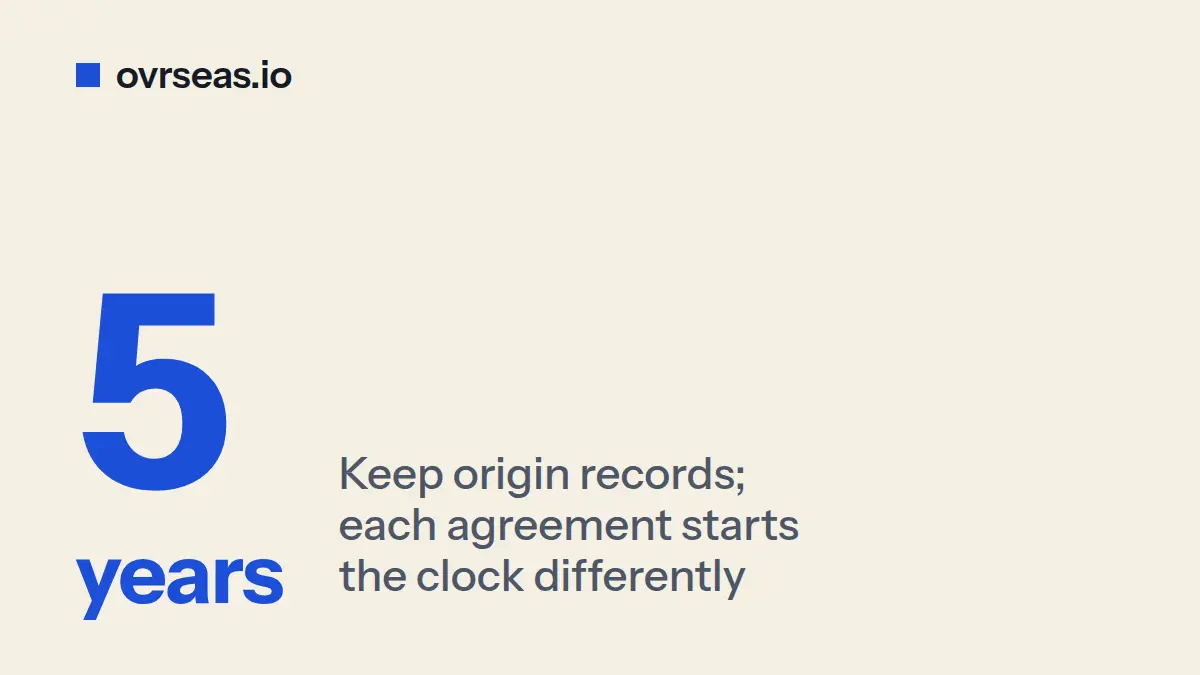
FTA Recordkeeping: How Long to Keep Your Origin Records
Across the main U.S. programs, FTA origin records run five years, from a different start date each, and a separate file per agreement.
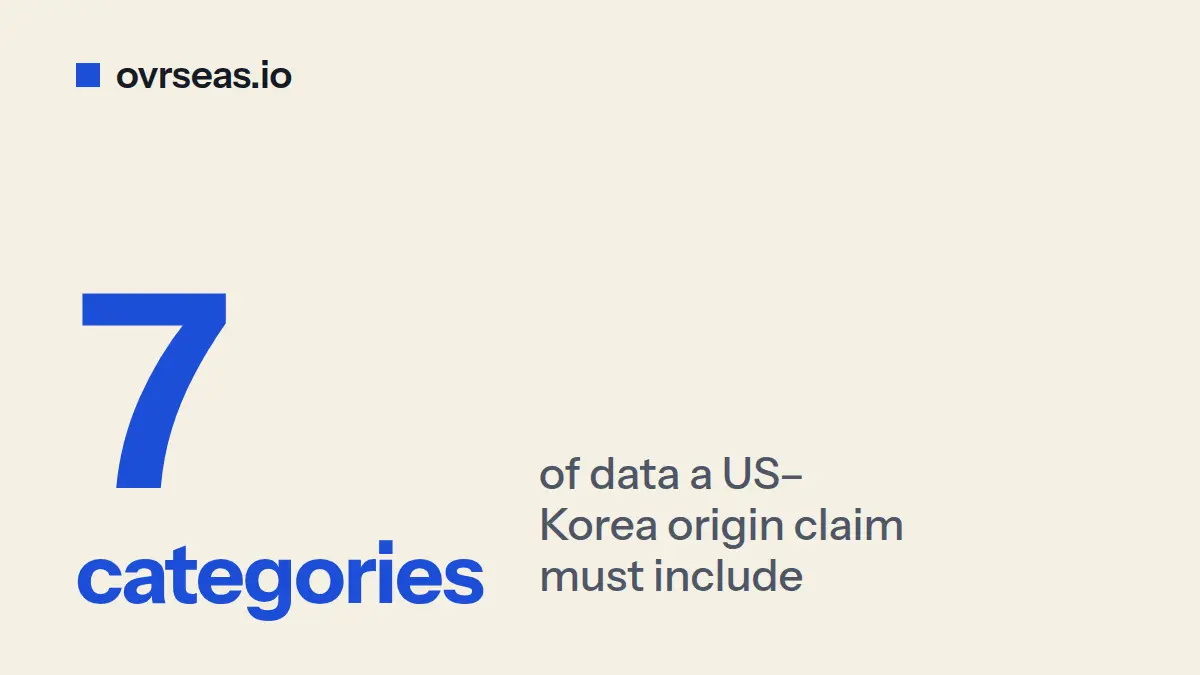
KORUS Certificate of Origin: Required Data Elements
KORUS has no official certificate of origin form. Here are the seven data elements (19 CFR 10.1004) needed to claim duty-free.